Noncommutativity and Rounding Schemes for Combinatorial Optimization
Explore noncommutativity and rounding schemes in combinatorial optimization, focusing on quantum optimization techniques and their applications in solving complex problems.
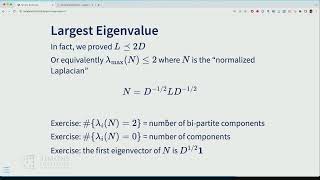
Graph Linear Algebra Part 1
Explore fundamental concepts of graph linear algebra, focusing on matrices, spectral theory, and their applications in algorithmic graph theory and network analysis.
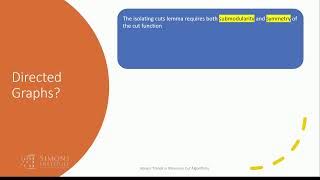
Minimum Isolating Cuts - A New Tool for Solving Minimum Cut Problems
Explore a powerful new tool for solving minimum cut problems in combinatorial optimization, with applications to global, Steiner, and all-pairs min-cut algorithms.
A Theory of Alternating Paths and Blossoms from the Perspective of Minimum Length - Part 2
Explores advanced graph theory concepts, focusing on alternating paths and blossoms in minimum length perspective. Provides in-depth insights into algorithm design for maximum cardinality matching in general graphs.
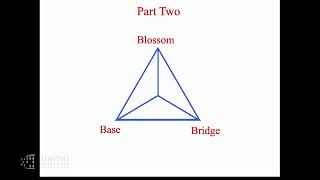
A Theory of Alternating Paths and Blossoms, from the Perspective of Minimum Length
Explores the Micali-Vazirani algorithm for maximum cardinality matching in graphs, presenting new ideas and insights into its structure and efficiency through a novel theory of alternating paths and blossoms.
An Algebraic Perspective on Perfect Graphs - Theory Seminar
Explore the algebraic perspective on perfect graphs, connecting graph theory with polynomial algebra and sum of squares decomposition. Gain insights into sos-perfectness and its equivalence to graph perfectness.

Formalising the Theory of Combinatorial Optimisation
Explore formalisation of combinatorial optimisation theory in Isabelle/HOL, focusing on matching theory and its mathematical implications for computer science and applied mathematics.
Log-Concave Polynomials, Lattice Point Counting, and Traveling Salesperson Problem
Explore log-concave polynomials and their applications in bounds, probability, and optimization, including recent advancements in lattice point counting and the Traveling Salesperson Problem.
Polyhedral Techniques in Combinatorial Optimization - Matchings and Tours
Explore recent advancements in combinatorial optimization, focusing on matching and traveling salesman problems. Learn about polyhedral techniques and linear programming formulations for designing efficient algorithms.
Information Complexity of Mixed-Integer Convex Optimization
Explore information complexity in mixed-integer convex optimization, including oracle-based bounds and partial first-order information impacts, with insights from Professor Amitabh Basu.
Integrality Gaps for Vertex Covers on Sparse Bernoulli Hypergraphs
Explore integrality gaps for vertex covers on sparse Bernoulli hypergraphs with insights from ETH Zurich researcher D. Dmitriev.

Karger's Mincut Algorithm - Introduction and Implementation
Explore Karger's mincut algorithm, its motivation, problem definition, and implementation through a practical example.
State Space Search: Problem-Solving Approaches and Examples
Explore problem-solving techniques through state space search, from simple puzzles to complex real-world scenarios.
Mathematical Foundation of Various MCMC Methods
Explore advanced MCMC methods for combinatorial optimization, including multi-spin flip techniques. Compare mathematical and numerical results to evaluate efficiency in different contexts.

Sparsifying Set Systems for Coverage Problems
Explore recent advancements in sparsifying set systems for coverage problems, focusing on sublinear graph simplification techniques.
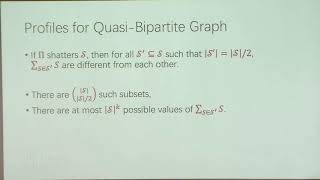
On (1 + ε)-Approximate (Vertex) Cut Sparsifiers
Explore advanced graph compression techniques for planar and quasi-bipartite graphs, focusing on high-quality cut sparsifiers and their size bounds. Analyze contraction-based approaches and their limitations.
Stochastic Minimum Vertex Cover with Few Queries: A 3/2-Approximation
Explore a 3/2-approximation algorithm for stochastic vertex cover using O(n/p) non-adaptive queries, improving upon previous 2-approximation methods and discussing extensions to correlated edge realizations.
Linear Sketching Hypergraph Sparsifiers
Explore linear sketching techniques for hypergraph sparsification, examining upper and lower bounds, dynamic streaming algorithms, and novel methods like random fingerprinting for efficient cut preservation.
Cut Sparsification and Succinct Representation of Submodular Hypergraphs
Explore cut sparsification of hypergraphs, focusing on submodular functions. Learn about new bounds, polynomial bounds, and succinct representation techniques for various submodular function families.

Finite Hypergraph Families with Rich Extremal Turan Constructions via Mixing Patterns
Explore finite hypergraph families and their extremal Turán constructions through mixing patterns. Gain insights into combinatorics and discrete structures from a renowned expert.
Sampling from the SK Measure via Algorithmic Stochastic Localization
Explore algorithmic stochastic localization for sampling from the SK measure in spin glass systems. Gain insights into advanced statistical physics techniques.