
What Powers the Mind-Body Connection
Explore the ancient brain-body connection rooted in cellular energy production, and discover how understanding this dynamic can transform perspectives on health and human experience.

Monitoring at Scale - Intuitive Dashboard Design
Explore intuitive dashboard design for large-scale monitoring, focusing on cognitive science principles to create effective visualizations that aid quick decision-making and system health evaluation.
How to Achieve Your Most Ambitious Goals
Discover a transformative approach to decision-making that can help you achieve ambitious goals through small, manageable steps and cognitive strategies for improved performance and personal growth.
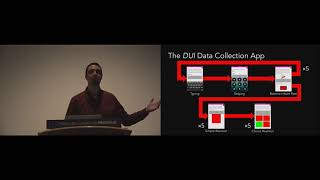
Drunk User Interfaces - Determining Blood Alcohol Level through Everyday Smartphone Tasks
Innovative smartphone interfaces measure blood alcohol levels through user performance, offering a potential alternative to breathalyzers for assessing inebriation in everyday scenarios.
Your Brain on Video Games
Explore the surprising cognitive benefits of action-packed video games, including improved learning, focus, and multitasking abilities, as revealed by cognitive researcher Daphne Bavelier.
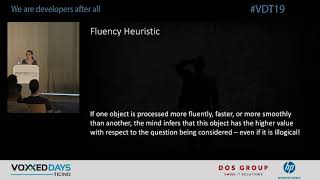
[VDT19] Cognitive UX Using cognitive science and psychology to drive UX design by Emilia Ciardi [IT]
Esplora come le scorciatoie mentali e i bias cognitivi influenzano la progettazione UX, applicando principi di psicologia e scienze cognitive per creare esperienze utente più efficaci.

Wired! How Your Brain Learns New Programming Languages
Explore how the brain learns programming languages from a linguistic and neurological perspective, with practical tips to enhance your learning curve and support others in software development.
Five Things I Learned Hosting Google's Design Podcast
Travis Neilson shares insights from hosting Google's design podcast, covering user testing, machine learning, and product impact. Learn from industry leaders about decision-making that shapes millions of internet users' experiences.
Free Energy Minimisation for Perception as Inference
Explores predictive processing theory and free energy principle in perception, comparing Helmholtz machine and message passing approaches to neural inference and consciousness.
A Categorical Formulation of Predictive Processing and Active Inference
Categorical formulation of Predictive Processing and Active Inference using string diagrams, clarifying key concepts and enabling comparison with Integrated Information Theory.
Insights from the Conscious Turing Machine - A Machine Model for Consciousness
Explores puzzling phenomena of consciousness using the Conscious Turing Machine model, including pain's impact on sleep, experiences vs. simulations, illusions, dreams, and free will.
Does Consciousness Emerge?
Explore the concept of emergence in consciousness theories, examining its meanings, applications, and implications for understanding the nature of consciousness.
Geometry of World Model Influences Behaviors - Exact Results for Curiosity-Based Exploration
Explores how the geometry of internal world models affects behavior, focusing on the Projective Consciousness Model and its implications for understanding consciousness and designing social robots.
Consciousness - Coherence of Modalities
Explores a coherence-based theory of consciousness, proposing structured nets and dynamic mappings as key elements. Discusses data structures, neural codes, and links to mathematical concepts.
Consciousness as a Coordination Mechanism
Exploring the hypothesis that consciousness arises from brain signal coordination, drawing parallels between neural traffic and road networks to understand global optimization patterns in brain activity.
Consciousness as a Coherence-Inducing Operator
Exploring consciousness as an operator that induces coherence in biological information processing, examining its properties, function, and potential for computational simulation.
Understanding Weak and Strong Artificial Consciousness
Explores the distinction between simulating and instantiating consciousness, using the free energy principle to analyze the difference between weak and strong artificial consciousness.
Quantum Instrument Models in Cognitive Science
Explores quantum instrument models in cognitive science, explaining non-Bayesian belief updates in the "question order effect" while maintaining response replicability, challenging previous quantum approaches.
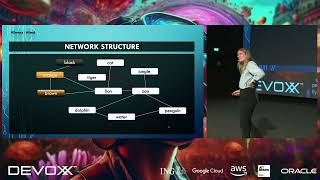
Wired! How Your Brain Learns New Programming Languages
Explore the cognitive processes behind learning programming languages, enhancing your ability to acquire new coding skills efficiently and effectively.

Probabilistic Programming in Python
Learn probabilistic programming in Python using PyMC3 for flexible statistical modeling, automated parameter estimation, and uncertainty quantification in data science and scientific research.

SIG Usability - Unifying the Experience for the Kubernetes User
Explore SIG Usability's initiatives in Kubernetes, focusing on user research, internationalization, and accessibility. Learn about usability principles and contribution opportunities for both coders and non-coders.