Impact of Climate Change: Causes, Effects, and Solutions
Explore climate change impacts, causes, and solutions. Learn about global warming effects, greenhouse gas emissions, and strategies for environmental sustainability. Discover the role of technology and engineering in addressing climate challenges.

Categorical Composition of Discrete Exterior Calculus Climate Models
Explore Decapodes.jl framework for composing multiphysics equations in climate modeling, featuring Discrete Exterior Calculus and undirected wiring diagrams for efficient simulation code generation.
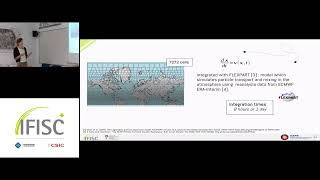
Complex Systems Perspectives on Large-Scale Weather and Climate Variability Patterns
Explore large-scale weather and climate variability patterns through complex systems perspectives, gaining insights into atmospheric dynamics and climate science.
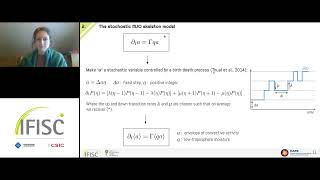
The Madden Julian Oscillation Skeleton Model with Time-Dependent Observation-Based Forcing
Explore the Madden Julian Oscillation skeleton model, incorporating time-dependent observation-based forcing for enhanced atmospheric understanding and prediction.
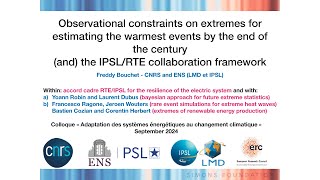
Observational Constraints on Extremes for Estimating the Warmest Events by the End of the Century
Explore observational constraints on extreme climate events and their impact on future temperature predictions through the IPSL/RTE collaboration framework.

IEA Modelling and Scenarios - Global Energy and Climate Model
Explore the IEA's Global Energy and Climate Model and energy scenario modelling approach used in the World Energy Outlook publication.
Computing Climate Extreme Events and Extremes of Production of Renewable Energy
Explore rare events algorithms for calculating climate extremes and renewable energy production anomalies. Learn advanced computational techniques for analyzing environmental data.
不確実性を伴う数値天気予報と気候予測
不確実性を考慮した数値天気予報と気候予測の最新手法について深く掘り下げ、予測の精度と限界、そして将来の展望について探究する学術講演。
Explainable AI for Climate Science - Opening the Black Box to Reveal Planet Earth
Discover how explainable AI techniques can revolutionize climate science research, from weather prediction to understanding human impacts on Earth's systems through advanced machine learning applications.
Deep Learning and Energy Models for Fine Dead Wood Segmentation - Jacquelyn Shelton
Explore deep learning and energy models for fine dead wood segmentation in climate research, focusing on carbon cycle implications and advanced image analysis techniques.
Deep Learning for Subseasonal Global Precipitation Prediction - Maria Molina
Explore deep learning techniques for predicting global precipitation patterns on a subseasonal timescale, advancing climate science through innovative machine learning approaches.
Representation Learning and Custom Loss Functions for Atmospheric Data - Christian Lessig
Explores representation learning and custom loss functions for atmospheric data analysis, advancing climate science through machine learning techniques to extract insights from complex Earth system observations.
Machine Learning Methods for Climate Science - Lecture 4
Explore machine learning applications in climate science, focusing on advanced techniques for analyzing and predicting complex atmospheric and oceanic processes.

Machine Learning Methods for Climate Science - Lecture 2
Explore machine learning applications in climate science, focusing on advanced techniques and their impact on understanding and predicting climate phenomena.
Machine Learning Methods for Climate Science - Lecture 3
Explore machine learning applications in climate science, focusing on advanced techniques for analyzing and predicting complex atmospheric and oceanic processes.
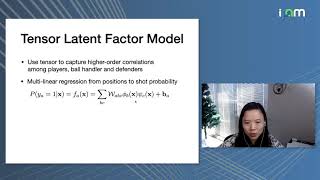
Multiresolution Tensor Learning for Efficient and Interpretable Spatial Analysis
Explore efficient and interpretable spatial analysis using multiresolution tensor learning, with applications in geology, sports, and climate science. Discover improved methods for handling complex spatial data.
Machine Learning and Earth System Modeling - From Parameter Calibration to Feature Detection
Explore machine learning applications in Earth system modeling, from parameter calibration to feature detection, enhancing climate predictions and understanding of complex environmental processes.
Lessons and Outlook for ML Parameterization of Sub Grid Atmospheric Physics From the Vantage of Emulating Cloud Superparameterization - Mike Pritchard
Exploring machine learning for atmospheric physics parameterization, focusing on cloud superparameterization emulation. Discusses challenges, strategies, and lessons learned in applying ML to climate modeling.
Interpretable and Generalizable Machine Learning for Fluid Dynamics - Steven Brunton
Explore interpretable and generalizable machine learning techniques for fluid dynamics, focusing on sparse identification of nonlinear dynamics and incorporating physical constraints for improved accuracy.
Physics-Guided Deep Learning for Fluid Dynamics - Rose Yu
Explores physics-guided deep learning for fluid dynamics, focusing on accelerating turbulence simulations and incorporating symmetry for generalization in ocean current forecasting.
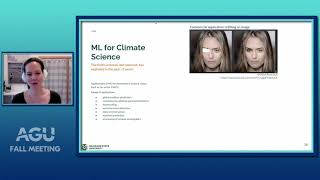
Explainable AI for the Geosciences
Explore machine learning interpretation techniques in geoscience, focusing on climate science applications and their potential for scientific discovery and increased trust in AI outputs.