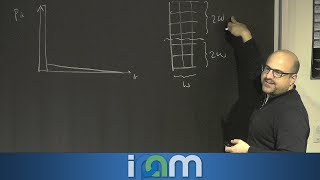
Tensor Networks and the Negative Sign Problem
Explore tensor networks and the negative sign problem in quantum systems, examining simulation challenges and correlation implications for systems with negative Hamiltonian entries.
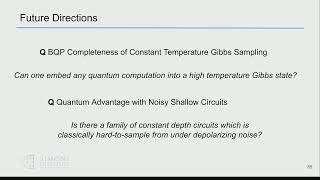
Quantum Computational Advantage With Constant-Temperature Gibbs Sampling
Explore quantum computational advantage through constant-temperature Gibbs sampling, examining thermalization processes and their implications for quantum systems and classical algorithms.
A Computational Framework for Solving Wasserstein Lagrangian Flows
Explore a computational framework for solving Wasserstein Lagrangian flows, covering optimal transport variations and applications in single-cell trajectory inference.

On the Shoulders of Giants
Renowned physicist Edward Witten explores fundamental concepts in physics, from waves to string theory, highlighting key contributions and unifying theories in this insightful World Science Festival lecture.
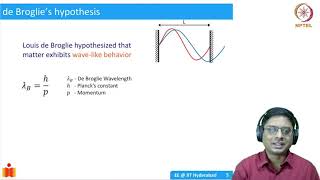
Classical vs Quantum Mechanics - Need for Quantum Mechanical Description
Explore the fundamental differences between classical and quantum mechanics, understanding the need for quantum descriptions in modern physics.
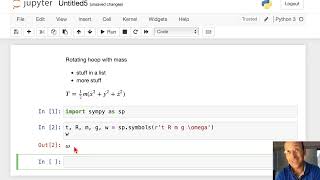
Using Python and SymPy to Solve a Mass on a Rotating Hoop Problem
Utilize Python and Sympy to solve complex physics problems, focusing on a mass rotating on a hoop using Lagrangian mechanics and differential equations.

Conservation of Momentum - Physics 101 - AP Physics 1 Review with Dianna Cowern
Explore conservation of momentum with Physics Girl's Dianna Cowern. Learn key concepts, solve practical problems, and gain insights for AP Physics 1 exam preparation.

Newton's Laws of Motion - Physics 101 / AP Physics 1 Review
Comprehensive review of Newton's Laws of Motion, including practical exercises and problem-solving. Ideal for beginners and AP Physics 1 exam preparation.
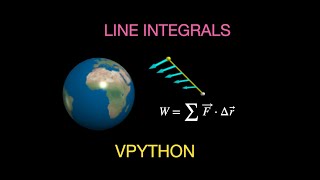
Python Physics: Numerical Line Integrals with Python
Explore numerical line integral calculations in Python for classical mechanics, breaking paths into short steps and comparing with analytical methods.
New AI Models for Solving Hamiltonian Mechanics - From Operator Theory to Neural Networks
Explore groundbreaking AI neural networks VaRONet and MambONet that revolutionize solving Hamiltonian mechanics through operator learning, bypassing traditional differential equations for efficient physical system modeling.
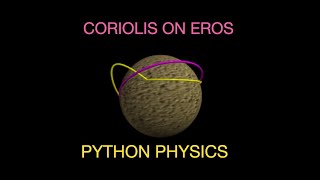
Classical Mechanics: Modeling Coriolis Force for a Kicked Ball on Eros
Explore the fascinating effects of Coriolis force by modeling the trajectory of a kicked ball on asteroid Eros, using Python to visualize non-inertial reference frames.
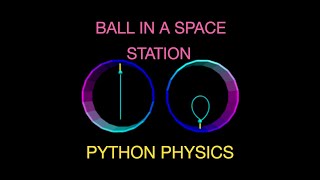
Classical Mechanics: Throwing a Ball in a Rotating Space Station
Explore the physics of throwing and catching a ball in a rotating space station, analyzing motion patterns and gravitational effects through computational modeling.
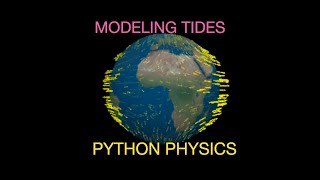
Modeling Earth's Tides with Python - Classical Mechanics
Explore the physics behind Earth's tides through Python modeling, understanding gravitational forces and creating visual simulations of tidal patterns and movements.
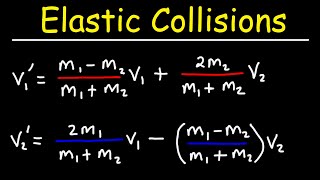
Elastic Collisions and Conservation of Momentum - Shortcut Formula
Master the shortcut formula for solving elastic collision problems in physics, focusing on momentum conservation principles and practical problem-solving techniques.
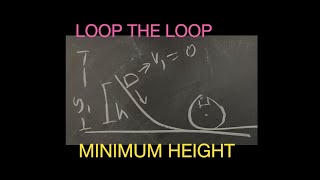
Physics Problem: Finding the Minimum Height and G-Force for Loop the Loop Track
Explore the physics behind roller coaster loops through calculations of minimum height requirements and g-forces, applying principles of energy conservation and circular motion.
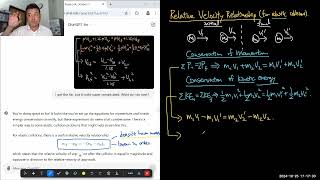
Physics 4A: Derivation of Relative Velocity Relationship in Elastic Collisions
Master the derivation of relative velocity relationships in elastic collisions through step-by-step mathematical proofs and practical physics applications.
Qubit-Efficient Randomized Quantum Algorithms for Linear Algebra
Explore quantum algorithms for matrix sampling and linear algebra operations using minimal qubits, focusing on efficient methods without quantum data structures for practical quantum computing applications.
Optimizing Fermionic Encodings for Both Hamiltonian and Hardware
Discover a method for generating optimized fermionic encodings that map Majorana monomials to Pauli operators, tailored for specific target operators and hardware connectivity through systematic search algorithms.
Improved Approximations for Extremal Eigenvalues of Sparse Hamiltonians
Discover advanced approximation techniques for eigenvalues in sparse Hamiltonians, exploring new methods for quantum systems with q-local terms and improved mathematical approaches for k-sparse configurations.
Perturbative Quantum Simulation: Theory and Applications
Explore perturbative quantum simulation techniques that combine classical perturbation theory with quantum computing to solve large quantum problems using limited quantum hardware resources.
Quantum Supremacy in Mechanical Tasks: Projectiles, Rockets and Quantum Backflow
Explore quantum mechanical advantages in particle behavior, focusing on probability distributions, quantum backflow, and the Bracken-Mellow constant through mathematical analysis and theoretical frameworks.