Gravity Simulator: Binary Star System - Episode 2
Explore gravitational interactions in binary star systems using a simulator. Learn about energy calculations, angular momentum, and the fascinating patterns of orbital motion.
Gravity Simulator - Sun and Earth Orbital Motion - Episode 1
Explore gravitational motion simulation using VPython, focusing on Sun-Earth dynamics. Learn about Euler-Cromer method, indices tracking, and Earth's scale in space.
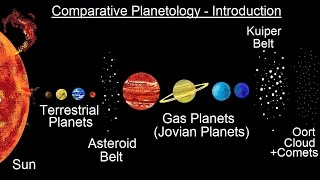
Astronomy - The Solar System - Comparative Planetology
Comprehensive exploration of solar system planets, comparing their physical properties, orbits, atmospheres, and compositions. Includes discussions on moons, asteroids, comets, and water distribution.

Feynman's Lost Lecture on Planetary Orbits
Explore Feynman's elegant proof of planetary elliptical orbits, featuring 3Blue1Brown's visualizations. Uncover the beauty of physics through this captivating demonstration of celestial mechanics.
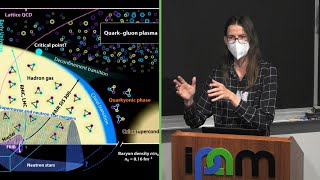
Gravitational-Wave Observations of Neutron-Star Mergers - IPAM at UCLA
Explore gravitational-wave observations of neutron-star mergers, their impact on understanding dense matter and stellar evolution, and future prospects in gravitational-wave astronomy.
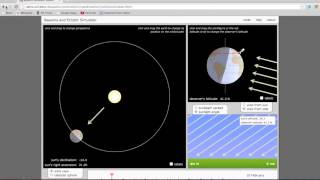
Introductory Astronomy - Causes of the Seasons
Explore Earth's seasonal changes through an in-depth examination of astronomical factors, utilizing interactive simulations and expert insights to enhance understanding of this natural phenomenon.
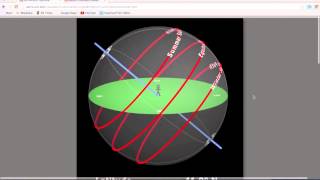
Introductory Astronomy - Path of the Sun in the Daytime Sky
Explore the Sun's changing path across the daytime sky throughout the year, enhancing your understanding of celestial movements and seasonal variations.
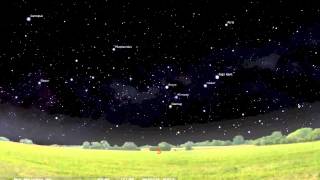
Introductory Astronomy: Star Motions at Different Latitudes
Explore celestial movements across Earth's latitudes using Stellarium, a free sky simulator, to understand how star motions appear differently from various global positions.
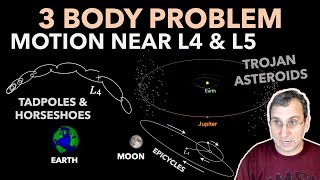
Motion Near L4, L5 Stable Lagrange Points - Tadpole, Horseshoe Orbits, Trojan Asteroids, Lucy Mission
Explore stable Lagrange points L4 and L5, analyzing motion types like tadpole and horseshoe orbits. Discover applications in celestial mechanics, including Trojan asteroids and the Lucy mission.
Black Holes, Binary Systems, and Gravitational Waves - Extreme Mass-Ratio Inspirals - Lecture 2
Explore extreme mass-ratio inspirals in binary systems, focusing on black holes and gravitational waves. Learn about cutting-edge research in astrophysics and general relativity.

The Story of Spacetime - From Galileo to Quantum Gravity
Explore the evolution of spacetime theory from Galileo to modern quantum gravity, as Professor Fay Dowker delves into general relativity and its interactions with Newtonian physics.
Solar Eclipses Explained - From History to Future
Explore fascinating aspects of solar eclipses, from historical perceptions to future predictions, animal behaviors, and geographical patterns, in this comprehensive video series by MinuteEarth.
Methods of Post-Newtonian Expansion
Explore advanced techniques in gravitational physics, focusing on post-Newtonian expansion methods for understanding celestial mechanics and gravitational wave sources.
Is There a Hidden Massive Planet in Our Solar System?
Explore the intriguing possibility of a hidden massive planet in our solar system, examining evidence, potential characteristics, and theories about its origin and elusive nature.
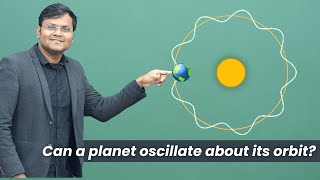
The Physics of Planetary Oscillations - Potential Energy Analysis of Circular Orbits
Explore planetary oscillations in circular orbits through potential energy analysis, understanding stable orbits, perturbations, and calculating oscillation frequencies and periods.
BAAO Astro Challenge Questions Explained - Astronomy and Astrophysics Olympiad Preparation
Detailed walkthrough of 2023 Astro Challenge Paper questions by Sofia, an experienced competitor, offering insights and problem-solving strategies for aspiring astronomy Olympiad participants.
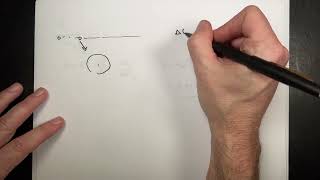
Physics Problem: Spacecraft Deflection due to an Asteroid
Explore spacecraft deflection by an asteroid using physics principles and Python code to calculate momentum changes.
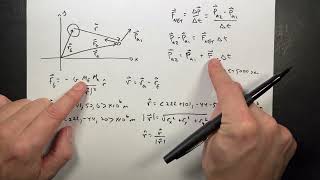
Physics Problem: Change in Momentum of an Asteroid
Explore the gravitational impact of Earth on an asteroid's momentum over time through a detailed physics problem analysis.
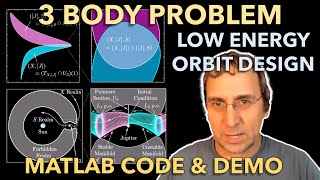
Trajectories with Prescribed Itineraries in the Three-Body Problem - MATLAB Tutorial
Learn to generate trajectories with prescribed itineraries in the planar CR3BP using numerical methods. Includes MATLAB tutorial for computing periodic orbits, invariant manifolds, and Poincaré sections.
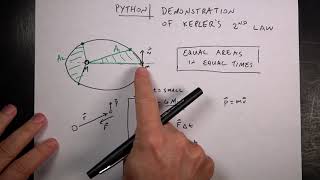
Verifying Kepler's Second Law with Python and Physics
Model planetary orbits and verify Kepler's 2nd Law using Python, demonstrating equal area sectors in equal time periods through orbital motion simulations and sector area calculations.
Classical Mechanics: Modeling Coriolis Force for a Kicked Ball on Eros
Explore the fascinating effects of Coriolis force by modeling the trajectory of a kicked ball on asteroid Eros, using Python to visualize non-inertial reference frames.