
Amplitudes - Lecture 2
Explore advanced concepts in particle physics amplitudes, focusing on modern computational techniques and their applications in quantum field theory.

How Space and Time Form Spacetime - Understanding the 4D Universe
Explore how space and time unite in spacetime, the foundation of modern physics. Discover the math, implications, and reasons behind our 3+1 dimensional universe.

Why No One Knows If Photons Really Are Massless - What If They Aren't?
Explores the possibility of photons having mass, challenging assumptions about light speed and its implications for physics, causality, and our understanding of the universe.

Quantum Fields: The Most Beautiful Theory in Physics
Explore quantum field theory, its historical context, advantages over quantum mechanics, and role in explaining particle interactions and forces in modern physics.
The Black Hole Information Paradox - Breaking Physics and Conservation Laws
Explore the mind-bending paradox of black holes destroying information, challenging fundamental physics laws and our understanding of causality, determinism, and the universe's workings.
Diagnosing Steinmann Violation Using Minimal Cuts
Explore advanced techniques for diagnosing Steinmann Violation in particle physics using minimal cuts, enhancing understanding of scattering amplitudes and quantum field theory.

Conformal Field Theory and The Bootstrap - Lecture 1
Explore conformal field theory and bootstrap methods in quantum physics with expert Balt van Rees, delving into S-matrices and their applications in theoretical physics.
Remarks on the Cosmological Constant as an Initial Condition for Milne-like Spacetimes
Explore Milne-like spacetimes and their implications for the cosmological constant, early universe expansion, and inflationary scenarios in this advanced physics lecture.
Amplitudes and Applications - Class 1
Explore amplitudes and their applications in particle physics through an in-depth lecture series, focusing on advanced concepts and cutting-edge research.
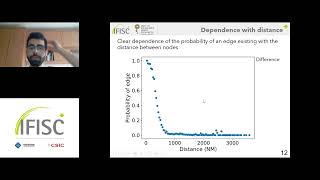
Functional Networks of Weather Events Propagation Between Airports
Explore weather event propagation between airports using functional networks, analyzing data sources, statistical tools, and network subdivision for quantitative insights.
Combinatorial Perturbation Prediction Using Causally-Inspired Neural Networks
Explore PDGRAPHER, a novel graph neural network model for phenotype-driven drug discovery. Learn how it predicts perturbagens to reverse disease effects, offering faster and more efficient therapeutic target identification.
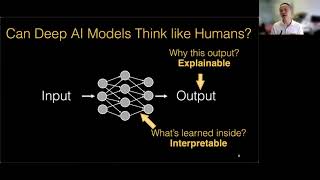
Human-Centric AI for Computer Vision and Machine Autonomy - ICCV'21 Tutorial
Explore human-centric AI in computer vision, covering explainable models, interpretable neural networks, and interactive machine learning for improved AI systems and autonomous machines.
William Marshall – A Measure for Intrinsic Information
Explores a unique information measure reflecting intrinsic perspectives in communication, with implications for integrated information theory and consciousness.
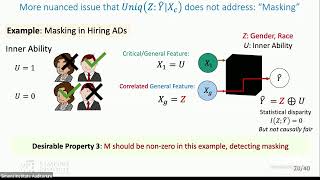
Algorithmic Fairness From The Lens Of Causality And Information Theory
Explore algorithmic fairness through causality and information theory, focusing on identifying and explaining sources of disparity in ML models and quantifying accuracy-fairness trade-offs.
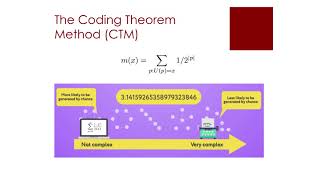
Computing the Uncomputable: The Coding Theorem Method - Unit 6, Module 2
Explore the Coding Theorem Method for computing uncomputable functions, delving into algorithmic information dynamics and its applications in causality and living systems.
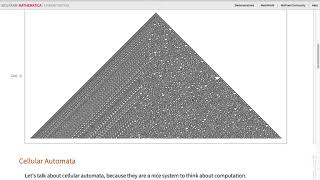
Cellular Automata: Algorithmic Information Dynamics in Living Systems
Explore cellular automata, a computational model for complex systems, and their applications in studying causality and living systems from networks to cells.
Bayesian Networks for Causal Reasoning - Lecture 1
Introduction to Bayesian networks for causal reasoning in healthcare, exploring their application in analyzing clinical data and inferring patterns to improve patient outcomes and medical decision-making.
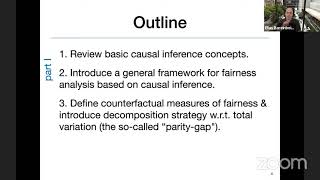
Translation Tutorial - Causal Fairness Analysis
Explore causal fairness analysis in AI, covering structural causal models, causal diagrams, and demographic disparities. Learn why causality matters and how to address fairness challenges in artificial intelligence.
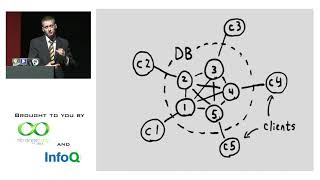
Partitions for Everyone
Explores network partitions in distributed systems, revealing design limits and bugs. Demonstrates challenges in building reliable distributed services through real-world testing of popular systems.

How to Have Your Causality and Wall Clocks, Too
Explore distributed monotonic clocks for causality and wall clock time synchronization in microservices. Learn about implementation, protocols, and applications in distributed systems.

Experimentation
Colin McFarland shares insights on scaling experimentation in businesses, covering causality, common pitfalls, and how tooling and education drive data-focused culture for competitive advantage.