A Tutorial on Causal Representation Learning
Explore Causal Representation Learning: combining machine learning with causal assumptions to identify causal variables from low-level data. Gain insights into core problems and future directions in scientific discovery.

Causality: Philosophical Perspectives - Part 1
Explore the concept of causality through the ideas of Aristotle, Hume, Kant, and Mill, gaining insights into philosophical perspectives on cause and effect relationships.

Causality: Philosophical Perspectives - Part 2
Explore philosophical perspectives on causality from Aristotle to Mill, deepening understanding of cause-effect relationships in scientific inquiry.
Causal Inference
Explore causal inference concepts, methodologies, and applications in AI with expert Adèle H. Ribeiro. Gain insights into probabilistic reasoning and decision-making.
Causal Inference - Lecture from Nordic Probabilistic AI School 2024
Explore causal inference principles, techniques, and applications in AI with expert Adele Ribeiro. Gain insights into probabilistic modeling and decision-making.

Causal Effects - Introduction to the Potential Outcomes Framework
Explore the Potential Outcomes Framework and three types of causal effects in this introductory video on causal inference, laying the groundwork for future discussions on observational data analysis.
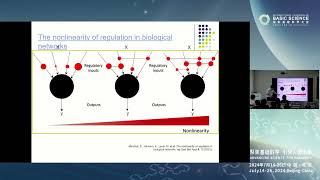
Quasi-Dynamic System Representation of Multiple Nonlinear Regression
Explore evolutionary game theory and allometric scaling to model nonlinear relationships between variables, overcoming limitations of linear regression for complex systems analysis.
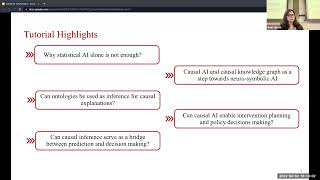
Causal AI for Web and Healthcare
Explore causal AI applications in web and healthcare using knowledge graphs for intervention and counterfactual reasoning, model-based explainability, and domain-specific insights.
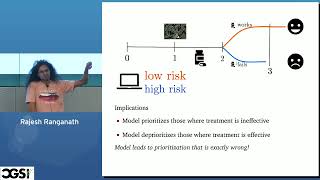
Understanding the Role of Causality in AI for Healthcare
Explore causality's crucial role in AI for healthcare, focusing on improving patient care, addressing self-fulfilling prophecies, and enhancing treatment outcome predictions.
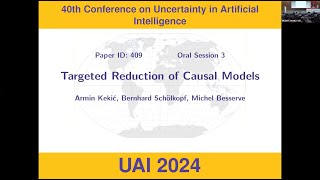
Causality in Artificial Intelligence - Oral Session 3
Explore cutting-edge research in causal inference, including bounding effects, model reduction, interventions in games, and causally abstracted bandits.
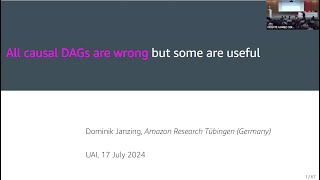
All Causal DAGs Are Wrong but Some Are Useful
Explore the concept of causal DAGs, their usefulness, and challenges in causal discovery. Gain insights into evaluating causal models without ground truth and understanding causality's meaning across various tasks.
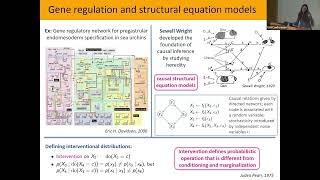
Causal Representation Learning and Optimal Intervention Design
Explore causal representation learning and optimal intervention design with Caroline Uhler's insightful keynote talk at UAI 2023.
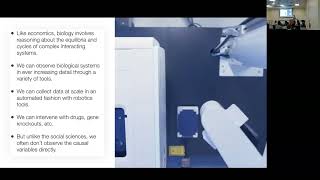
Causal Representation Learning - Tutorial
Explore causal representation learning, combining machine learning with causal assumptions to identify causal variables from low-level data. Gain insights into core problems and future directions in scientific discovery.
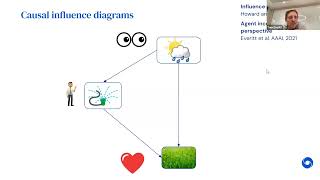
Towards Causal Foundations of Safe AI - Tutorial
Explore causal foundations for safe AI, covering models, fairness, risks, and mitigation strategies to ensure ethical and beneficial AI decision-making.
Passive Learning of Causal Strategies in Language Models
Exploring passive learning of causal strategies in AI, including generalization from interventional data and the role of natural language explanations in enhancing causal understanding.
Understanding Spacetime from Causality and Discreteness
Delve into the fundamental concepts of spacetime through the lens of causality and discreteness, exploring theoretical physics principles and their implications for our understanding of the universe.

Spacetime Atoms and the Unity of Physics - Perimeter Public Lecture
Explore black hole thermodynamics and the concept of spacetime atoms in this lecture by Fay Dowker. Discover how this theory unifies physics and suggests a granular structure of spacetime at microscopic scales.
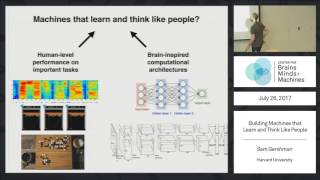
Building Machines that Learn and Think Like People
Explore computational neuroscience and AI inspired by human cognition, covering intuitive theories, compositionality, and learning to learn for more human-like artificial intelligence.
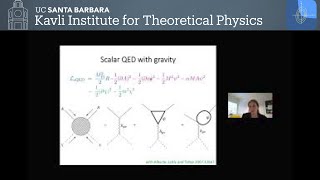
Causality and Positivity with Gravity - Claudia de Rham
Explores causality and positivity in gravitational theories, examining effective field theory bounds, scalar QED, and the interplay between gravity and quantum field theory concepts.
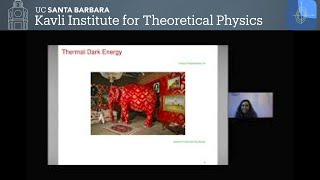
Thermal Dark Energy and Other String Candidates - Susha Parameswaran - EFTBounds
Explores string theory's implications for low-energy physics, focusing on thermal dark energy and other string candidates. Discusses swampland program, Weak Gravity Conjecture, and connections to particle phenomenology.
The Cosmic Censorship Conjectures in General Relativity - Lecture 3
Explore cosmic censorship conjectures in general relativity, focusing on global high publicity, null infinity, and the Hawking pass, with expert Mihalis Dafermos.