
Secure Programming Practices in C++
Explore safe C++ programming practices, focusing on navigating dangerous language features and building awareness of potential pitfalls to write more secure and robust code.

Expect the Expected
Explore efficient error handling in C++ using the 'Expected' type, combining strengths of error codes and exceptions for resilient code. Learn practical techniques for local and centralized error management.

What I Talk About When I Talk About Cross Platform Development
Explore cross-platform development using the Salami Method, a system architecture for creating portable, maintainable C++ code across multiple platforms, with practical examples and benefits.
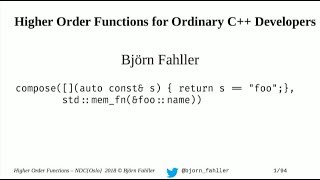
Higher Order Functions for Ordinary C++ Developers
Explore higher-order functions in C++ to elevate code abstraction, improve readability, reduce duplication, and maintain performance through simple techniques and practical examples.

C++ - Be Type-Safe - The Journey of Determining the Number of Elements in an Array
Explore implementing type-safe array size determination in C++ using constexpr, enhancing code robustness and compile-time error detection for critical systems.

Enough String View to Hang Ourselves
Explore string handling challenges in C++ projects, focusing on std::string_view in C++17. Learn strategies for managing multiple string types and optimizing performance in large-scale applications.
Secure Programming Practices in C++
Explore secure C++ programming practices, focusing on vulnerability patterns, coding culture, and safer language constructs to build robust and reliable software.

Type Safe C++? LOL!
Explore techniques for creating strong types in C++ to reduce bugs, improve clarity, and enhance performance. Learn about simple methods and advanced open-source libraries for implementing type safety.
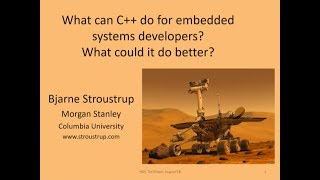
What Can C++ Do for Embedded Systems Developers
Explore C++'s capabilities for embedded systems, focusing on hardware efficiency, resource management, reliability, and maintainability across various application domains.
Simplicity - Not Just for Beginners
Explore techniques for writing simpler, more effective C++ code, focusing on naming, function length, and modern language features to improve readability and maintainability.

C++ Core Guidelines - Safer C++
Explore safer C++ practices with Core Guidelines, focusing on efficiency, const usage, and minimizing raw pointers. Learn to modernize code and improve quality through automated tooling and refactoring techniques.
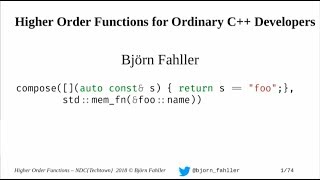
Higher Order Functions for Ordinary C++ Developers
Explore techniques for writing higher order functions in C++, elevating code abstraction, improving readability, and reducing duplication while maintaining performance.

A Modern Embedded Product Platform
Explore the development of a modern embedded platform for high-end projectors, covering Linux, C++, IPC, Node.js, and HTML. Learn about software stacks, services, and interface design.
Integrate Python and C++ with pybind11
Discover how to combine Python's rapid development with C++'s performance using pybind11. Learn to expose C++ libraries as Python modules for efficient hybrid solutions in data science and machine learning.
CUDA Kernels with C++
Explore CUDA for C/C++ with practical examples, focusing on using C++ features to enhance kernel code safety without compromising performance in GPU programming.

A Performance Analysis of a Trading System over Compilers
Explore high-frequency trading optimization techniques, compiler quirks, and performance analysis in C++. Gain insights on static branch prediction, switch statements, and hardware impacts on trading systems.
The Nightmare of Move Semantics for Trivial C++ Classes
Explore the complexities of implementing a simple C++ class with string members, delving into move semantics, perfect forwarding, and advanced techniques for optimal performance.

C++ Unit Testing - The Good, The Bad & The Ugly
Explore effective C++ unit testing techniques, tools, and best practices to enhance code quality, catch defects early, and improve development efficiency for both new and legacy projects.

Type Safe C++? LOL!
Explore techniques for creating strong types in C++ to reduce bugs, improve clarity, and enhance performance. Learn about simple and advanced approaches, their impact on code, and their pros and cons.

C++ - No More Nulls! - Fixing the Billion Dollar Mistake
Explore techniques to eliminate null in C++, enhancing code safety and clarity. Learn to use non-nullable types, std::optional, and gsl::not_null for improved software design.

Sane and Safe C++ Class Types
Explore safe C++ class design, focusing on best practices, rules, and guidelines for creating robust and maintainable code while navigating complex language features and potential pitfalls.