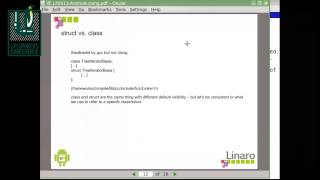
Getting Android Userland to Build with Clang
Explore challenges and solutions in porting Android userland to clang 3.3, including compatibility issues, bug fixes, and code reorganizations. Discuss future improvements for clang-built Android systems.
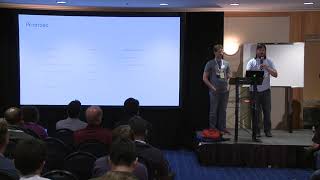
Clang + Linux
Explore Clang and LLVM for Linux kernel development, covering priorities, tools, and techniques to enhance compilation, debugging, and code analysis processes.

Honey, I Shrunk the TinyML
Explore TinyML: train, convert, and run machine learning models on microcontrollers. Learn quantization, pruning techniques, and step-by-step integration for embedded AI applications.
Beyond CUDA - GPU Accelerated Computing on Cross-Vendor Graphics Cards with Vulkan Kompute - AMD, Qualcomm, NVIDIA & Friends
Explore cross-vendor GPU computing with Vulkan and Kompute. Learn to write GPU-accelerated machine learning algorithms using Python and C++, applicable to various GPUs including AMD, Qualcomm, and NVIDIA.

Joyful Polyglot - Beautiful Insights from Many Languages
Explore programming concepts from various languages and learn how to apply them in Ruby, broadening your coding perspective and enhancing problem-solving skills.

Build Your Own Native Module
Learn to create custom Native Modules for React Native, accessing platform APIs and integrating existing code. Explore real-world examples of high-performance extensions and advanced functionality.

Native Code on the Web
Exploring the challenges and possibilities of running native code on the web, including C++ compilation to JavaScript, browser internals, and multi-threaded programming.

N-API - The New Native in Node.js
Learn to leverage N-API for seamless C++ integration in Node.js, exploring its benefits, implementation, and practical applications for efficient native module development.
A Rust Crate that Also Quacks Like a Modern C++ Library
Explore API design patterns for seamless integration of Rust crates into C++ codebases, focusing on encoding_rs as a case study for cross-language compatibility in systems programming.

Toolchain Options in 2023 - What's New in Compilers and Libcs?
Explore recent advancements in compilers and C libraries, comparing alternatives to traditional GNU tools and discussing their advantages, drawbacks, and potential pitfalls for embedded systems.

Generic Locking in C++
Explore generic locking in C++, focusing on folly/Synchronized library for reliable encapsulated locking. Learn about multithreading, STL containers, and techniques to avoid common pitfalls in lock-based synchronization.
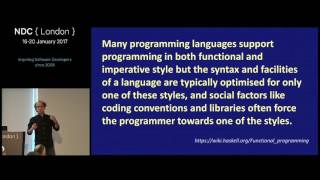
Functional C++
Explore functional programming concepts in C++, focusing on immutability, concurrency, and function composition. Learn idiomatic approaches to apply these ideas in modern C++ development.

Better Code - Runtime Polymorphism
Explore advanced C++ techniques for implementing polymorphism without inheritance, featuring practical examples and C++11 features to enhance code quality and efficiency.
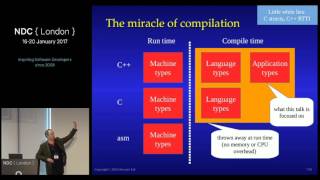
The C++ Type System is Your Friend
Explore how C++'s type system and templates can create efficient, safe, and reusable code through lightweight abstractions, type-rich APIs, and zero-overhead template techniques.
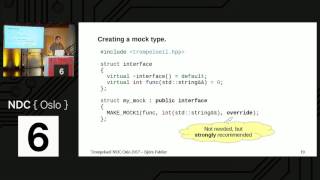
Using Trompeloeil - A Mocking Framework for Modern C++
Explore Trompeloeil, a C++14 mocking framework, through TDD. Learn advanced techniques for unit testing, including patterns, sequential ordering, and custom matchers.

Functional C++ for Fun & Profit
Explore functional programming concepts in C++, including immutable data types, persistent structures, and atomic references, for practical application in real-world scenarios.
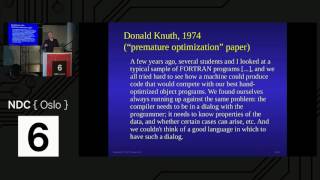
C++ Performance and Optimisation
Explore multi-level strategies for optimizing C++ applications, covering design issues, data structures, algorithms, memory allocation, and modern hardware considerations.
Fast and Small - What are the Costs of Language Features
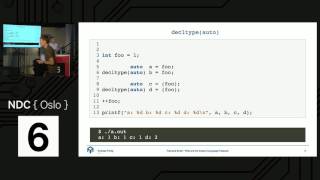
Explore the performance and code-footprint costs of modern C++ features like lambdas and static, empowering developers to make informed decisions on their usage in projects.

Concurrent Programming in C++
Explore C++ concurrency API, learn to create and manage threads, avoid race conditions and deadlocks, and utilize async operations and futures for efficient concurrent programming.
C++ Performance and Optimisation
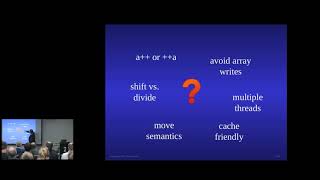
Explore C++ performance optimization techniques, covering design issues, data structures, memory allocation, modern CPUs, move semantics, and string handling, with practical examples and measurement strategies.

The Holy Grail - A Hash Array Mapped Trie for C++
Explores Hash Array Mapped Tries as an efficient data structure for C++, combining benefits of trees and hash tables. Discusses implementation, performance, and applications in concurrency and functional programming.