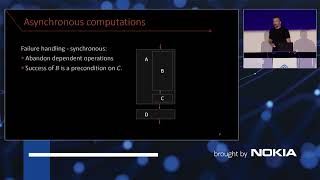
Asynchrony with ASIO and Coroutines
Explore asynchronous programming in C++ using ASIO and coroutines, enhancing performance and simplifying complex operations in high-performance systems.
Beyond std - vector
Explore advanced C++ vector implementations, their features, performance, and use cases. Learn about static, small, and random vectors for optimized memory management.
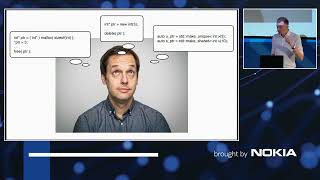
What C and C++ Developers Can Learn from Rust
Explore how Rust's ownership model, memory safety features, and modern practices can enhance C/C++ development, improving code reliability and efficiency.
Modules in C++
Explores options for introducing modules in C++, discussing challenges and opportunities to address preprocessor limitations and improve development tools and build times.
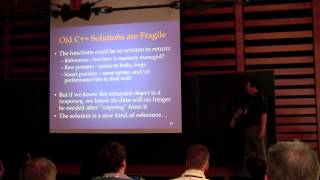
A Whirlwind Overview of C++11
Comprehensive overview of C++11 features, covering lambdas, uniform initialization, auto, rvalue references, multithreading, smart pointers, and new STL containers for improved code clarity and performance.

Now What? A Vignette in Three Parts
Exploring C++11's potential for beautiful, efficient code, addressing performance challenges, and adapting to the evolving landscape of networked devices and ubiquitous data access.
Lambda Functions
Lambda functions in C++11: syntax, usage, and benefits. Explore anonymous function objects, capture mechanisms, and practical applications through examples and exercises to enhance code expressiveness and reduce bugs.
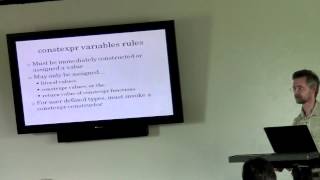
C++11 - New Tools for Class and Library Authors
Explore advanced C++11 features like variadic templates, static assert, constexpr, and decltype, enhancing your ability to create robust classes and libraries with improved functionality and performance.
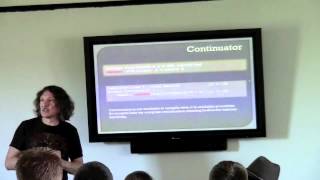
Compile-Time - Run-Time Functional Programming in C++
Explore advanced C++ programming techniques at the compile-time/run-time boundary, including functional concepts like monads and continuations, with a focus on practical applications.
Refactoring C++ with Clang
Explore automated C++ refactoring using Clang, covering recognition of patterns, source-to-source translation, and API updates. Learn to build safe, efficient tools for modernizing codebases.
Type to String Conversions, and Vice-Versa
Explore options for type-to-string conversions in C++, from traditional methods to modern solutions like std::stoi and boost::lexical_cast. Introduces boost::coerce, highlighting its speed and extensibility.
Regex in C++11 and Boost
Comprehensive introduction to regular expressions in C++11 and Boost, covering basics to advanced usage. Learn powerful string manipulation techniques for efficient coding.
Using Boost.Coroutine to Untangle a State Machine
Simplifying complex event-driven programming with Boost.Coroutine, transforming convoluted state machines into clear, maintainable code with improved control flow and easier debugging.
ConceptClang - An Implementation Model for C++ Concepts
Exploring ConceptClang: An infrastructure for implementing C++ concepts in Clang. Discusses concept-based lookup, overloading, constrained templates, and design exploration for constraint-based polymorphism in C++.
C++ Component Extensions for WinRT
Exploring approaches to integrate C++ with foreign object models, focusing on Microsoft's WRL library and C++ syntax extensions for cross-language component interaction in heterogeneous environments.
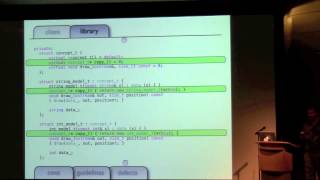
Value Semantics and Concepts-based Polymorphism
Explore value semantics and concepts-based polymorphism in C++, learning advanced techniques to improve code efficiency, maintainability, and performance in modern software development.
Metaprogramming Applied to Numerical Problems
Explore advanced Template Metaprogramming techniques for implementing efficient Runge-Kutta schemes to solve ordinary differential equations in various scientific fields.
Boosting Libraries for TR2
Guidance on proposing Boost libraries for C++ TR2, including tips for successful submissions and navigating the standards committee process.
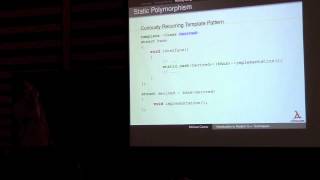
Introduction to Modern C++ Techniques - Part I
Explore advanced C++ techniques including concepts, traits, policy classes, CRTP, SFINAE, and tag dispatching. Learn building blocks and strategies for effective generic programming in modern C++.
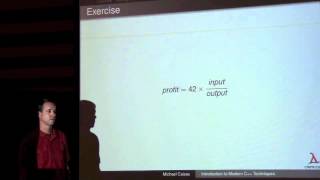
Introduction to Modern C++ Techniques - Part II
Explore advanced C++ concepts like policies, SFINAE, and tag dispatching. Learn building blocks and strategies for generic programming to enhance your modern C++ skills.
Exception-Safe Coding in C++ - Part I
Comprehensive guide to exception safety in C++, covering best practices, implementation techniques, and strategies for transitioning legacy code to robust exception handling.