Advanced Tutorials - Runtime Analysis of Population-Based Evolutionary Algorithms
Explore advanced techniques for runtime analysis of population-based evolutionary algorithms, covering selection mechanisms, random family trees, and level-based analyses to optimize algorithm performance.
Machine Learning and the Earth David Hall
Explore machine learning's potential in addressing urgent global challenges like climate change, with insights on strategies, risks, and implications for various fields.
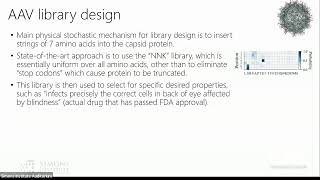
Machine Learning-Based Design of Proteins
Explore machine learning-based protein design with Jennifer Listgarten, covering directed evolution, predictive models, and optimization techniques for gene therapy applications.
Decoding Nonhuman Communication - Polylogues
Explore cutting-edge research on decoding nonhuman communication, from sperm whale vocalizations to plant acoustic responses, using machine learning and natural language processing techniques.
Backpropagation and Deep Learning in the Brain
Explore deep learning in the brain, backpropagation, and credit assignment algorithms. Discover neuroscience evidence and new models of neurons in this computational brain theory talk.
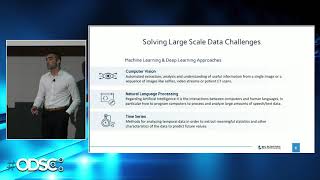
Practical AI Solutions Within Healthcare and Biotechnology - Michael Segala
Explore AI applications in healthcare, including image analysis, NLP, and time-series data. Learn about challenges, workflows, and real-world use cases in diagnostics and patient care.
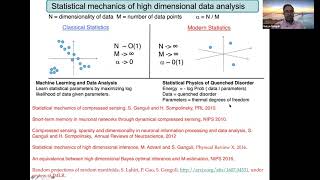
Weaving Together Machine Learning, Theoretical Physics, and Neuroscience
Exploring the intersection of machine learning, physics, and neuroscience through complex systems analysis to develop better algorithms and understand neural systems.
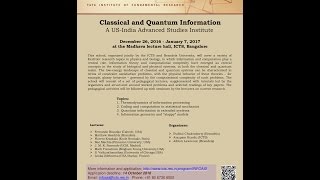
From Information Theory to Learning via Statistical Physics - Introduction
Explore connections between information theory, statistical physics, and learning. Delve into classical statistics, high-dimensional problems, and Bayesian approaches, with applications in signal processing and regression.
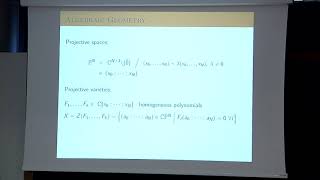
The Geometry of Tensors - Carolina Araujo
Explore tensor decomposition, its applications, and geometric interpretation. Learn about recent developments in determining tensor ranks and their significance in various fields.
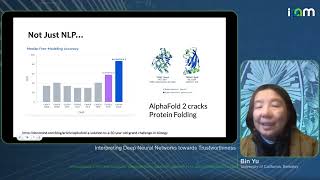
Interpreting Deep Neural Networks Towards Trustworthiness - IPAM at UCLA
Explore techniques for interpreting deep neural networks, including ACD and AWD methods, to enhance trustworthiness in AI applications across scientific domains.
Contextual Conformational Variability in CryoEM and CryoET Using Deep Learning
Explore deep learning methodologies for analyzing CryoEM and CryoET data, focusing on population dynamics and contextual annotation of macromolecules in cellular environments.
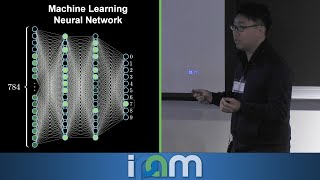
AI Inroads in Imaging Sciences for Materials Research - IPAM at UCLA
Explore deep learning applications in materials research, focusing on convolutional neural networks for transmission electron microscopy and tomographic imaging advancements.
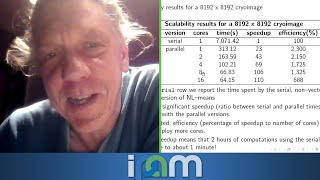
Algorithms for Non-Local Filtering - Application Cryo-Electron and Biological Microscopy
Efficient algorithms for non-local filtering in microscopy, focusing on fast implementations of Non-Local Means Denoising and feature detection in biological images for improved image processing and analysis.
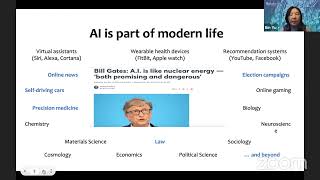
Interpreting Deep Neural Networks Towards Trustworthiness
Explores methods for interpreting complex neural networks, introducing ACD and AWD techniques. Advocates for a quality-controlled data science lifecycle to ensure trustworthy model interpretation.
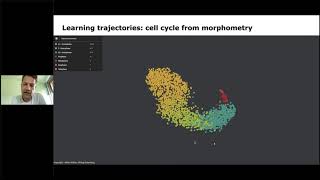
Interpretable Machine Learning to Model Drug Perturbations in Single Cell Genomics
Explore interpretable machine learning for modeling drug effects on single-cell genomics. Learn about deep autoencoders, manifold identification, and predicting novel perturbations in cellular states.

What Are CycleGANs? - A Novel Deep Learning Tool in Pathology
Explore CycleGANs for unpaired image conversion, including applications in pathology and microscopy. Learn model architecture, training, and inference through code demos and real-world examples.
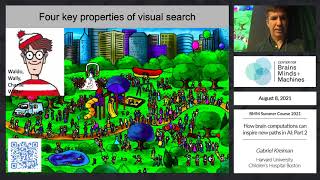
How Brain Computations Can Inspire New Paths in AI - Part 2
Explore brain-inspired AI advancements, focusing on object recognition, contextual reasoning, and model performance. Gain insights into cutting-edge computational approaches and their applications.
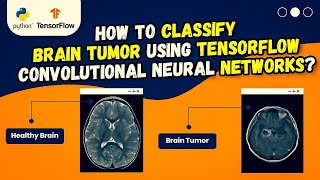
Cancer Detection in Brain Using Deep Learning
Learn to detect brain tumors using deep learning, CNN, and TensorFlow. Build, train, and test a model for classifying brain images with hands-on coding and practical implementation.

The Deep Learning Revolution
Explore the evolution of deep learning, from its origins to modern applications, covering key milestones, breakthroughs, and future prospects in AI and neuroscience.
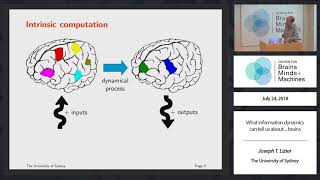
What Information Dynamics Can Tell Us About Brains
Explore information dynamics in complex systems, focusing on intrinsic computation, information transfer, and applications in neuroscience and network analysis.
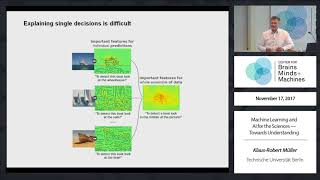
Machine Learning and AI for the Sciences - Towards Understanding
Explore ML and AI applications in sciences, focusing on neuroscience, medicine, and physics. Learn about extracting insights from ML models to enhance understanding in fields like quantum chemistry.