Hippocampal Mechanisms of Memory and Cognition - Part 1
Explore hippocampal mechanisms underlying memory and cognition, including structure, storage, retrieval, brain oscillations, and spatial firing patterns.
The Neural Basis of Consciousness
Explore the neural foundations of consciousness, examining brain structures and theories with neuroscientist Christof Koch in this thought-provoking lecture.
The Quest to Create Engineer-Quality Models of the Mechanisms of Human Visual Object Recognition - Pt1
Explore the mechanisms of human visual object recognition, focusing on systems-level models, reverse engineering, and the ventral visual stream's role in perception and AI applications.
How Brain Computations Can Inspire New Paths in AI - Part 1
Explore how brain computations inspire AI advancements, covering visual illusions, neural connectivity, and deep learning networks to uncover new paths in artificial intelligence research.
The Neural Circuits for Face Recognition
Explore neural circuits for face recognition, including a newly discovered temporal pole region. Learn about face processing systems, computational principles, and their implications for visual intelligence.
Connectomics at the Nano and Petascale
Explore the intricate world of neural connections from nano to petascale, delving into motor memory, brain structure, and cutting-edge neuroscience research techniques.
Next-Generation Recurrent Network Models for Cognitive Neuroscience
Explore next-gen recurrent neural networks for cognitive neuroscience, addressing challenges and combining biological knowledge with computational goals for improved brain and mind understanding.
Invariant Representation of Physical Stability in the Human Brain
Explore how the human brain represents physical stability, from infant intuition to neural computations, and its applications in robotics and computer vision.
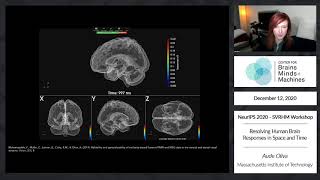
Resolving Human Brain Responses in Space and Time
Explore cutting-edge techniques for mapping brain responses, uncovering insights into visual and auditory perception, memory, and cognitive processes.
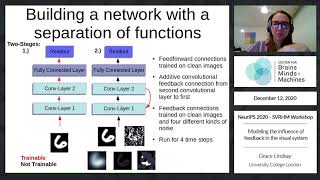
Modeling the Influence of Feedback in the Visual System
Explore how feedback influences visual processing, using masking studies and network modeling to understand its impact on classification accuracy and neural activity.

Functional Specificity in the Human Brain - What, Whether, and Why?
Explore the functional specificity of the human brain, examining key questions, methodologies, and findings in cognitive neuroscience with MIT researcher Nancy Kanwisher.
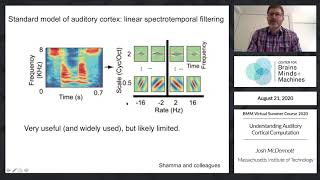
Understanding Auditory Cortical Computation
Explore auditory processing through computational models, comparing AI and human performance in speech recognition, sound localization, and pitch perception.

Toward Brain Computer Interface - Deep Generative Models for Brain Reading
Explore deep generative models for brain reading, covering GAN implementation, image reconstruction from brain signals, and evolving latent codes using genetic algorithms.
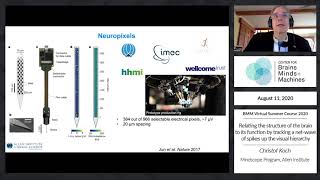
Relating the Structure of the Brain to Its Function by Tracking a Net-Wave of Spikes
Explore brain structure-function relationships through spike tracking in the visual hierarchy, using advanced techniques like neural pixels and high-resolution 3D atlases.
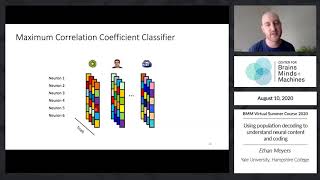
Using Population Decoding to Understand Neural Content and Coding
Explore neural population decoding to uncover abstract representations in the brain, analyzing experiments on invariance and information processing in visual cognition.
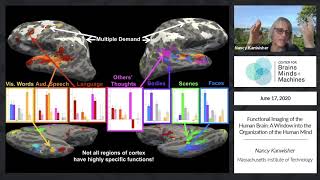
Functional Imaging of the Human Brain - A Window into the Organization of the Human Mind
Explore brain imaging techniques revealing mind organization, focusing on temporal lobe functions, face perception, and cognitive neuroscience methods for understanding human cognition and behavior.
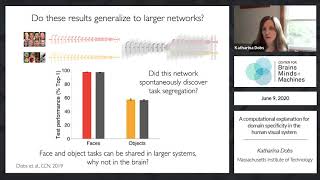
A Computational Explanation for Domain Specificity in the Human Visual System
Exploring how domain-specific organization in the brain emerges from computational optimization for face and object recognition tasks, using artificial neural networks to model cortical segregation.
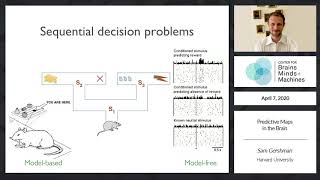
Predictive Maps in the Brain
Explore reinforcement learning theory using predictive maps, bridging model-based and model-free approaches. Discover insights into hippocampal spatial representation and entorhinal grid cells.
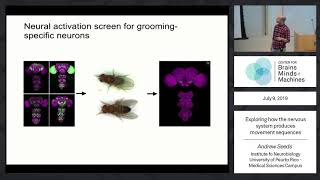
Exploring How the Nervous System Produces Movement Sequences
Explore how the nervous system orchestrates movement sequences, focusing on grooming behaviors in flies and the neural circuits responsible for specific grooming movements.
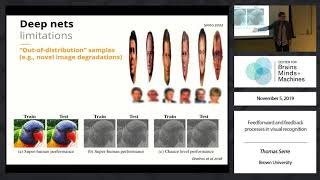
Feedforward and Feedback Processes in Visual Recognition
Explore visual recognition processes, comparing deep learning models with neuroscience-inspired approaches. Gain insights into complex visual reasoning and potential advancements in AI through computational neuroscience.

Neuroscience Methods Tutorial
Explore diverse neuroscience methods including psychophysics, electrophysiology, and signal analysis. Learn about electrode types, spike sorting, and oscillatory activity.