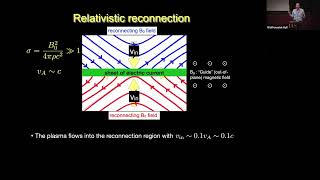
Life on the Edge: Reconnection-Powered Emission at the Boundaries of Black Hole Jets
Explore cutting-edge astrophysics research on emission patterns at black hole jet boundaries and their connection to magnetic reconnection phenomena in space.
Decoding the Physics of the Early Universe Through Primordial Black Holes, Dark Matter and GWs
Explore the complex physics of primordial black holes, their role in universe reheating, dark matter production, and gravitational waves through advanced theoretical concepts and recent observational data.
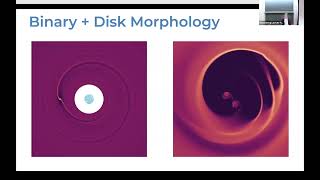
Accreting Binaries: From Brown Dwarfs to Major Mergers
Explore the dynamics of binary systems across cosmic scales, from molecular cloud collapse to galactic mergers, focusing on circumbinary accretion and black hole binary evolution in various environments.
Quantum Sensing at meV Energy-Scales for Dark Matter Searches
Delve into advanced quantum sensing techniques for dark matter detection, exploring meV energy-scale measurements, superconducting qubit applications, and calibration challenges in particle physics research.
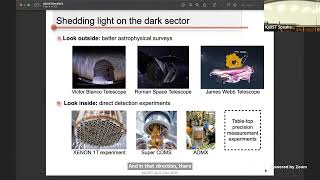
Searching for Dark Matter and Dark Energy with Mechanical Systems
Explore groundbreaking research on detecting dark matter and dark energy using mechanical systems, examining innovative detection methods and experimental approaches in quantum physics.
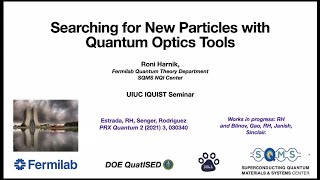
New Particle Searches with Nonlinear Optics
Explore cutting-edge particle physics research using nonlinear optics, focusing on axions and dark photons detection through Dark SPDC process and innovative quantum measurement techniques.

Astronomy and Astrophysics Research at Raman Research Institute
Discover the pioneering research and legacy of the Raman Research Institute in astronomy and astrophysics, exploring past achievements and current groundbreaking work.
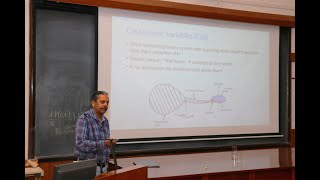
X-ray View of Cataclysmic Variable Stars: Binary Systems and X-ray Emissions
Explore the fascinating world of cataclysmic variable stars through X-ray observations, focusing on binary systems with white dwarfs and the unique characteristics of asynchronous polars.
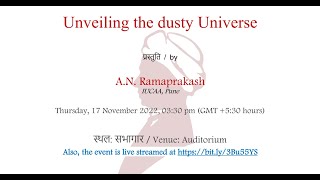
Unveiling the Dusty Universe
Explore the mysteries of cosmic dust and its role in shaping our understanding of the Universe through advanced astronomical observations and research findings.

Multi-messenger Astronomy: Progress and Problems in Exploring the Dynamic Sky
Explore the dynamic universe through multi-messenger astronomy, examining cosmic rays, neutrinos, photons, and gravitational waves to understand astrophysical phenomena and recent research developments.
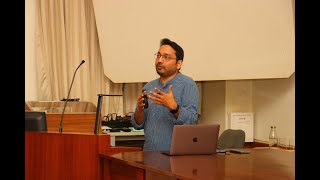
Peering into the Early Universe - Observing Cosmic History Through High-Precision Measurements
Explore high-precision astronomical techniques and custom telescope designs used to study crucial epochs of the early Universe, overcoming observational challenges to reveal our cosmic origins.
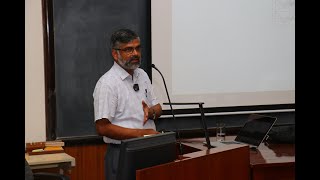
Highs and Lows of Accreting Neutron Stars: X-ray Observations and Binary Systems
Explore the fascinating world of X-ray emitting neutron stars, their binary systems, and groundbreaking discoveries including massive planets and orbital period glitches, plus insights into the POLIX instrument.

Outflows from Galaxies - Understanding Gas Ejection and Star Formation
Explore the physics of galactic gas ejection and its impact on star formation through multi-wavelength observations, understanding how this process shapes galaxy evolution.

Overview of SKA Radio Interferometer Telescope Activities - Design and Implementation
Explore the design challenges and scientific activities of the Square Kilometer Array (SKA) radio telescope project, focusing on the low-frequency aperture array and RRI's contributions to pulsar research.

Seeing the High Energy Universe - Understanding Cosmic Rays and Neutrino Detection
Explore high-energy cosmic phenomena, from cosmic rays to neutrinos, and discover cutting-edge detection methods and astronomical observations in this comprehensive physics lecture.
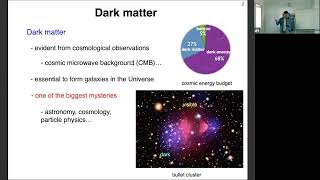
Current Status of Self-Interacting Dark Matter
Explore the latest findings on self-interacting dark matter, examining velocity-dependent cross sections and their implications for dark matter halos across different cosmic scales.
How Cosmological Filaments Reset the Formation of Disc Galaxies - Florent Renaud
Explore how cosmic filaments influence disc galaxy formation, examining the interplay between the cosmic web and galaxy evolution across time and its implications for cosmology.
Tracking Halo Orbits and Their Mass Evolution Around Large-Scale Filaments - Hannah Jhee
Explore halo orbits and mass evolution around cosmic filaments, examining their dynamics, virialization, and impact on galaxy formation across cosmic time.
New Appreciation of the Role of Shocks in Nova Eruptions - Jeno Sokoloski
Explore new insights into nova eruptions, focusing on the role of shocks in gamma-ray production, dust formation, and light curve behavior. Learn about recent observations and their implications for our understanding of these stellar events.
Gas-Embedded Binaries - A Link Between Stars, Black Holes and Gravitational Waves - Lucio Mayer
Explore the connection between gas-embedded binaries, stellar evolution, and gravitational waves. Gain insights into supermassive black holes and merging binaries in this comprehensive lecture.
Circumbinary Disks Across Different Scales - Roman Rafikov
Explores circumbinary disks across stellar and black hole binary systems, discussing gas evolution, observational signatures, and numerical modeling techniques to understand these complex astrophysical phenomena.