Dust Properties of Galaxies from a Data-Driven Hierarchical Model - John Forbes
Explore data-driven hierarchical modeling to uncover dust properties in galaxies, revealing insights into galaxy formation and evolution through advanced statistical techniques.
Computational and AI Funding Opportunities - Andreas Berlind (NSF)
Explore NSF funding opportunities for computational and AI research in astrophysics. Learn about available grants and how to apply for support in astrostatistics and machine learning projects.
Galaxy Zoo in the Deep Learning Era - Mike Walmsley
Exploring Galaxy Zoo's evolution with deep learning, focusing on self-supervised techniques and new tools for galaxy morphology analysis in the era of big astronomical data.
Galaxy Merger Reconstruction with Generative Graph Neural Networks - Yuan Sen Ting
Exploring galaxy merger reconstruction using generative graph neural networks, advancing our understanding of galaxy formation and evolution through innovative machine learning techniques.
Finding Environmental Measures Sensitive to Halo Properties Using Neural Networks
Exploring neural networks to identify environmental measures that reveal halo properties in galaxy formation studies, enhancing our understanding of cosmic structure evolution.
The Brightest Cluster Galaxy and Intracluster Light - Louise Edwards
Explore the Brightest Cluster Galaxy and Intracluster Light in this talk by Louise Edwards. Gain insights into galaxy clusters, their central galaxies, and the diffuse light between them.
Learning to Simulate the Universe with Deep Learning - Elena Giusarma
Explore deep learning techniques for simulating the universe, focusing on innovative approaches to model cosmic structures and enhance our understanding of galaxy formation and evolution.
Star Formation Histories of Galaxies Near and Far
Explore galaxy formation and evolution through star formation histories, using advanced statistical and machine learning techniques to analyze vast datasets from current and future astronomical surveys.
Outliers - How I Learned to Love Them, and Why You Should Too
Discover the value of statistical outliers in galaxy formation studies. Learn how anomalous galaxies challenge current paradigms and drive new insights in astrophysics and cosmology.
Tracing Dark Matter with Stars - Lina Necib
Explore innovative techniques for detecting dark matter using stellar dynamics. Learn how advanced statistical methods and machine learning are revolutionizing our understanding of galactic structure and evolution.

Towards a Posthuman Future - Advances in Technology and AI
Martin Rees explores how technological and AI advancements could empower humanity to overcome global threats, discussing the potential for a posthuman future and its implications for our species.

Unconscious Bias in Science - Exploring Prejudices and Unfair Judgments
Explore unconscious prejudices and biases in scientific fields with experts discussing their impact on career choices, gender stereotyping, and organizational dynamics in research and academia.
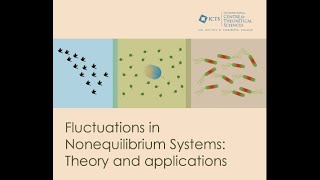
Persistence and First-Passage Properties of Stochastic Processes by Satya N Majumdar
Explore stochastic processes, focusing on persistence and first-passage properties. Covers applications in chemistry, finance, astrophysics, and more. Examines Markov processes and run-and-tumble particle models.
Truth and the Scientific Method by David Gross
Explore the nature of scientific truth, the scientific method's strengths and limitations, and its role in society. Gain insights into reductionism and the challenges facing modern science.
Spacetime, Quantum Mechanics and Positive Geometry by Nima Arkani Hamed
Explore the intersection of spacetime, quantum mechanics, and positive geometry, delving into scattering amplitudes, the mystery of time, and emergent phenomena in theoretical physics.
Quantum Field Theory as the Language of Physics by Nathan Seiberg
Explore quantum field theory's role as the universal language of physics, its applications, limitations, and potential reformulation in this insightful talk by Nathan Seiberg.
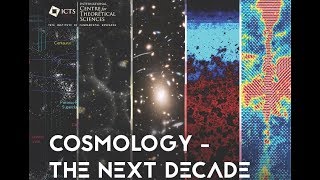
Cosmological Simulations by R. Angulo
Explore cosmological simulations in this lecture, covering key concepts, techniques, and applications in modern cosmology research for understanding the universe's structure and evolution.
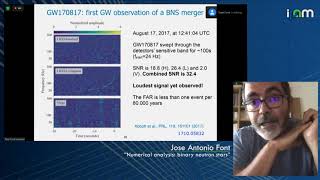
Numerical Analysis - Binary Neutron Stars - IPAM at UCLA
Explore numerical modeling of binary neutron star mergers, covering hydrodynamics, MHD equations, and simulation methods. Learn about gravitational waves, gamma-ray bursts, and r-process elements.
The Role of Mathematics in Solving the World's Main Challenges
Explore how mathematics and computation contribute to understanding climate, energy, the cosmos, and life itself through TED-style talks by renowned computational scientists.
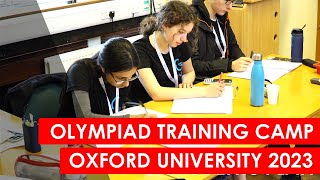
Olympiad Physics Training Camp - Easter 2023
Explore the British Physics Olympiad camp at Oxford, featuring interviews with participants and organizers. Learn about the competition, practical sessions, and astrophysics components.
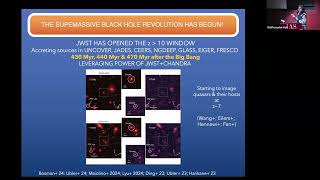
New Insights into the First Supermassive Black Holes in the Universe
Explore groundbreaking discoveries about supermassive black holes, from their formation and growth to their cosmic influence, featuring latest findings from JWST, NANOGrav, and computational advances.