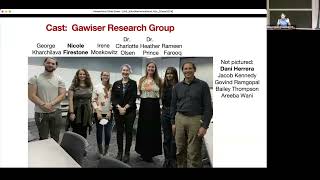
What We Think We Know About Lyman Alpha Emitting Galaxies - Lecture
Explore high-redshift Lyman Alpha Emitting galaxies, examining common assumptions and their validity. Discover ongoing research methods to test these hypotheses about LAEs.
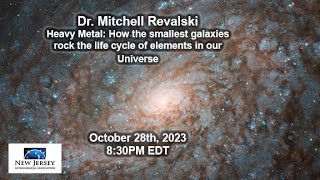
Heavy Metal: How the Smallest Galaxies Impact the Life Cycle of Elements in Our Universe
Explore the role of small galaxies in the cosmic metal cycle, examining their metal content and evolution over billions of years using deep space observations from Hubble and ground-based telescopes.
Cosmic 75 - 75 Years of the School of Cosmic Physics at DIAS
Explore 75 years of groundbreaking research in cosmic physics, from Earth's interior to the universe's edge, with DIAS's pioneering discoveries and ongoing contributions to scientific understanding.
Dark Matter: What We (Don't) Know - Samhain Agus Science 2022
Explore the mysteries of Dark Matter, its existence, detection methods, and potential production in collider experiments. Gain insights into this enigmatic component of the universe.
A Novel Proposal for Ultra Light Dark Matter
Explore a groundbreaking proposal for Fuzzy Dark Matter, inspired by Schrodinger's work, and examine potential evidence supporting this ultra-light dark matter scenario.
A Novel Proposal for Ultra Light Dark Matter
Explore a groundbreaking proposal for Fuzzy Dark Matter, inspired by Schrodinger's work, and examine potential evidence supporting this ultra-light dark matter scenario.
Neutrinos and the Prospects for New Physics
Explore neutrino oscillations, mass origins, and their connection to dark matter and flavor problems in particle physics.
PRyMordial - The First Minutes of the Universe Computed in Seconds
Explore the computational simulation of the universe's earliest moments, uncovering insights into cosmic origins and evolution.
Freeze-in: Problems and Opportunities in Dark Matter Production
Explore FIMP dark matter production, challenges in detection, and solutions involving matter-dominated epochs and low reheating temperatures. Discover implications for direct detection and freeze-out transitions.
Dark Energy with a Little Help from its Friends - Why It Might Need Somebody
Explore string theory's insights into dark energy, quantum gravity, and coupled dark sectors, with potential observable consequences.
New Physics: Where Do We Stand? - A Decade After the Higgs Discovery
Explore the current state of High-Energy Physics, examining past theories, ongoing research, and future prospects in the search for new phenomena.
Search for Cosmic Strings Through Their Gravitational Wave Signals
Explore gravitational wave signals from cosmic strings and their detection prospects with upcoming experiments and recent pulsar timing array data.
Are Supermassive Black Holes Primordial?
Explore the origins of supermassive black holes, their potential primordial nature, and challenges in explaining their existence through early universe models and observational constraints.
Gravitational Waves as a Probe of the Early Universe
Explore gravitational waves as a probe of the early Universe, covering search status, stochastic background evidence, data analysis challenges, and new high-frequency detection ideas.
A Revolution in Solar System Astronomy with JWST
Explore groundbreaking JWST observations of solar system bodies, from gas giants to asteroids, and their impact on our understanding of planetary formation and evolution.
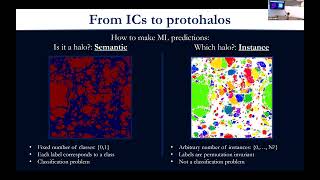
Machine Learning Applications in Cosmology - Past, Present, and Future
Explore the evolution and impact of machine learning in cosmological research, from historical applications to cutting-edge developments and future possibilities in astronomical studies.

Supermassive Black Holes - Rethinking Their Origin and Formation
Explore groundbreaking theories on supermassive black hole formation with astrophysicist Priya Natarajan, who challenges traditional collapse models and proposes direct formation from galactic matter.
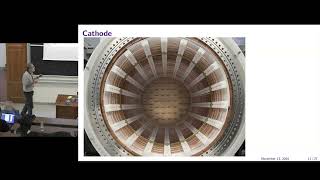
Experimental Searches with Xenon - Lecture 4
Dive into advanced experimental physics techniques and methodologies for conducting searches using Xenon, exploring key principles and applications in particle detection.
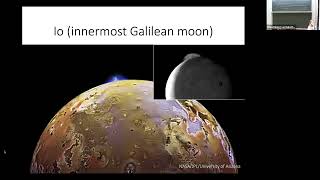
Tidal Sculpting of Short-Period Exoplanets
Explore how tidal forces shape short-period exoplanets, their orbital patterns, and interior structures, with insights from JWST observations and explanations for demographic mysteries in planetary systems.
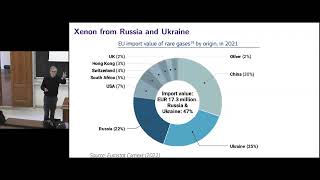
Experimental Searches with Xenon - Lecture 1 Part 2
Dive into advanced experimental techniques and methodologies for conducting searches using Xenon, exploring key principles and applications in particle physics research.
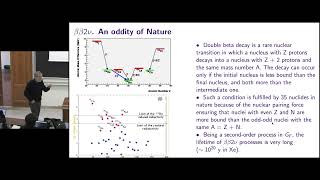
Experimental Searches with Xenon - Lecture 1
Dive into experimental particle physics research using Xenon, exploring detection methods, properties, and applications in modern physics experiments.