
Eclipse 2017 - Scientific Data Collection and Initial Results
Scientists share initial results from diverse studies conducted during the 2017 North American eclipse, covering solar physics, Earth science, and space biology using ground-based telescopes, high-altitude balloons, aircraft, and satellites.
Disaster Resilience and Cosmic Exploration - Keynote Lectures
Renowned scientists Lucy Jones and Takaaki Kajita discuss disaster resilience, science communication, and cosmic exploration through neutrinos, gravitational waves, and gamma rays.
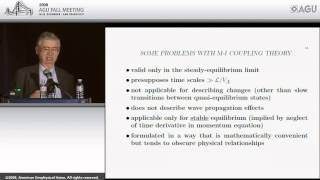
Understanding the Magnetosphere: The Counter-intuitive Simplicity of Cosmic Electrodynamics
Explore cosmic electrodynamics and the magnetosphere's counter-intuitive simplicity. Gain insights into energy transfer, coupling theory, and the interplay between classical and quantum physics in space.
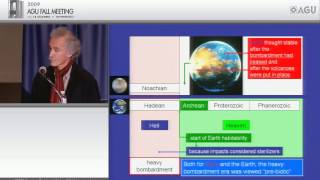
Mars Exploration: Bridging Our Past and Future
Explore Mars's geological history and its potential for hosting life through cutting-edge space missions and scientific discoveries, bridging our understanding of the Red Planet's past and future.
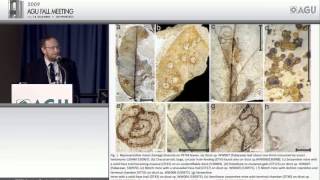
The Biggest Control Knob: Carbon Dioxide in Earth's Climate History
Explore Earth's climate history and CO2's pivotal role as the primary climate regulator, from ancient ice ages to modern global changes, with insights from geological evidence and ice cores.
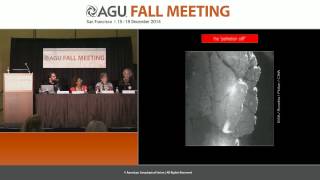
Rosetta Comet Science Results - Fall Meeting 2014
Explore groundbreaking findings from the Rosetta mission's comet encounter, including surface composition, structure, and atmospheric interactions, presented by leading space scientists.
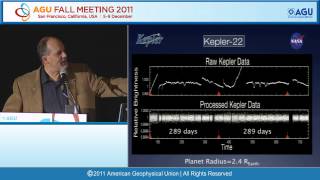
Radii, Masses, Densities, and Occurrence for Planets Within 0.25 AU - Sagan Lecture
Explore planetary characteristics and occurrence rates for exoplanets within 0.25 AU, focusing on radii, masses, and densities in this insightful lecture by Geoffrey W. Marcy.
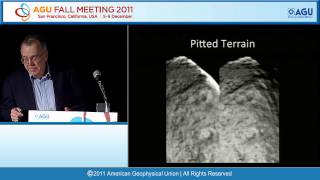
The Complex Evolution of Comet Nuclei - Evidence from Deep Impact and Stardust-NExT
Explore the complex evolution of comet nuclei through evidence from Deep Impact and Stardust-NExT missions. Gain insights into comet composition, structure, and geological processes.

Black Hole Formation Explained by Prize-Winning Astrophysicist Steven Balbus
Renowned astrophysicist Steven Balbus discusses his award-winning work on black hole formation, focusing on accretion disks and magnetic fields. Includes insights into his career and quick-fire questions on mathematics.

String Theory, Quantum Gravity and Black Holes - Are We Holograms?
Explore cutting-edge physics with Brian Greene and Juan Maldacena, delving into string theory, quantum gravity, black holes, and the holographic principle. Uncover fascinating connections in modern theoretical physics.

What is a White Hole? - Exploring Black Holes and Quantum Gravity
Explore the mysteries of black holes and white holes with physicist Carlo Rovelli, delving into quantum gravity, loop theory, and the frontiers of physics in this mind-expanding journey through space-time.

From Black Holes to Quantum Computing
Explore the fascinating connection between black holes and quantum computing, uncovering how these cosmic phenomena could revolutionize our understanding of information processing and error correction.

The Ghost Particle: Searching for the Mysterious Neutrino
Explore the elusive neutrino's history, detection challenges, and potential to unlock cosmic mysteries. Discover its role in astronomy, dark matter research, and understanding the Universe's origin.
Building New Tools for Gravitational Wave Astronomy
Explore cutting-edge techniques and innovations in gravitational wave detection with experts, enhancing our understanding of cosmic phenomena and astrophysical events.
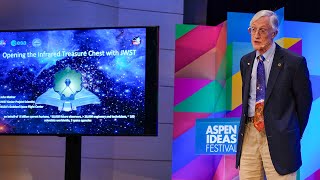
Opening the Infrared Treasure Chest - Images from the James Webb Space Telescope
Explore groundbreaking discoveries from the James Webb Space Telescope, revealing cosmic history from the Big Bang to present-day star formation, with unexpected findings that challenge NASA's predictions.
Secrets Revealed by the Webb Telescope - Looking at Ourselves from the Beginning of Time
Explore the universe's origins with the James Webb Space Telescope. Dr. Bullock discusses its groundbreaking capabilities to observe early stars, galaxies, and nearby planet formation, offering unique insights into our cosmic history.
Coronal Mass Ejections and Solar Gamma-ray Emission
Explore sustained gamma-ray emission from the Sun, its detection methods, and connection to solar phenomena like coronal mass ejections, solar flares, and energetic particle events.
The Spins of Binary Black Holes Following LIGO and Virgo's Third Observing Run
Explore binary black hole spins after LIGO and Virgo's third observing run, featuring insights from MIT experts on gravitational wave detections and their implications for astrophysics.
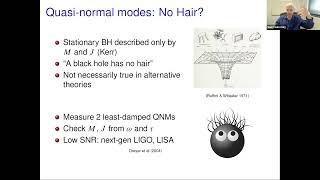
Nonlinearities in Black-Hole Ringdowns
Explore nonlinearities in black-hole ringdowns with experts Keefe Mitman and Saul Teukolsy, delving into advanced concepts in gravitational physics and astrophysics.
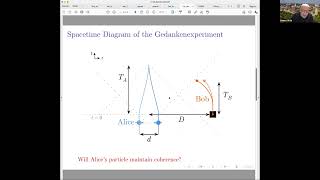
Black Holes are Watching You
Explore the intriguing world of black holes with experts Prof. Bob Wald and Dr. Gautam Satishchandran as they delve into cutting-edge research and theories in astrophysics.
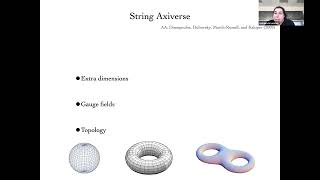
Searching for Ultralight Particles with Black Hole Superradiance - DGRAV Seminar Series
Explore ultralight particle detection using black hole superradiance with experts Arvanitaki and Baryakhtar. Gain insights into cutting-edge astrophysical research and its implications for particle physics.