Machine Learning and Gravitational Wave Detectors
Explore machine learning applications in gravitational wave detector science, focusing on noise subtraction and advanced control systems to enhance sensitivity and robustness in astrophysical research.
Computational Challenges in Gravitational Wave Parameter Estimation - IPAM at UCLA
Explore computational challenges in gravitational wave parameter estimation, including novel techniques and future requirements for analyzing compact binary signals in astrophysics.
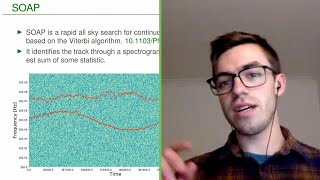
Rapidly Searching for Continuous Gravitational Waves
Explore challenges and solutions in detecting continuous gravitational waves from neutron stars, focusing on SOAP's rapid search method using neural networks for signal identification and parameter estimation.

Machine Learning in Low-Latency Electromagnetic Counterpart Inference
Explore machine learning applications in electromagnetic counterpart inference from gravitational waves, focusing on low-latency data products for efficient follow-up of gravitational wave candidates.
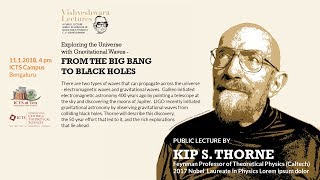
Exploring the Universe with Gravitational Waves - From the Big Bang to Black Holes
Nobel laureate Kip Thorne explores gravitational waves, from their detection by LIGO to their potential for unveiling cosmic mysteries like black holes and the birth of the universe.
Gravitational Waves from Neutron Stars - Lecture 1
Explore gravitational waves from neutron stars, covering detection methods, signal analysis, radiation mechanisms, and fluid dynamics in astrophysical contexts.
Tides in Binary Star Systems - Lecture 1
Explore gravitational waves, tides in binary star systems, and multipole moments in this advanced lecture on theoretical astrophysics and gravitational-wave astronomy.
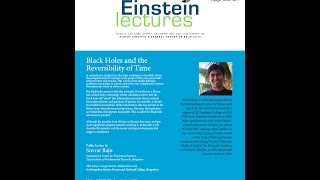
Black Holes and the Reversibility of Time by Suvrat Raju
Explore the black hole information paradox and recent developments in resolving it, examining the conflict between time reversibility in physics and the apparent loss of information in black holes.
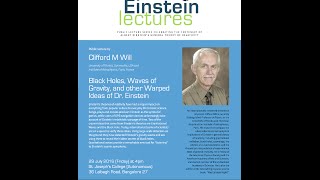
Black Holes, Waves of Gravity, and Other Warped Ideas of Dr. Einstein
Explore Einstein's revolutionary theories, including black holes and gravitational waves, and their impact on science and culture. Learn about recent breakthroughs in detecting cosmic phenomena using advanced technology.
What Happens When Black Holes Collide - Expert Answers on Gravitational Waves
Explore the fascinating world of gravitational waves, black hole collisions, and the stretching of spacetime. Gain insights into cutting-edge physics research and its implications for our understanding of the universe.
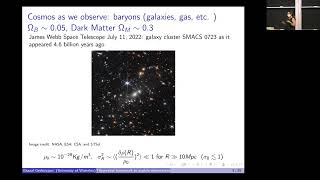
Introduction to Cosmological Perturbation Theory
Explore the foundations of cosmological perturbation theory, examining how small fluctuations in the early universe evolved into large-scale structures we observe today.

The Inexplicable Universe - Exploring Cosmic Mysteries
Explore the universe's mysteries with Neil deGrasse Tyson, from quarks to galaxies. Discover modern scientific approaches to cosmic enigmas and potential future breakthroughs in astronomy and physics.
Cosmology - DM Halo - Local Group - Risa Wechsler (Stanford)
Explore cosmology, dark matter halos, and the local group with Stanford researcher Risa Wechsler. Gain insights into cutting-edge astrophysical concepts and their implications for our understanding of the universe.
Modeling Dwarf Galaxy Formation with UniverseMachine - Richie Wang (Stanford)
Explore dwarf galaxy formation using UniverseMachine, a statistical tool for modeling galaxy evolution in cosmological simulations. Learn about abundance matching, multiresolution simulations, and future research directions.
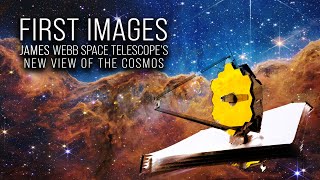
First Images - James Webb Space Telescope's New View of the Cosmos
Explore the groundbreaking first images from the James Webb Space Telescope with Nobel laureate John Mather and leading scientists, discussing their impact on our understanding of the universe's origins and evolution.

Black Holes - Seeing the Unseeable
Explore groundbreaking observations of black holes with Brian Greene and Shep Doeleman, discussing the Event Horizon Telescope's achievements and the first image of our galaxy's supermassive black hole.
The Future of Cosmology - Space Telescopes and Cosmic Understanding
Nobel laureate Saul Perlmutter and Brian Greene explore revolutionary space telescopes and their potential impact on our understanding of the cosmos in this engaging scientific discussion.
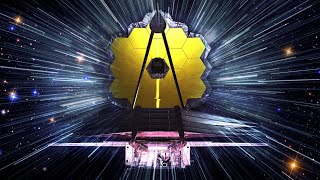
Things We've Never Seen - The James Webb Space Telescope Explores the Cosmos
Explore the universe's mysteries with leading scientists as they discuss the James Webb Space Telescope's potential to revolutionize our understanding of cosmic origins, planet formation, and the search for extraterrestrial life.
Illuminating Black Holes - Understanding Spacetime and Quantum Information Theory
Explore spacetime, black holes, and quantum information theory with physicist Veronika Hubeny. Delve into gauge/gravity duality to uncover the fundamental nature of our universe.
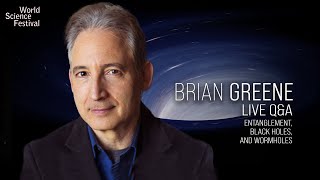
Entanglement, Black Holes, and Wormholes - An Informal Discussion
Explore groundbreaking advances in black hole physics, quantum entanglement, and wormholes with renowned physicist Brian Greene in this engaging year-end science discussion.
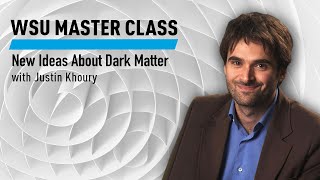
New Ideas About Dark Matter - Quantum Effects and Non-Newtonian Gravity
Explore quantum effects in dark matter and their potential impact on galactic structure with physicist Justin Khoury, offering new perspectives on the universe's formation.