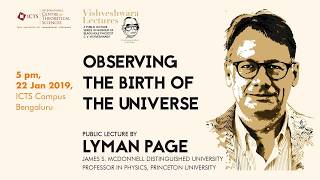
Observing the Birth of the Universe by Lyman Page
Explore the cosmic microwave background, its measurement techniques, and implications for understanding the early universe and gravitational waves in this comprehensive lecture by a Princeton physicist.
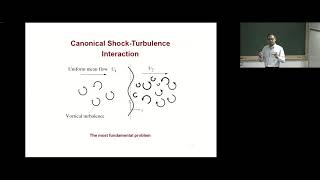
Shock Waves and Turbulence - Physical Modeling, Numerical Challenges
Explore shock waves and turbulence in high-speed flows, covering physical modeling, numerical simulations, and applications in aerospace and astrophysics. Learn about shock-turbulence interactions and heat transfer.
Exotic Compact Objects and Their Gravitational-Wave Signatures - Lecture 1
Explore exotic compact objects and their gravitational-wave signatures in this advanced lecture, covering black hole history, alternatives, and potential detection methods.
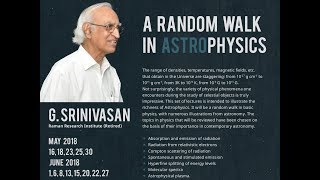
Millisecond Pulsars by Professor G Srinivasan
Explore millisecond pulsars: their discovery, evolution, properties, and significance in astrophysics. Learn about recycled pulsars, binary systems, and their role in gravitational wave detection.
Journey to the Centre of a Neutron Star by Professor G Srinivasan
Explore neutron star formation, structure, and exotic states. Dive into superfluidity, superconductivity, and their implications in these extreme cosmic objects.
Quantum Stars by Professor G Srinivasan
Explore quantum physics in astrophysics, from white dwarfs to neutron stars. Learn about Chandrasekhar's theory, supernova explosions, and the fate of massive stars in this comprehensive lecture.
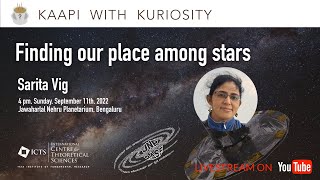
Finding Our Place Among Stars
Explore our place in the Milky Way galaxy, from star mapping techniques to the latest GAIA mission findings. Discover the structure, dynamics, and mysteries of our cosmic home.
Quantum Aspects of Black Holes - Lecture 3
Explore quantum aspects of black holes, including traversable wormholes, quantum teleportation, and the Hayden-Preskill problem. Delve into chaotic systems, random matrices, and gravity solutions for the ramp.
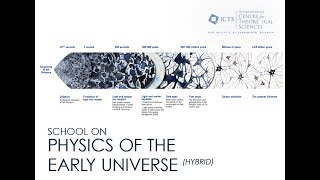
Dark Matter: Properties and Behavior in the Early Universe - Lecture 1
Comprehensive exploration of dark matter's nature, thermal history, and interactions in the early universe, examining empirical evidence and theoretical constraints to understand its properties and behavior.
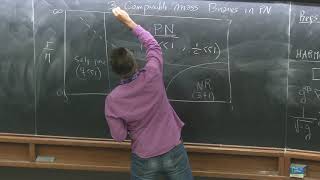
Black Holes, Binary Systems, and Gravitational Waves - Comparable-Mass Binaries
Explore comparable-mass binary systems, post-Newtonian theory, and relaxed Einstein equations in the context of gravitational waves and black hole physics.
Black Holes, Binary Systems, and Gravitational Waves - Kerr Black Hole
Explore Kerr black holes, binary systems, and gravitational waves with expert Nicolas Yunes. Delve into advanced concepts like Killing tensors and zero angular momentum observers in this comprehensive lecture.
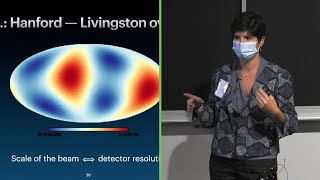
Stochastic Background Searches in GW Experiments - IPAM at UCLA
Explore stochastic gravitational wave backgrounds, their characteristics, detection methods, and future prospects in ground-based and space-borne observatories with insights from recent LVK collaboration searches.
From the Possibility to the Certainty of a Supermassive Black Hole - IPAM UCLA
Explore groundbreaking research on supermassive black holes at the galactic center, including stellar orbit measurements, unexpected environmental discoveries, and new insights into gravity's behavior near these cosmic giants.
Challenges and Options for Beyond General Relativity Explorations - IPAM at UCLA
Explore challenges in extending General Relativity, including mathematical pathologies and potential solutions, with insights on computational approaches in multi-messenger astrophysics.
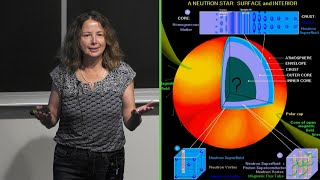
Realistic Binary Neutron Stars Collisions Simulations - Challenges and Opportunities
Explore challenges and opportunities in simulating binary neutron star collisions, focusing on realistic models, electromagnetic counterparts, and remnant properties using open-source codes and parametrized equations of state.
Merging Black Hole Binaries - Accretion Dynamics and Outflows
Explore accretion dynamics and outflows in merging black hole binaries, covering simulations, evolution, and multimessenger astronomy implications.
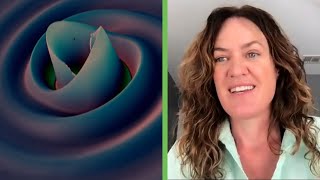
Numerical Relativity and the Next Generation of Gravitational Wave Detections
Explore numerical relativity's role in gravitational wave astronomy, its impact on understanding gravity, and future challenges as detectors improve. Insights into computational and data hurdles in this evolving field.
Computational Challenges with Modeling Core Collapse Supernovae - IPAM at UCLA
Explore computational challenges in modeling core collapse supernovae and gravitational wave emission, covering recent progress, physics requirements, and future directions in multi-dimensional simulations.
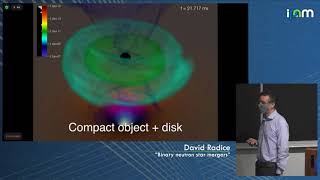
Binary Neutron Star Mergers - IPAM at UCLA
Explore neutron star mergers, their multimessenger emissions, and implications for astrophysics. Gain insights into recent simulations, future challenges, and prospects in this cutting-edge field.
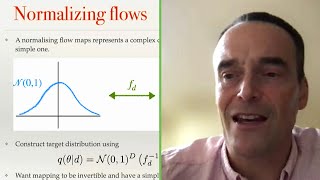
Rapid and Robust Parameter Estimation for Gravitational Wave Observations
Explore rapid parameter estimation techniques for gravitational wave observations, focusing on machine learning approaches like DINGO that use normalizing flows to efficiently analyze data from future detectors.
Low-Latency Noise Mitigation Techniques in Gravitational-Wave Detector Data Using Auxiliary Sensor Information
Explore low-latency noise mitigation techniques in gravitational-wave detectors, focusing on automated methods to enhance sensitivity and enable rapid multi-messenger follow-up of astrophysical events.