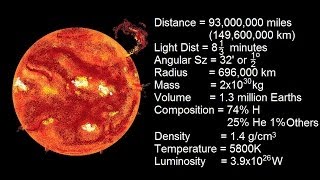
Astronomy - The Sun
Comprehensive exploration of the Sun's structure, processes, and phenomena, from its core to its atmosphere, including fusion, sunspots, and solar wind.
A Survey of Gravitational Waves
Explore gravitational waves, their detection, and implications for understanding the universe in this comprehensive survey by renowned physicist Frans Pretorius.
The Discovery of Gravitational Waves by Parameswaran Ajith
Explore the groundbreaking discovery of gravitational waves, their detection methods, and the new perspectives they offer on the universe. Learn about India's contributions to this scientific milestone.
Reflections on the History of Black Holes and Gravitational Waves by C. V. Vishveshwara
Explore the historical journey of black holes and gravitational waves in this insightful talk by C. V. Vishveshwara, part of a special event celebrating the groundbreaking discovery of gravitational waves.
Supernova Detection
Explore cutting-edge techniques for detecting supernovae in real-time, enhancing our understanding of cosmic explosions and their implications for astrophysics.
Capturing the First Portrait of Our Milky Way's Black Hole & Beyond
Explore the groundbreaking methods used to capture the first image of Sagittarius A*, our galaxy's central black hole, and future directions in black hole imaging technology.
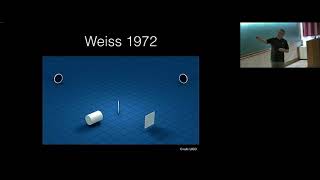
Cosmic Collisions - Learning About Black Holes and Neutron Stars Using Gravitational Waves by Patrick Brady
Explore gravitational-wave astronomy, black hole and neutron star mergers, and their implications for understanding the universe. Learn about LIGO observations, merger rates, mass distributions, and multi-messenger astronomy.
How Well Do We Know Our Universe? by Jayant Narlikar
Explore the evolution of our understanding of the universe, from ancient ideas to modern cosmology, challenging current theories and advocating for alternative perspectives in astrophysics.
The Realm of Supermassive Black Holes - Lecture 13
Explore the realm of supermassive black holes, from quasars to radio galaxies. Learn about their discovery, properties, and recent observations, including the groundbreaking image from the Event Horizon Telescope.
Universe or Multiverse? - Neutron Stars and Black Holes Lecture 14
Explore the universe's expansion, cosmic microwave background, and inflationary theories. Delve into cosmological phase transitions, gauge theories, and the concept of multiverses in this comprehensive lecture.
Neutron Stars and Black Holes - Lecture 11: Millisecond Pulsars
Explore millisecond pulsars: formation, evolution, and significance in astrophysics. Learn about their unique properties, detection methods, and role in gravitational wave research.
Neutron Stars and Black Holes - Recycled Pulsars - Lecture 10
Explore recycled pulsars, neutron star spin-up, and magnetic field evolution in binary systems. Gain insights into the Hulse-Taylor pulsar, accretion processes, and the physics of neutron star interiors.
The QCD Axion - Lecture 1
Comprehensive lecture on QCD axions, covering theoretical foundations, strong CP problem, spontaneous symmetry breaking, and axion models. Explores potential solutions to dark matter mysteries.
Introduction to Primordial Black Hole Dark Matter - Lecture 1
Explore primordial black holes as dark matter candidates, covering formation mechanisms, abundance, mass functions, and detection prospects through gravitational waves from binary mergers.
Introduction to Primordial Black Hole Dark Matter - Lecture 2
Explore primordial black holes as dark matter candidates through gravitational wave detection, microlensing, and fast radio bursts. Discover constraints, observational prospects, and implications for cosmology.
Physics and Astrophysics of Gamma-Ray Bursts - Part 1
Comprehensive exploration of gamma-ray bursts, covering discovery, observational facts, physics, and astrophysical implications. Delves into prompt emission, afterglows, and theoretical models, providing insights for researchers and students.
Numerical Relativity - Mathematical Formulation by Harald Pfeiffer
Explore mathematical formulation of numerical relativity, focusing on simulating binary black hole coalescence, gravitational waves, and advanced computational techniques in astrophysics.
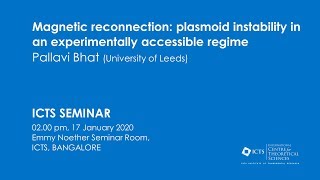
Magnetic Reconnection - Plasmoid Instability in an Experimentally Accessible Regime by Pallavi Bhat
Explore magnetic reconnection and plasmoid instability in the semi-collisional regime, with theoretical and numerical investigations validating its existence at lower, experimentally accessible Lundquist numbers.
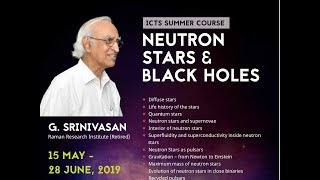
Maximum Mass of Neutron Stars - Lecture 8
Explore the physics of neutron stars, including their maximum mass, equation of state, and exotic internal states. Delve into key concepts like Fermi gas, Bose-Einstein condensation, and gravitational implosion.
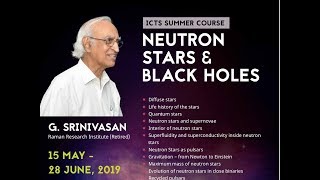
Supernovae and Neutron Stars - Lecture 3
Explore the formation and evolution of neutron stars, supernovae, and their remnants. Delve into stellar physics, cosmic rays, and the violent interstellar medium in this comprehensive lecture.
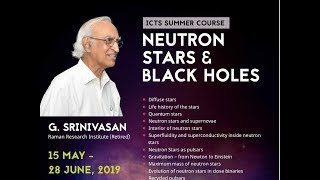
Neutron Stars and Black Holes - Lecture 6: Pulsars and Their Properties
Explore pulsars, neutron stars, and their remarkable properties. Delve into the Crab Nebula's history, pulsar discovery, and radiation mechanisms. Gain insights into magnetospheres and electrodynamics of these fascinating cosmic objects.