
The Beginning of Our Universe - The Big Bang and the Theory of Everything
Explore the Big Bang theory, cosmic inflation, and the universe's evolution with a Fermilab scientist. Delve into epochs of early universe formation and discover how expansion continues to shape our cosmos today.

The Multiverse, Science or Science Fiction? - Sean Carroll
Explore the scientific validity of multiverse theory with Sean Carroll, examining concepts like vacuum energy, eternal inflation, and string theory, while addressing challenges and future directions in this fascinating field.
Is Dark Matter Real? - With Sabine Hossenfelder
Physicist Sabine Hossenfelder explores evidence for dark matter, proposing a superfluid theory that combines dark matter with modified general relativity to explain cosmic observations.
How Easy Is It to Grow a Supermassive Black Hole? - With Dr Becky
Explore the fascinating growth of supermassive black holes with Dr Becky Smethurst. Discover the challenges, mechanisms, and limits of their expansion in this engaging astrophysics lecture.
The End of Everything - With Katie Mack
Explore cosmic endings with astrophysicist Katie Mack, delving into quantum mechanics, cosmology, and string theory to uncover potential fates of our universe based on current scientific understanding.
Low-Energy Interface of Quantum and Gravity - Igor Pikovski
Exploring the interface between quantum mechanics and gravity through novel experiments, focusing on atomic clocks, interferometry, and quantum effects in gravitational fields.
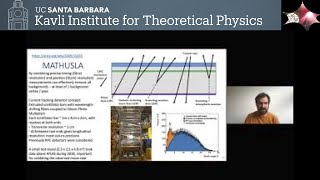
Far Detectors at the LHC - Jamie Boyd
Explores novel experiments for fundamental physics, focusing on far detectors at the LHC. Covers topics like dark matter, axions, and weak short-range forces, discussing opportunities and challenges in experimental physics.
Novel Experiments for Fundamental Physics - General Discussion - KITP Conference Participants
Explore cutting-edge experiments in fundamental physics, including dark matter, axions, and gravitational waves. Discuss theoretical interpretations and potential advancements using cold atoms and interferometric techniques.
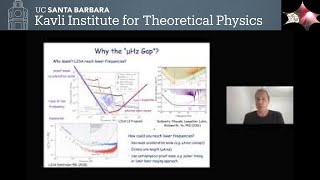
Gravitational Waves and New Physics - Peter Graham
Exploring gravitational waves and new physics through novel experiments, focusing on atomic clocks, pulsar timing, and asteroids to detect weak signals and test fundamental physics theories.
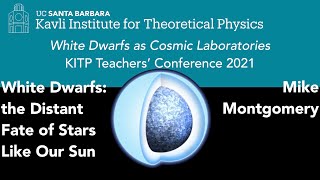
White Dwarfs - The Distant Fate of Stars Like Our Sun - Mike Montgomery
Explore white dwarfs' role in astrophysics, from exoplanets to supernovae. Learn about recent discoveries, cooling processes, and their importance in understanding the Universe's expansion.
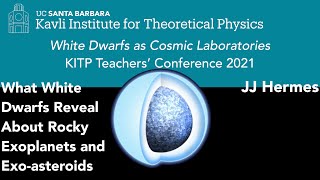
What White Dwarfs Reveal About Rocky Exoplanets and Exo-asteroids - JJ Hermes
Explore white dwarfs as cosmic laboratories, revealing insights into exoplanets, stellar evolution, and the composition of rocky bodies in the universe. Learn about recent discoveries and their implications for astrophysics.
Characterizing the Galactic Double White Dwarf Population - Na'ama Hallakoun, Valeriya Korol
Explore the Galactic double white dwarf population through astrometric, photometric, and spectroscopic data, discussing implications for stellar evolution, gravitational waves, and supernovae.
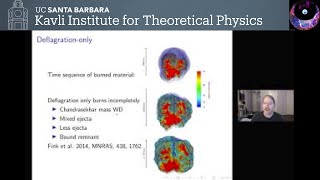
The Makings of Models for White Dwarf Supernovae - Dean Townsley
Explore the physics of white dwarf supernovae models, including detonation, deflagration, and double detonation mechanisms, with insights on their implications for astrophysics and future research directions.
The Detection of Lithium in Cool White Dwarf Atmospheres - Ben Kaiser, Mark Hollands - White Dwarfs
Explore lithium detection in cool white dwarf atmospheres, examining model atmospheres, infrared photometry, and abundances to advance understanding of stellar remnants and galactic evolution.

Our Incredible Sun - Wondrium Perspectives
Explore the Sun's incredible features, from its composition and fusion processes to solar phenomena like flares and eclipses, with insights from experts on its role in our solar system and beyond.

The Life and Death of Stars - White Dwarfs, Supernovae, Neutron Stars, and Black Holes
Explore the fascinating journey of stars, from birth to spectacular death, including white dwarfs, supernovae, neutron stars, and black holes. Uncover the mysteries of stellar evolution and remnants.

Cosmology - A Big Bang and the Beginning of the Universe
Explore the origins and development of the universe through cosmology. Learn about the Big Bang theory and current astronomical knowledge on the universe's beginnings and evolution.
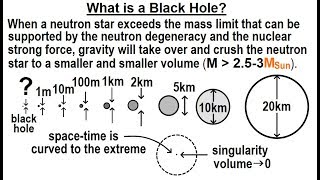
Astronomy - Black Holes
Explore the mysteries of black holes, from their basic properties to supermassive ones in galaxies. Learn about event horizons, photon spheres, and how we detect these cosmic enigmas.
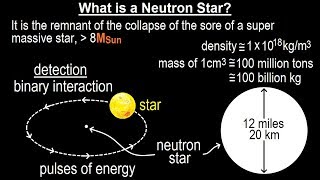
Astronomy - Neutron Stars & Pulsars
Explore neutron stars and pulsars, covering their formation, structure, properties, and behavior. Learn about key concepts like neutron degeneracy, quark pressure, and synchrotron radiation in pulsars.
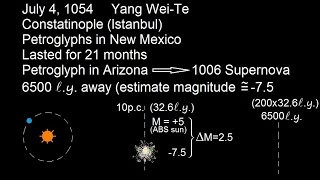
Astronomy - Supernova: The Death of Stars
Explore the fascinating world of supernovas, from historical observations to types and mechanisms. Learn about white dwarfs, electron degeneracy, and how supernovas help measure cosmic distances.
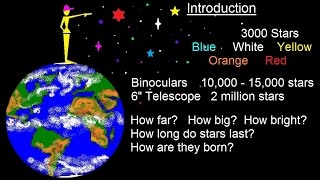
Astronomy - Stars and the H-R Diagram
Comprehensive exploration of stellar properties, classification, and measurement techniques, covering magnitude, luminosity, temperature, and mass-luminosity relationships in astronomy.