Tools for Mobile Photography and Computer Vision
Explore computational photography and computer vision for mobile devices, covering NVIDIA's research, hardware developments, and software tools like OpenCV and FCam for innovative mobile applications.
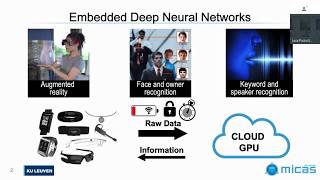
From Small to Tiny: Co-designing ML Models, Computational Precision, and Circuits - Energy-Accuracy Trade-offs
Explore co-designing ML models, computational precision, and circuits for energy-efficient tinyML systems. Learn about cross-layer optimization and cascaded networks for embedded applications.
Visual AI in Milliwatts - A Grand Challenge and Massive Opportunity
Explore visual AI's potential in low-power devices, discussing challenges, opportunities, and applications in security cameras and beyond. Learn about deep learning, processors, and algorithms driving this technology.

Ultra-Low-Power Command Recognition for Ubiquitous Devices
Explore ultra-low-power command recognition for ubiquitous devices, covering noise challenges, system goals, core functions, training, and implementation on tiny hardware.
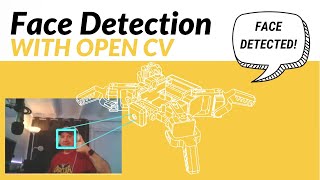
Face Detection Using OpenCV Using a Raspberry Pi Zero
Learn face detection with OpenCV on Raspberry Pi Zero. Covers installation, object detection basics, neural networks, and practical implementation using Python. Includes live demo and next steps.

Build Your Own AI Assistant - Object Classification with Python
Learn to build an AI assistant using Python, TensorFlow, and Google Colab for object classification. Covers neural networks, image processing, and hands-on demos for practical implementation.

Build Your Own AI Assistant - Creating a Voice-Activated System
Learn to create your own AI assistant using Python and Raspberry Pi. Covers architecture, hardware/software setup, and implementation of key features like speech recognition and natural language processing.
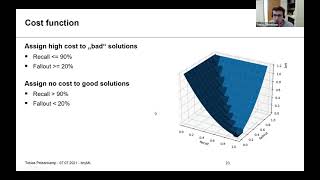
Analysis of ECG Data by Energy Efficient Decision Trees on a Reconfigurable ASIC
Innovative approach using decision tree ensembles for energy-efficient ECG analysis, achieving high accuracy in detecting atrial fibrillation with minimal energy consumption.
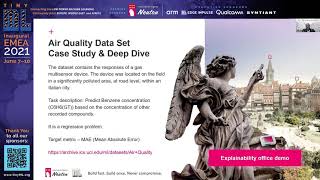
Avoiding Loss of Quality in Tiny Models - Neuton.ai Partner Session
Explore compact AI models without sacrificing quality. Learn to assess model quality, understand decision-making logic, evaluate training data, and interpret model outputs for tinyML applications.
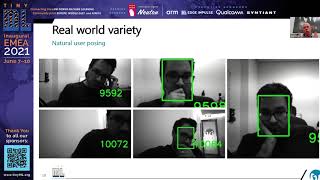
TinyML Journey - From Face Detection Demo to Real-Life Commercial Deployment
Explore the journey of TinyML from face detection demos to large-scale commercial deployment in notebooks, addressing real-world challenges and bridging the gap between technology and business.
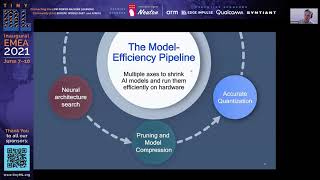
The Model Efficiency Pipeline: Enabling Deep Learning Inference at the Edge
Explore optimizing deep learning for edge devices through model efficiency techniques, including neural architecture search, pruning, quantization, and conditional processing.
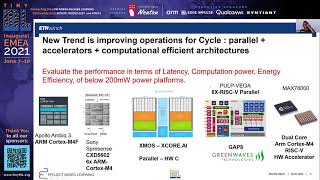
A Battery-Free Long-Range Wireless Smart Camera for Face Detection
Explore battery-free wireless smart cameras for face detection using edge AI and low-power microcontrollers. Learn about energy harvesting, tiny ML algorithms, and novel hardware architectures for IoT devices.
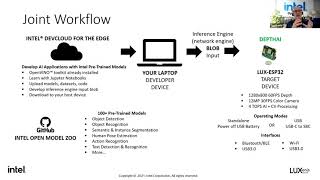
tinyML Vision Challenge - Intel-Luxonis DepthAI Platform Overview
Explore Intel and Luxonis' DepthAI platform for advanced vision solutions. Learn about AI inference, OpenVINO toolkit, and developing spatial edge applications using the LUX-ESP32 device.
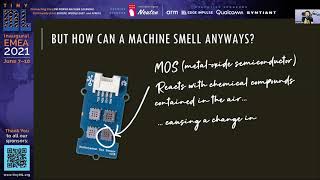
Lessons Learned from Building a TinyML-Powered Artificial Nose
Explore building a TinyML-powered artificial nose, from concept to implementation. Learn about hardware, sensors, models, and integrating TinyML applications into IoT ecosystems.
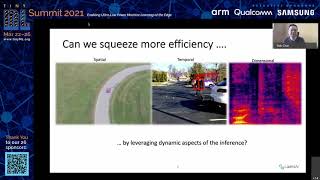
Adaptive Neural Networks for Agile TinyML - Keynote
Explore adaptive neural networks for efficient tinyML, enabling dynamic footprint minimization and runtime flexibility. Learn about throttleable networks, controller training, and hardware acceleration.
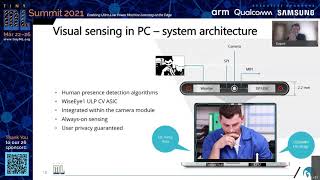
TinyML Journey: From Face Detection Demo to Real-Life Commercial Deployment
Exploring the journey from tinyML face detection demos to large-scale commercial deployment, addressing real-world challenges and bridging the gap between prototypes and practical applications.
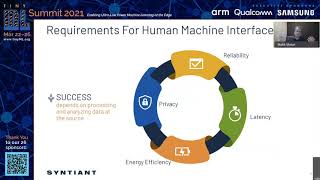
tinyML: Impact and Growth of Always-On Devices
Explore the growing impact of tinyML devices in everyday life, from always-on voice in phones to environmental sensing in machines, and learn about the market's rapid expansion and technological requirements.
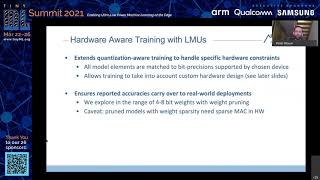
Hardware Aware Training for Efficient Keyword Spotting - tinyML Research Symposium 2021
Explore hardware-aware training for efficient keyword spotting, focusing on Legendre Memory Unit networks to achieve state-of-the-art accuracy and power efficiency on various hardware platforms.
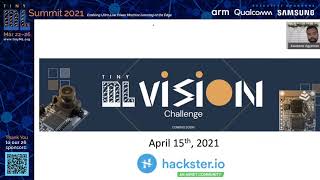
TinyML Vision Challenge - Summit 2021
Discover the tinyML Vision Challenge: Create innovative computer vision applications using tinyML, compete for $6k in prizes, and gain recognition from the tinyML Foundation.
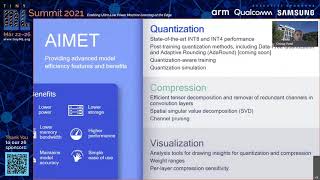
Advanced Network Quantization and Compression Using AIMET - tinyML Summit 2021
Explore advanced network quantization and compression techniques using AIMET to optimize AI models for efficient deployment on end devices, addressing memory, compute, and energy constraints.
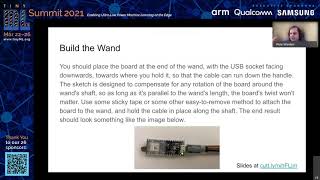
Building a Magic Wand with TensorFlow Lite Micro - Tutorial
Learn to build an IMU-based gesture recognition model for Arduino, covering data gathering, training, and deployment using TensorFlow Lite Micro and CMSIS-NN library.