
Cohere vs. OpenAI Embeddings - Multilingual Search
Explore multilingual semantic search using Cohere's new model, comparing it with OpenAI's GPT 3.5. Learn implementation, data preparation, vector indexing, and query techniques for enhanced search capabilities.

Powering the Next Generation of IoT with Embedded Machine Learning
Unlock IoT potential with Edge Impulse machine learning and Nordic's low-power wireless solutions. Learn to create motion detection, sound recognition, and image classification on edge devices using nRF52840 and nRF5340 kits.

Constraining 3D Fields for Reconstruction and View Synthesis
Explore advanced techniques in 3D field reconstruction and view synthesis, covering RegNeRF, MonoSDF, and TensoRF for improved neural rendering and geometric representation in computer vision.

AI at the Edge - Enabling Vision for Low-Power Devices
Explore AI's shift to edge devices, focusing on building efficient computer vision algorithms for battery-powered devices. Learn about data collection, continuous learning, and optimization techniques.

Accelerate Edge Compute with Syntiant's TinyML Platform
Explore Syntiant's TinyML platform for efficient edge AI in battery-powered devices, featuring Neural Decision Processors for enhanced processing and power efficiency compared to MCUs.

De-risking Embedded Machine Learning Projects Using Novel Technologies
Explore novel technologies for successful embedded machine learning projects, addressing challenges and ensuring customer success through innovative design and engineering philosophies.
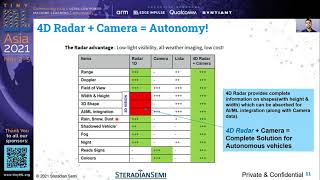
Imaging Radars - Learning for Enhanced Vision in Modern Radar Systems
Explore imaging radars and machine learning for enhanced object classification in traffic enforcement and autonomous driving applications using millimeter-wave technology.

Efficient On-Device Deep Learning: Challenges and Opportunities
Explore efficient on-device deep learning, focusing on affordable AI models for edge devices and maximizing inference performance using heterogeneous computing resources.
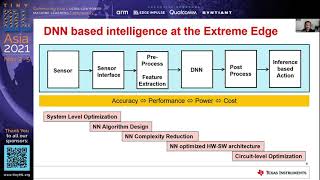
Machine Learning at the Extreme Edge of Always-on Intelligent Sensor Networks
Explore ML optimization techniques for resource-constrained IoT sensor nodes, focusing on system, algorithm, architecture, and circuit levels to achieve significant area-power improvements.

TinyML for Good: Ready to Take Off for a Big Impact
Explore tinyML's potential for positive impact through expert insights on vision, value, device recommendations, education, and involvement opportunities.
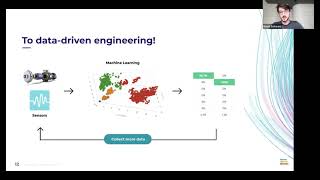
AutoML + TinyML with Edge Impulse's EON Tuner
Explore AutoML for TinyML with Edge Impulse's EON Tuner. Learn how to optimize embedded machine learning models within device constraints for innovative applications.
TinyML Talks Morocco - Enabling Ultra-Low Power Always-On Computer Vision at Qualcomm
Exploring ultra-low power computer vision for TinyML applications, focusing on Qualcomm's innovations in sensors, hardware, and algorithms to enable always-on vision at 1mW power consumption.
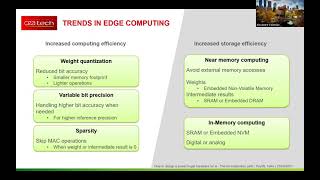
TinyML Talks France - How to Design a Power Frugal Hardware for AI - The Bio-Inspiration Path
Explore bio-inspired hardware design for energy-efficient AI, focusing on spiking neural networks and novel technologies to enhance data locality and power efficiency in embedded systems.

Stable Diffusion DreamBooth Guide - Optimal Classification Images Count Comparison Test
Comprehensive guide on optimizing DreamBooth training in Automatic1111, comparing classification image counts for best results in AI image generation and fine-tuning.

Machine Learning and Earth System Modeling - From Parameter Calibration to Feature Detection
Explore machine learning applications in Earth system modeling, from parameter calibration to feature detection, enhancing climate predictions and understanding of complex environmental processes.
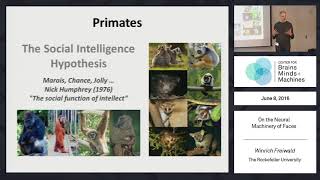
On the Neural Machinery of Faces
Explore the neural mechanisms behind face recognition, from visual processing to specialized face-selective cells, and their role in primate social cognition and intelligence.
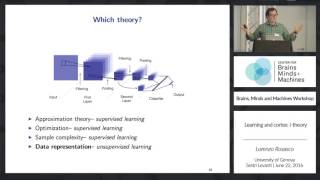
Learning & Cortex - I-Theory
Explore principles of data representation, invariance, and selectivity in deep neural networks, focusing on convolutional architectures and their theoretical foundations.

Filters and Other Potions for Early Vision and Recognition
Explore early vision and recognition techniques, including filters, deep networks, and multiscale processing. Learn about spacetime oriented filters and tensor factorization for improved visual analysis.

Compositional Models - Complexity of Representation and Interference
Explore compositional models, their representation complexity, and interference effects. Delve into data-driven approaches, feedforward/feedback mechanisms, and hierarchical structures in generative modeling.
Transformations in Early Vision from a Symmetry Argument
Explore visual processing, machine vision, and V1 computations, delving into pinwheels, transfer functions, and edge detection filters in early vision transformations.
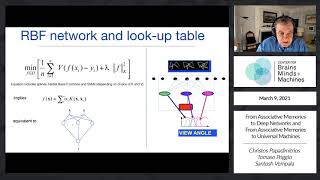
From Associative Memories to Deep Networks and From Associative Memories to Universal Machines
Explore the evolution from associative memories to deep networks and universal machines, discussing their similarities, limitations, and potential for understanding human intelligence.