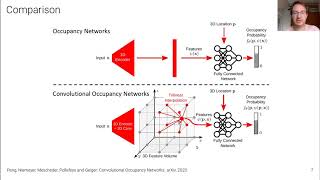
Implicit Neural Representations: From Objects to 3D Scenes
Explore advanced 3D reconstruction techniques using neural representations, from single objects to large-scale scenes. Learn about convolutional occupancy networks, object appearance modeling, and material estimation.
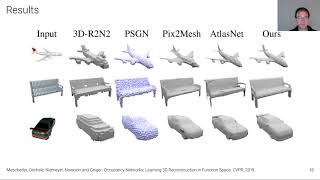
Learning 3D Reconstruction in Function Space - Long Version
Explore neural implicit 3D representations for geometry, texture, and motion reconstruction. Learn innovative techniques for modeling complex 3D shapes using continuous function spaces and 2D supervision.
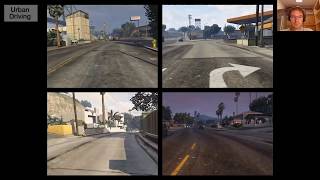
Label Efficient Visual Abstractions for Autonomous Driving
Explore efficient visual abstractions for autonomous driving, analyzing segmentation-based modalities and their impact on driving performance in CARLA simulator. Gain insights on label-efficient approaches.
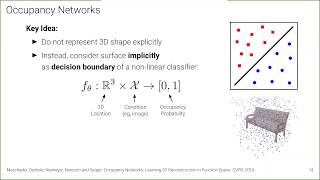
Learning 3D Reconstruction in Function Space
Explore neural implicit models for 3D reconstruction, covering occupancy networks, texture fields, and differentiable rendering. Gain insights into cutting-edge techniques and recent advancements in the field.
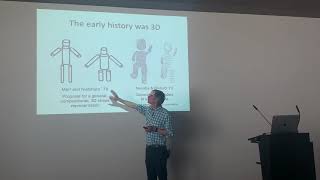
Estimating Human Motion: Past, Present, and Future
Explore the evolution of human motion estimation techniques, from early computer vision approaches to modern 3D body modeling, with insights on challenges and future directions.
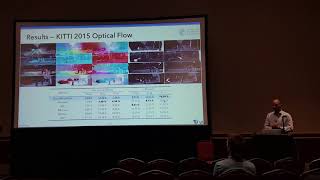
Stefan Roth: Robust Scene Analysis
Explore robust scene analysis techniques, focusing on optical flow estimation, motion segmentation, and uncertainty in computer vision tasks. Learn about challenges, objectives, and innovative approaches.
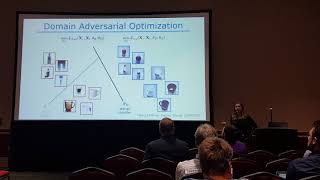
Making Our Models Robust to Changing Visual Environments
Explore techniques for making machine learning models robust to changing visual environments, covering domain adaptation, adversarial optimization, and continuous learning strategies.
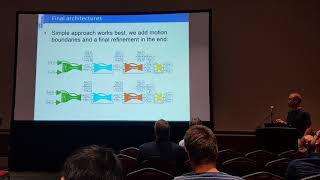
ROB 2018 - Eddy Ilg- Occlusions, Motion and Depth Boundaries with a Generic Network
Explore cutting-edge techniques in computer vision, focusing on occlusions, motion, and depth boundaries using a generic network architecture for improved multiview stereo results.
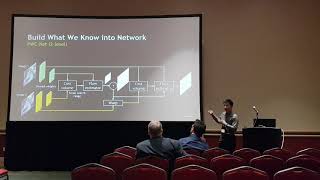
Deqing Sun- PWC Net- CNNs for Optical Flow Using Pyramid, Warping, and Cost Volume
Explore PWC-Net, a CNN-based optical flow algorithm using pyramid processing, warping, and cost volume. Learn its principles, advantages, and limitations for robust motion estimation.
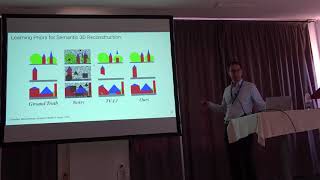
DALI 2018 - Andreas Geiger: How to Satisfy the Thirst for Data
Explore innovative approaches to address data scarcity in computer vision, including specialized architectures, soft constraints, self-supervision, and label transfer techniques.

EfficientDet - Scalable and Efficient Object Detection
Explore EfficientDet, a scalable object detection model that improves accuracy and efficiency through innovative techniques like BiFPN and compound scaling.
StyleGAN Explained
Comprehensive exploration of StyleGAN architecture, detailing its innovations over traditional GANs. Covers mapping networks, style control, and noise injection for high-quality image generation.

What Are GANs - Generative Adversarial Networks Explained
Explore generative adversarial networks (GANs), their working principles, training phases, and applications in AI and deep learning. Learn how GANs generate realistic data through generator-discriminator competition.
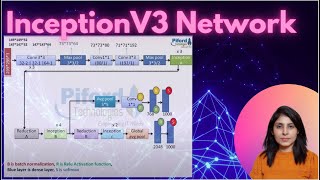
InceptionV3 - Inception Network
Detailed exploration of InceptionV3 architecture, covering its improvements over previous versions, including factorized convolutions, RMSProp optimizer, and label smoothing for enhanced CNN performance.
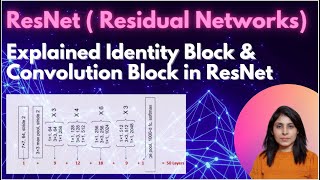
Explained Identity Block and Convolution Block in ResNet - Residual Networks
Practical explanation of identity and convolutional blocks in ResNet, including line-by-line code breakdown and discussion of residual concepts in deep learning architectures.
Face Detection with OpenCV
Learn face detection using OpenCV and Python on Raspberry Pi Zero. Explore object detection, AI, neural networks, and computer vision fundamentals. Practical implementation and insights provided.
Supercharge Your Vision AI Business with NVIDIA Metropolis
Discover how NVIDIA Metropolis can enhance your Vision AI business through improved performance, streamlined deployments, enterprise readiness, and access to GPU infrastructure and business support.
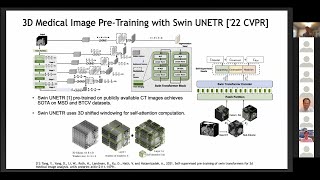
Modern Medical Image Segmentation, AutoML, and Beyond
Explore advanced medical image segmentation techniques, including AutoML and deep learning, for improved disease understanding and clinical diagnosis.

Getting Started with Caffe - Deep Learning Framework Introduction - Class 3
Learn to define, train, and deploy Deep Neural Networks using Caffe framework. Covers data management, network definition, training monitoring, and deployment for classification or feature extraction.
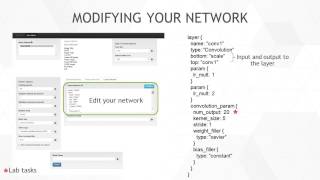
NVIDIA Deep Learning: Getting Started with DIGITS - Class 2
Learn to create, test, and optimize deep neural networks using NVIDIA's DIGITS tool for image classification tasks, with hands-on examples and practical deployment strategies.
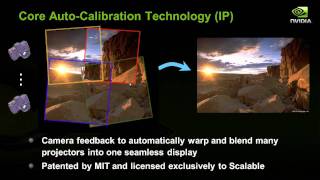
Using the GPU to Create a Seamless Display from Multiple Projectors - SIGGRAPH 2011
Explore GPU-based techniques for creating seamless multi-projector displays, covering warp blending, SLI Mosaic, and Nvidia's API for scalable desktop and command systems.