
Deep Residual Learning for Image Recognition - Paper Explained
Explore deep residual learning for image recognition, covering the problem of depth, residual connections, and their impact on neural network performance in computer vision tasks.
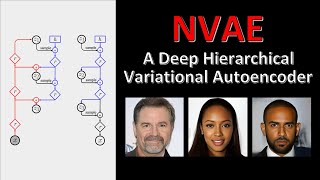
NVAE- A Deep Hierarchical Variational Autoencoder
Detailed explanation of NVAE, a deep hierarchical variational autoencoder for high-resolution image generation, covering architecture, training techniques, and state-of-the-art results.
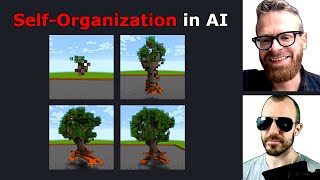
The Future of AI Is Self-Organizing and Self-Assembling - With Prof. Sebastian Risi
Explore self-organizing AI systems, swarm intelligence, and neural cellular automata with Prof. Sebastian Risi. Discover applications, challenges, and future directions in this emerging field of artificial intelligence.

A Path Towards Autonomous Machine Intelligence - Paper Explained
Explanation of Yann LeCun's paper on autonomous machine intelligence, combining self-supervised learning, energy-based models, and hierarchical predictive embedding for creating world models and planning.

Author Interview - ACCEL- Evolving Curricula with Regret-Based Environment Design
Explore ACCEL, a novel approach combining regret-based sampling and level-editing for training robust AI agents. Learn about curriculum generation, minimax regret, and the future of reinforcement learning.
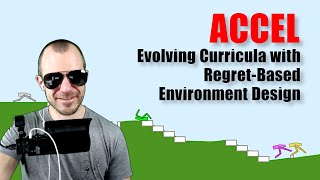
ACCEL - Evolving Curricula with Regret-Based Environment Design
Explore ACCEL, a novel approach combining regret-based sampling and level-editing for creating adaptive curricula in reinforcement learning, enhancing agent capabilities and robustness.

The Weird and Wonderful World of AI Art
Explore the evolution of AI art, from early techniques to modern tools like CLIP and DALL-E. Discover the impact on artists, researchers, and amateurs, and ponder the future of this rapidly advancing field.

Improving Intrinsic Exploration with Language Abstractions - Author Interview
Interview exploring how language abstractions can improve intrinsic exploration in reinforcement learning, discussing experimental results, challenges, and future directions in this promising research area.
Improving Intrinsic Exploration with Language Abstractions - Machine Learning Paper Explained
Explores using natural language to improve reinforcement learning agents' exploration in sparse-reward environments, demonstrating significant performance gains across challenging tasks in MiniGrid and MiniHack.
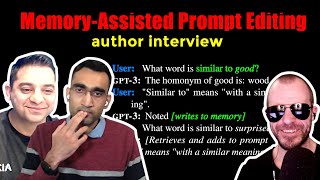
Author Interview - Memory-Assisted Prompt Editing to Improve GPT-3 After Deployment
Explore a method to improve GPT-3's performance post-deployment by maintaining interaction memory and dynamically adapting prompts, enhancing accuracy without retraining the model.
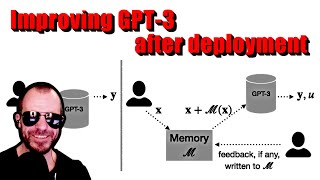
Memory-Assisted Prompt Editing to Improve GPT-3 After Deployment - Machine Learning Paper Explained
Explore adaptive methods to enhance GPT-3's performance post-deployment using memory-based prompts, improving accuracy without retraining the model. Learn about applications in fine-tuning and personalization.
Active Dendrites Avoid Catastrophic Forgetting - Interview With the Authors
Interview exploring how active dendrites in neural networks can mitigate catastrophic forgetting, enabling better multi-task and continual learning for AI systems in dynamic environments.
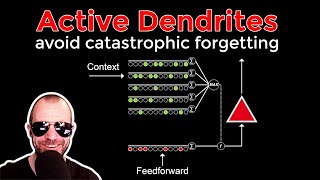
Avoiding Catastrophe - Active Dendrites Enable Multi-Task Learning in Dynamic Environments
Explore how active dendrites in neural networks mitigate catastrophic forgetting, enabling multi-task learning and adaptation in dynamic environments through context-sensitive gating and sparse representations.
Author Interview - VOS- Learning What You Don't Know by Virtual Outlier Synthesis
Interview exploring Virtual Outlier Synthesis for out-of-distribution detection in neural networks. Discusses motivations, methodology, and key findings of novel approach to improve model robustness using synthesized outlier data.

Spurious Normativity Enhances Learning of Compliance and Enforcement Behavior in Artificial Agents
Explore how arbitrary social norms enhance learning of rule enforcement in AI agents, with insights on societal implications and potential applications in artificial general intelligence.
AI and Formal Math - Formal Mathematics Statement Curriculum Learning
Explore AI's potential in formal mathematics through expert iteration, curriculum learning, and language modeling. Discover how machines and humans can collaborate to solve complex mathematical problems.
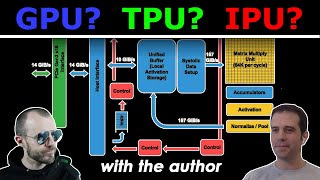
All About AI Accelerators - GPU, TPU, Dataflow, Near-Memory, Optical, Neuromorphic & More
Comprehensive exploration of AI accelerator technologies, from GPUs to emerging innovations like neuromorphic computing, discussing their principles, advantages, and future potential in advancing artificial intelligence.

Language Models as Zero-Shot Planners - Extracting Actionable Knowledge for Embodied Agents
Exploring how large language models can translate high-level tasks into actionable steps for virtual environments, with techniques to improve executability and potential real-world applications.
Dynamic Inference with Neural Interpreters - Interview with the Authors
Explore Neural Interpreters: a modular deep learning architecture for systematic generalization. Learn about its structure, function routing, and applications in image classification and abstract reasoning.
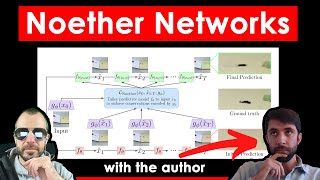
Noether Networks - Meta-Learning Useful Conserved Quantities
Explore Noether Networks: a novel approach to meta-learning conserved quantities in sequential prediction problems, inspired by Noether's theorem and aimed at discovering useful symmetries and inductive biases.

Resolution-Robust Large Mask Inpainting with Fourier Convolutions - With Author Interview
Explore LaMa, an advanced image inpainting system using Fourier convolutions for large mask removal. Learn about its architecture, loss function, and impressive results in reconstructing complex structures.