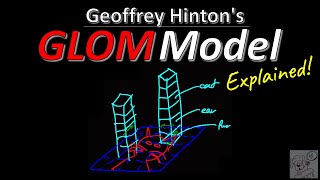
How to Represent Part-Whole Hierarchies in a Neural Network - Geoff Hinton's Paper Explained
Explore GLOM, a novel computer vision model combining transformers, neural fields, and capsule networks to dynamically construct parse trees for object recognition and scene understanding.
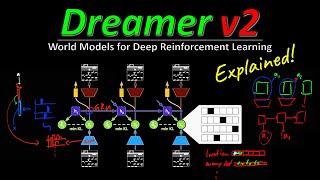
Mastering Atari with Discrete World Models - Machine Learning Research Paper Explained
Explore cutting-edge reinforcement learning with DreamerV2, a model-based AI agent achieving human-level performance on Atari games using discrete world models and latent space predictions.
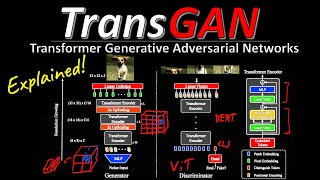
TransGAN - Two Transformers Can Make One Strong GAN - Machine Learning Research Paper Explained
Explore TransGAN, a novel approach using transformers for image generation. Learn about its architecture, key techniques, and competitive performance in various datasets.
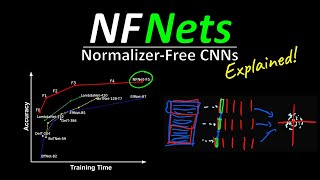
NFNets - High-Performance Large-Scale Image Recognition Without Normalization
Explore Normalizer-Free Networks, a novel approach to image recognition that achieves state-of-the-art accuracy without batch normalization, offering faster training and improved transfer learning performance.
Feedback Transformers - Addressing Some Limitations of Transformers with Feedback Memory
Explores Feedback Transformers, an architecture that improves on standard Transformers by allowing higher-level representations to inform lower-level processing, enhancing performance on complex reasoning and long-range dependency tasks.
SingularityNET - A Decentralized, Open Market and Network for AIs
Explore SingularityNET's decentralized AI marketplace, enabling open development and interoperability of AI services. Learn about its blockchain foundation, token economy, and potential impact on the future of artificial intelligence.

OpenAI CLIP- Connecting Text and Images
Detailed explanation of OpenAI's CLIP model, which connects text and images using contrastive learning on 400M image-text pairs, enabling zero-shot transfer to various computer vision tasks.

OpenAI DALL·E - Creating Images from Text - Blog Post Explained
Explore OpenAI's DALL·E model, its architecture, capabilities, and limitations in generating high-quality images from text descriptions. Learn about its potential impact on AI applications combining text and visuals.
ReBeL - Combining Deep Reinforcement Learning and Search for Imperfect-Information Games
Explores ReBeL, an AI framework combining reinforcement learning and search for imperfect-information games. Explains its application to poker, convergence to Nash equilibrium, and superhuman performance with minimal domain knowledge.
Language Models Are Open Knowledge Graphs
Explore how pre-trained language models can be used to construct knowledge graphs without human supervision, uncovering new relations and outperforming existing methods in automated KG construction.
LambdaNetworks- Modeling Long-Range Interactions Without Attention
Explore LambdaNetworks, a novel approach to modeling long-range interactions in AI without traditional attention mechanisms, offering improved efficiency and performance in computer vision tasks.
An Image is Worth 16x16 Words - Transformers for Image Recognition at Scale
Explore how Transformers outperform CNNs in image recognition, delving into Vision Transformer architecture, experimental results, and implications for AI research.
The Hardware Lottery - Paper Explained
Explores the "hardware lottery" concept in AI research, discussing how hardware availability influences algorithmic success, with historical examples and future implications for machine learning progress.
Assessing Game Balance with AlphaZero - Exploring Alternative Rule Sets in Chess
Explore how AlphaZero assesses chess variants, analyzing game dynamics and strategic changes resulting from rule modifications. Gain insights into AI's potential for game design and balance evaluation.
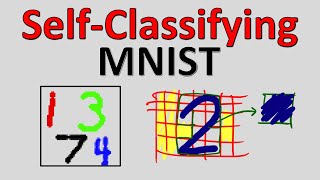
Self-Classifying MNIST Digits - Paper Explained
Explore how neural cellular automata can achieve global consensus through local communication, applied to digit classification. Discover innovative approaches to modeling biological systems and machine learning tasks.
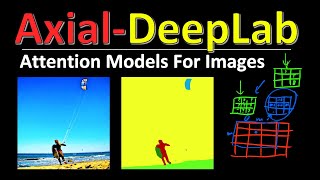
Axial-DeepLab - Stand-Alone Axial-Attention for Panoptic Segmentation
Explore a novel approach to image processing using axial-attention, combining positional embeddings and factorized self-attention to achieve state-of-the-art results in image segmentation tasks.
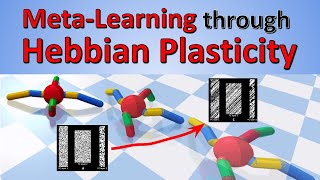
Meta-Learning Through Hebbian Plasticity in Random Networks - Paper Explained
Explores biologically-inspired Hebbian learning for adaptive AI agents. Demonstrates how random neural networks can self-organize during runtime to solve RL tasks and adapt to new situations without fixed policies.
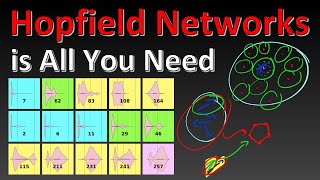
Hopfield Networks Is All You Need - Paper Explained
Explores the connection between Hopfield networks and transformer attention, analyzing BERT through this lens and applying Hopfield attention to immune repertoire classification.
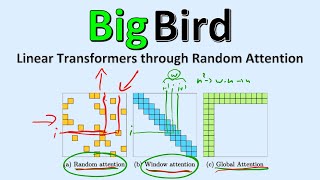
Big Bird- Transformers for Longer Sequences
Explanation of BigBird's sparse attention mechanism for transformers, enabling longer sequence processing. Covers theoretical foundations, architecture details, and experimental results in NLP and genomics applications.
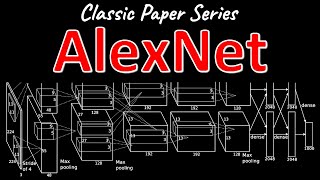
ImageNet Classification with Deep Convolutional Neural Networks - Paper Explained
Detailed explanation of AlexNet, the groundbreaking deep convolutional neural network that revolutionized computer vision and kickstarted the deep learning era in image classification.

Generative Adversarial Networks - Paper Explained
Explore the groundbreaking Generative Adversarial Networks paper, covering its innovative approach, theoretical foundations, and practical implications for AI-driven image generation and deep learning advancements.