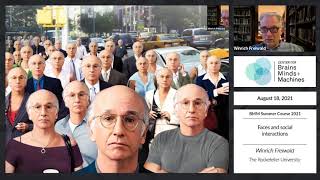
Faces and Social Interactions
Explore primate social intelligence, face perception, and neural mechanisms behind facial recognition and social interactions.
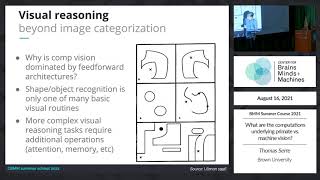
What Are the Computations Underlying Primate vs. Machine Vision?
Explore primate and machine vision computations, comparing face recognition, image processing, and neural networks. Gain insights into computational neuroscience and visual perception illusions.
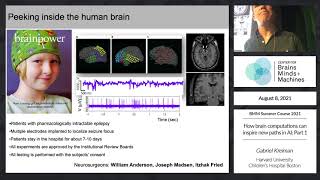
How Brain Computations Can Inspire New Paths in AI - Part 1
Explore how brain computations inspire AI advancements, covering visual illusions, neural connectivity, and deep learning networks to uncover new paths in artificial intelligence research.
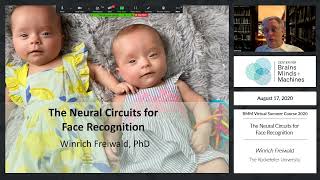
The Neural Circuits for Face Recognition
Explore neural circuits for face recognition, including a newly discovered temporal pole region. Learn about face processing systems, computational principles, and their implications for visual intelligence.
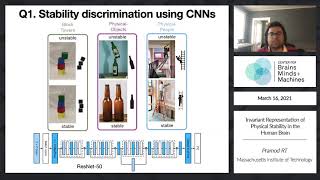
Invariant Representation of Physical Stability in the Human Brain
Explore how the human brain represents physical stability, from infant intuition to neural computations, and its applications in robotics and computer vision.

Functional Specificity in the Human Brain - What, Whether, and Why?
Explore the functional specificity of the human brain, examining key questions, methodologies, and findings in cognitive neuroscience with MIT researcher Nancy Kanwisher.
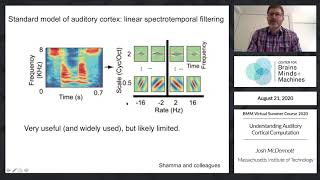
Understanding Auditory Cortical Computation
Explore auditory processing through computational models, comparing AI and human performance in speech recognition, sound localization, and pitch perception.

Toward Brain Computer Interface - Deep Generative Models for Brain Reading
Explore deep generative models for brain reading, covering GAN implementation, image reconstruction from brain signals, and evolving latent codes using genetic algorithms.
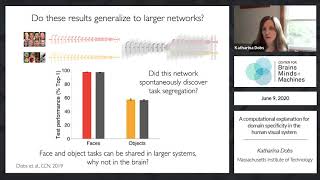
A Computational Explanation for Domain Specificity in the Human Visual System
Exploring how domain-specific organization in the brain emerges from computational optimization for face and object recognition tasks, using artificial neural networks to model cortical segregation.
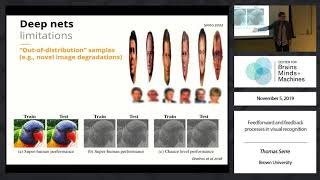
Feedforward and Feedback Processes in Visual Recognition
Explore visual recognition processes, comparing deep learning models with neuroscience-inspired approaches. Gain insights into complex visual reasoning and potential advancements in AI through computational neuroscience.
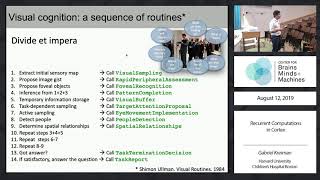
Recurrent Computations in Cortex
Explore recurrent computations in the brain's cortex, focusing on visual processing, neural networks, and cognitive models to understand human perception and cognition.
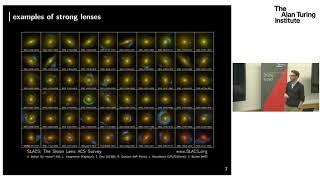
Exploring the Cosmos with Deep Learning
Explore how deep learning revolutionizes cosmology, from detecting gravitational lenses to generating galaxy images and modeling cosmic structures, addressing challenges in modern astronomical surveys.
The CubeRover for Lunar Mobility as a Service
Explore CubeRover: an innovative, ultra-light lunar rover for diverse payloads. Learn about its modular design, scalability, and potential to revolutionize lunar exploration and commercial space ventures.

DeepMind AlphaFold - A Gift to Humanity
Explore DeepMind's AlphaFold, a revolutionary AI system for protein structure prediction, and its potential impact on biology, medicine, and scientific research.
Importing a Video and Getting Data - Tracker for Beginners Lesson 1
Learn to import videos and generate graphs using Tracker, a video analysis tool for physics exploration. Covers basic processes like creating axes, setting scales, and auto-tracking.
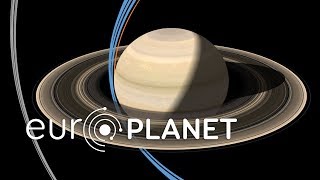
Exploration of Saturn's Icy Moons as Possible Habitats
Explore Saturn's icy moons as potential habitats and learn about European involvement in the Cassini mission, focusing on ocean worlds like Europa, Enceladus, and Titan.
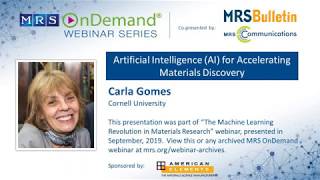
Artificial Intelligence for Accelerating Materials Discovery
Explore how AI accelerates materials discovery through machine learning, high-throughput methods, and autonomous systems. Learn about crystal structure mapping, phase mapping, and future opportunities in materials research.

Selfie With Blackhole ODRAW Hands on Session by Ananda Hota
Hands-on training for citizen-scientists to create and analyze astronomical images using NASA tools and GMRT data, focusing on galaxies with supermassive black holes and plasma jets.
How Do Neural Networks Grow Smarter? - With Robin Hiesinger
Exploring neural networks' growth into brains, this talk delves into the interplay between neurobiology and AI, questioning if biological brains are just messy hardware and if nature or artificial intelligence holds the key to smarter systems.

A Unifying Framework for Memory and Abstraction
Explore the Tolman-Eichenbaum Machine, a computational model unifying memory and spatial navigation in the hippocampus. Learn about its architecture, performance, and implications for neuroscience.

Networks of Spiking Neurons Learn to Learn and Remember
Explore how spiking neural networks acquire learning and memory capabilities, bridging computational neuroscience and artificial intelligence research.