
The 2024 Camera RAW Interface in Photoshop
Explore the Camera RAW interface in Photoshop 2024, learning essential tools and techniques for enhancing your photos and preparing for advanced compositing projects.
Optics and Neural Networks: Applications in Experimental Physics
Explore the synergy between optics and machine learning through experimental demonstrations of optical neural networks, robotic alignment, and super-resolution imaging applications.
Brain-Computer Interfaces - Ethical Issues and Resolutions
Explore the ethical challenges and solutions surrounding AI-enhanced brain-computer interfaces, focusing on experimental psychiatric treatments and corporate responsibility in neurotechnology development.
Network Neuroscience - Where the Brain and Social Networks Work the Same
Explore fascinating parallels between neural networks and social interactions, discovering how billions of neurons mirror human communication patterns in network neuroscience.

AI-Facilitated Real-Time Earthquake Monitoring - From Development to Production
Discover how AI-driven seismological monitoring revolutionizes earthquake detection through advanced deep learning techniques, focusing on real-time implementation in Texas's seismic network for improved accuracy and efficiency.
AI's Environmental Storage Problem - Distributed Solutions for Sustainable Cloud Storage
Explore how distributed storage solutions can reduce cloud computing's environmental impact while enhancing security, performance, and sustainability through innovative disk drive utilization and global node networks.
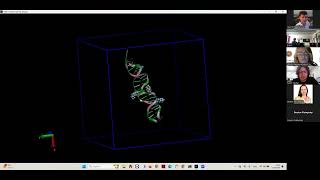
Using ChatGPT in Molecular Dynamics Simulations - Applications to Nucleic Acids
Discover how to leverage ChatGPT for molecular dynamics simulations, focusing on nucleic acids analysis and computational physics applications in DNA research.
Debiasing Coarse-Scale Climate Models Using Statistically Consistent Neural Networks
Explores using neural networks to improve coarse-scale climate models, addressing unresolved scales and enhancing predictions. Discusses framework, wavelet analysis, and multi-model architecture for more accurate climate simulations.

Surviving the Century
Exploring humanity's future: biotech, cyber, robotics, and space advancements offer promise, but also pose risks. Sir Martin Rees examines societal challenges and potential solutions.
Differences Between Neural Networks and the Brain
Explore the similarities and differences between neural networks and the brain in this panel debate featuring leading experts in neuroscience and artificial intelligence.

Explore MIT Today - Reverse Engineering the Mind - Brain and Cognitive Sciences
Panel discussion exploring brain science, AI, and human intelligence, covering neural processing, learning, robotics, brain-computer interfaces, and ethical considerations in cognitive research.
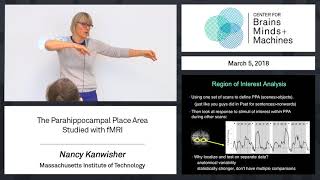
The Parahippocampal Place Area Studied with fMRI
Explores the parahippocampal place area's role in scene recognition using fMRI, discussing methodological considerations and replication in cognitive neuroscience research.
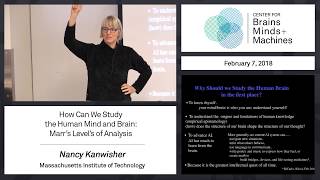
How Can We Study the Human Mind and Brain? - Marr's Levels of Analysis
Explore Marr's levels of analysis for studying the human mind and brain, focusing on computational theory and its application to color vision and other cognitive processes.
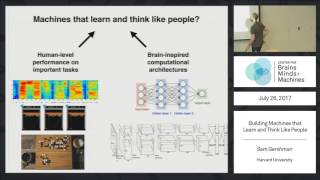
Building Machines that Learn and Think Like People
Explore computational neuroscience and AI inspired by human cognition, covering intuitive theories, compositionality, and learning to learn for more human-like artificial intelligence.

Nancy Kanwisher: History of Neuroimaging Research on Face Recognition
Explore the evolution of neuroimaging research on face recognition, from early studies to modern fMRI techniques, and discover key findings in this fascinating field of cognitive neuroscience.
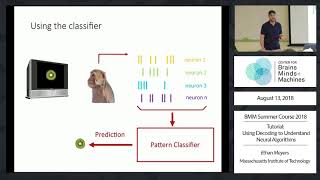
Using Decoding to Understand Neural Algorithms
Explore neural decoding techniques to uncover algorithms in the brain's visual processing, focusing on information representation, invariance, and attention in neural networks.
Does the Neocortex Use Grid Cell-Like Mechanisms to Learn the Structure of Objects?
Explore how the neocortex might use grid cell-like mechanisms to learn object structure, drawing parallels between spatial navigation and object recognition in the brain.
The Prefrontal Cortex as a Meta-Reinforcement Learning System
Explore the prefrontal cortex's role in meta-reinforcement learning, connecting neuroscience and AI through recurrent neural networks and cognitive tasks like Harlow's experiment.
Automated Reconstruction of Synaptic-Resolution Neural Wiring Diagrams
Explore automated reconstruction of neural wiring diagrams using advanced techniques like generative adversarial networks and crowdsourcing, with applications in connectomics and targeted brain data discovery.
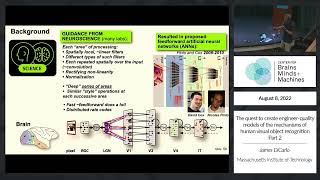
The Quest to Create Engineer-Quality Models of the Mechanisms of Human Visual Object Recognition - Part 2
Explore advanced neural models and mechanisms of human visual object recognition, including linear decoders, adversarial attacks, and individual variability in visual processing.
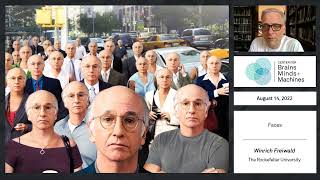
Faces
Explore primate face recognition, from neural substrates to computational principles, examining face cells, processing systems, and recognition architectures in this comprehensive overview.