Cloud Native Machine Learning - Automated Anomaly Detection
Explore automated anomaly detection techniques for machine learning, enhancing your ability to identify and respond to data irregularities in cloud-native environments.
PyReason and Abduction for Trajectory Generation
Explore combining PyReason's annotated logic with abductive inference for robust human movement trajectory generation, countering anomaly detection.
Leveraging Generative AI and Transformers in Healthcare - Anomaly Detection and Implementation
Explore AI and transformers in healthcare, focusing on anomaly detection, data annotation, and machine learning frameworks. Learn about challenges, implementations, and generative AI applications.

Observability Standardization: The Elephant in the Room - DevOps 2024
Explore observability standardization challenges and solutions, focusing on Netdata's approach to efficient monitoring, distributed systems, and AI-driven insights for DevOps professionals.
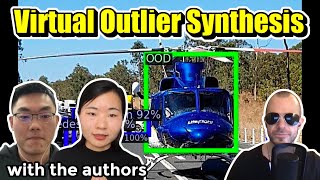
Author Interview - VOS- Learning What You Don't Know by Virtual Outlier Synthesis
Interview exploring Virtual Outlier Synthesis for out-of-distribution detection in neural networks. Discusses motivations, methodology, and key findings of novel approach to improve model robustness using synthesized outlier data.

Learning What You Don't Know by Virtual Outlier Synthesis - Paper Explained
Explore Virtual Outlier Synthesis, a novel method for improving out-of-distribution detection in deep learning models by generating synthetic outliers during training to enhance decision boundary regularization.

Unsupervised Learning for Stellar Spectra with Deep Normalizing Flows - Jo Ciuca
Explore unsupervised machine learning techniques for analyzing stellar spectra using deep normalizing flows, with applications in galaxy evolution and big data astronomy.
NTOPNG - A Free, Open Source, Self Hosted, Network Monitoring and Analysis Tool
Explore NTopNG, a free open-source tool for network monitoring and analysis. Learn installation, setup, and usage to enhance network security and detect anomalies in traffic patterns.
Anomaly Detection with Autoencoder
Learn to detect anomalies using autoencoders in high energy physics data analysis. Explore advanced machine learning techniques for uncovering rare events and potential new physics.

No Data, No Problem - Giving Nuclear Inspectors Better Tools Without Revealing State Secrets
Explore privacy-preserving computation in nuclear safeguards, focusing on garbled circuits for anomaly detection without compromising sensitive information between inspectors and facilities.
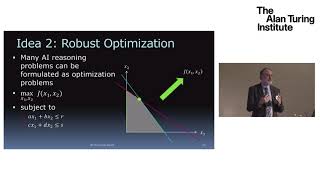
Steps Toward Robust Artificial Intelligence - Thomas G Dietterich, Oregon State University
Explore methods for developing robust AI systems capable of handling known and unknown threats in high-stakes applications, including probabilistic inference, anomaly detection, and causal modeling.

Recent Progress in Predictive Inference - Emmanuel Candes, Stanford University
Emmanuel Candes discusses novel calibration techniques for machine learning predictions, addressing issues like false discovery rate control and adaptive conformal inference to handle distribution shifts.
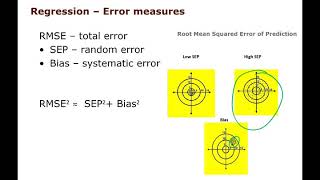
PLS Number of Components
Learn validation techniques for PLS models, including outlier detection, error measures, cross-validation, and practical tips for selecting the optimal number of components.

Autoencoders Explained Easily
Intuitive explanation of autoencoders, covering key concepts like representation learning and latent space, with applications in data generation, denoising, and anomaly detection.
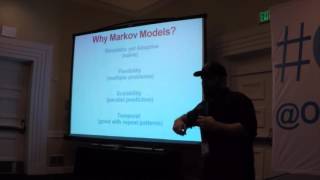
ODSC West 2015 - Hacking Machine Data
Explore techniques for analyzing machine data, including Hidden Markov Models and anomaly detection. Learn to handle time-series datasets with high volatility and noise, applying real-world methods to extract valuable insights.
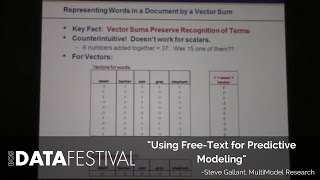
Using Free Text for Predictive Modeling
Explore efficient text representation for predictive analytics, covering techniques to transform varied-length text into fixed-length vectors for machine learning applications like sentiment analysis and news classification.
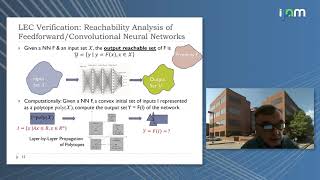
Towards Assurance-Based Learning-Enabled Cyber-Physical Systems
Exploring formal verification, monitoring, and safety case formalization for assurance-based learning-enabled cyber-physical systems, focusing on autonomous vehicles and their complex components.
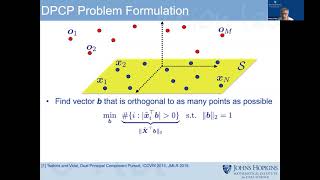
Dual Principal Component Pursuit
Explore a novel approach to learning subspaces from corrupted data, tolerating high outlier ratios and dimensions. Discover algorithms and theoretical guarantees for this non-convex optimization problem.
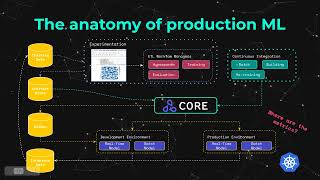
Production Machine Learning Monitoring- Principles, Patterns and Techniques
Practical deep dive on production monitoring of machine learning models, covering standard techniques and advanced paradigms like concept drift, outlier detection, and explainability, with hands-on examples and architectural patterns.
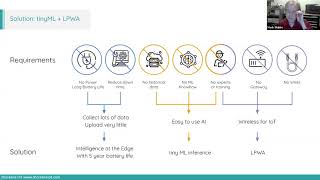
Practical Application of TinyML in Battery Powered Anomaly Sensors for Predictive Maintenance of Industrial Assets
Explore tinyML for industrial anomaly detection, enabling predictive maintenance through low-power sensors, wireless tech, and IoT cloud integration. Includes live demo and practical insights.
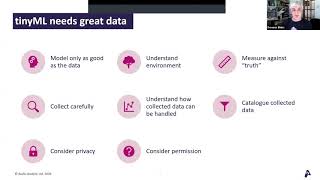
TinyML Talks - Dr. Dominic Binks- TinyML Doesn’t Need Big Data, It Needs Great Data
Explore challenges and solutions in obtaining quality audio data for tinyML sound recognition, focusing on data sources, collection methods, labeling strategies, and performance evaluation.