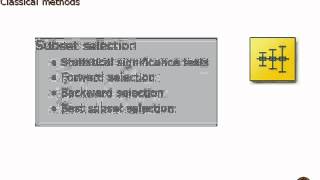
Variable Selection in Chemometrics: Advanced Methodologies - Part 2
Advanced methodologies for variable selection in chemometrics, including genetic algorithms, jack-knifing, and iPLS, building on fundamental concepts.
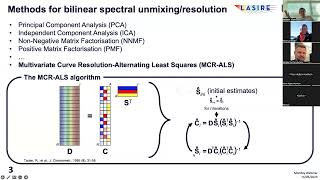
The Black Hole Effect in MCR with Raffaele Vitale
Exploring the black hole effect in Multivariate Curve Resolution, its impact on data analysis, and strategies to overcome this phenomenon in chemometrics and machine learning.
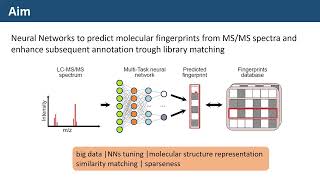
Chemometrics and Molecular Fingerprints to Enhance LC-MS/MS Spectral Match
Explore computational approaches to enhance LC-MS/MS spectral matching using chemometrics and deep learning for improved molecular structure prediction and compound identification.
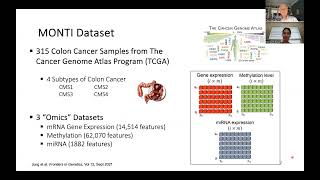
TUSCA: A Method for Tucker3 Modeling with ASCA+ - Webinar
Explore TUSCA, a novel method combining Tucker3 and ASCA+ for analyzing multi-way datasets from designed experiments, enhancing interpretation and visualization of complex data structures.
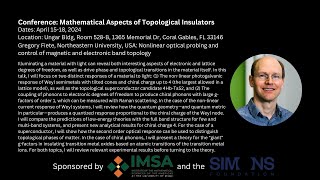
Nonlinear Optical Probing and Control of Magnetic and Electronic Band Topology
Explore nonlinear optical responses in Weyl semimetals and chiral phonons. Discover how light reveals material properties and drives topological transitions in quantum systems.
Recent Advancements in the Characterization of Dolomite
Explore recent breakthroughs in dolomite research, including field studies, geochemical analysis, and laboratory synthesis, providing insights into its formation and geological significance.
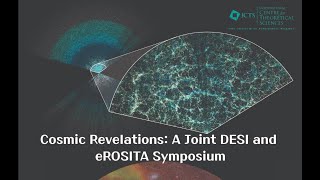
A Short Introduction to the Long Path to DESI and eROSITA
Explore groundbreaking discoveries from DESI and eROSITA surveys, unveiling cosmic mysteries, dark energy, neutrinos, and large-scale structures. Join eminent scientists for cutting-edge cosmology research insights.
Planet Hunting in the Cosmos
Explore the search for extraterrestrial life with Lisa Kaltenegger as she unveils cutting-edge techniques to detect habitable exoplanets and decode their potential for hosting life using Earth as a model.
Introduction to Observational Astrophysics
Explore fundamental concepts and techniques of observational astrophysics, from celestial objects to data analysis methods.
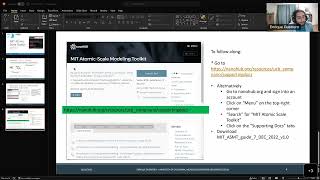
Teaching and Learning with the MIT Atomic Scale Modeling Toolkit - Classical and Quantum Atomic Modeling
Explore classical and quantum atomic modeling using MIT's toolkit. Perform molecular dynamics, Monte Carlo simulations, and quantum chemistry computations. Learn practical applications for various physics and chemistry courses.
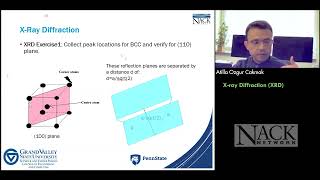
X-ray Diffraction and Spectroscopy Techniques for Nanomaterial Characterization
Explore wave-based characterization techniques including X-ray diffraction, photoelectron spectroscopy, FTIR, and UV-Vis spectroscopy. Gain insights into nanomaterial analysis and practical applications using simulation tools.
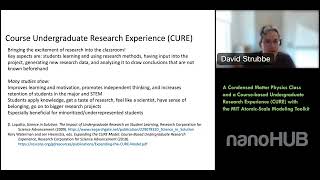
Condensed Matter Physics Class and Research Experience with MIT Atomic-Scale Modeling Toolkit
Explore condensed matter physics through simulations and research experiences using the MIT Atomic-Scale Modeling Toolkit. Learn about covalent bonding, bandstructure, phonons, and magnetic phase transitions.
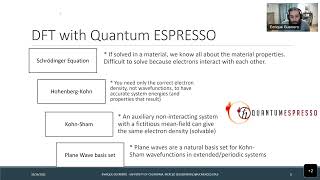
Interactive Modeling of Materials with DFT Using Quantum ESPRESSO - MIT Atomic Scale Toolkit
Explore interactive modeling of materials using density functional theory with Quantum ESPRESSO in the MIT Atomic-Scale Modeling Toolkit. Learn to compute and analyze various material properties through hands-on examples.
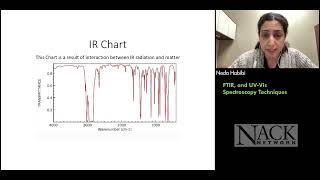
FTIR and UV-Vis Spectroscopy Techniques - Lecture 3
Explore FTIR and UV-Vis spectroscopy techniques, their principles, applications, and operational mechanisms. Gain insights into radiation interactions, vibration types, and spectrum analysis for nanoscale characterization.
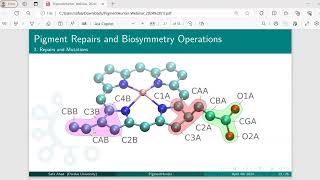
Building a Graphical Interface for Exploring Protein Dynamics and Spectroscopy - PigmentHunter
Explore protein dynamics and spectroscopy with PigmentHunter, a user-friendly nanoHUB tool for simulating excitonic spectra of chlorophyll proteins. Learn its interface, workflow, and applications in molecular dynamics and spectral analysis.
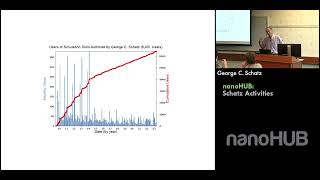
Teaching Chemistry Tools on nanoHUB - Overview by George Schatz
Explore nanoHUB tools for teaching chemistry, including DDSCAT, QC-Lab, and Nanosphere Optics Lab. Learn about applications in optics, spectroscopy, and molecular modeling from Prof. George Schatz.
Black Hole Spectroscopy with Next Generation Gravitational Wave Detectors
Explore cutting-edge techniques for analyzing black hole properties using advanced gravitational wave detectors, unveiling cosmic mysteries and pushing the boundaries of astrophysics.
New Horizons: Testing the Black Hole Paradigm
Explore black hole physics, from singularities to spectroscopy, with insights on testing the Kerr nature, nonlinearities, and bouncing geometries in this advanced astrophysics lecture.
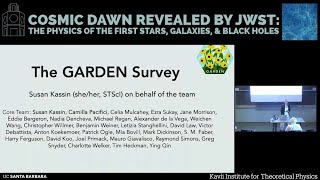
The GARDEN Survey - Exploring Galaxy Evolution in the Early Universe
Exploring cosmic dawn with JWST: Insights on first stars, galaxies, and black holes. Conference talk discusses GARDEN Survey findings and implications for understanding early universe evolution.
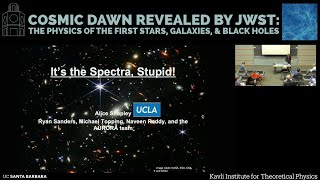
A New Era for Emission-line Probes of Star-forming Galaxies back to Cosmic Dawn
Explore cosmic dawn with JWST: Discover first stars, galaxies, and black holes. Discuss key questions on early universe evolution, connecting near-field and deep-field observations.
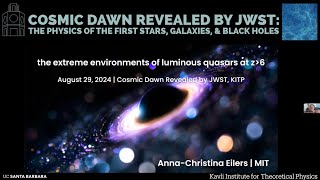
The Extreme Environments of Luminous Quasars at z~6
Explore luminous quasars at z~6 and their extreme environments. Discover insights into cosmic dawn, early black holes, and galaxy formation through cutting-edge JWST observations and theoretical models.