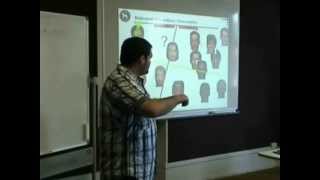
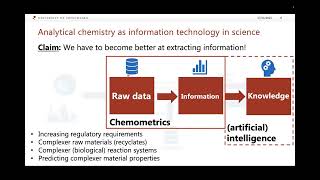
Basic Definition of Multivariate Data Analysis - Chemometrics
Explore fundamental concepts of multivariate data analysis and chemometrics, including univariate vs. multivariate data, latent variables, and their applications in analytical chemistry.
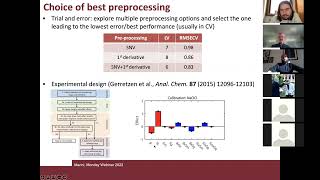
Preprocessing Revisited
Explore new developments in chemometric preprocessing, including multi-block strategies and Variable Sorting for Normalization, to reduce unwanted variability in experimental data.
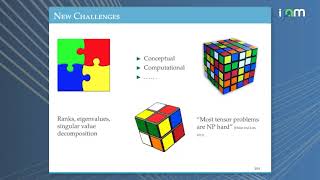
Low Rank Tensor Methods in High Dimensional Data Analysis
Explore low rank tensor methods for analyzing high-dimensional data in various fields. Learn about recent progress, challenges, and applications in extracting information from multilinear arrays.
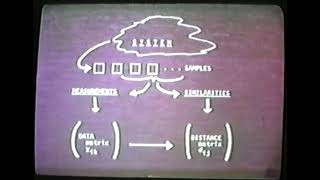
Introduction to Chemometrics - Historical Lecture by Bruce Kowalski
Explore the foundations of chemometrics with Bruce Kowalski's 1991 lecture, covering key concepts like CLS, PLS, regression, and neural networks that remain relevant in modern data science.
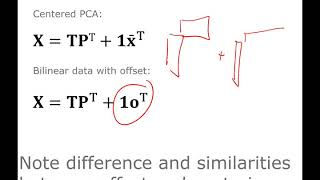
Preprocessing: Centering and Scaling in Chemometric Machine Learning
Learn techniques for centering and scaling data to enhance information in chemometric machine learning contexts like PCA and PLS models.
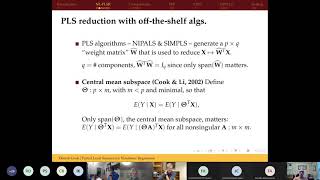
Partial Least Squares for Nonlinear Regression
Explore dimension reduction in PLS regression for nonlinear relationships, challenging traditional views and proposing new insights into PLS-like methods for predictive modeling.
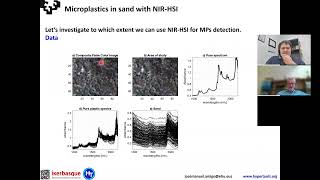
Classical and Generalized Least Squares
Explore advanced least squares techniques for analytical chemistry, including applications in microplastics detection and spectral analysis of biological samples.
The Cage of Covariance
Explore strategies for handling correlated variables in data analysis, including orthogonalization techniques and predictive component methods.

Fusing Calibration Models
Explore techniques for merging multiple calibration models to improve efficiency and robustness in quality control, with a focus on balancing simplicity and prediction accuracy.
Shift-Invariant Trilinearity and Soft Shift-Invariant Trilinearity in GC-MS Data Analysis
Explore a novel method for shift-invariant non-negative tensor factorization in GC-MS data analysis, offering faster peak resolution and flexible modeling of elution profile changes.
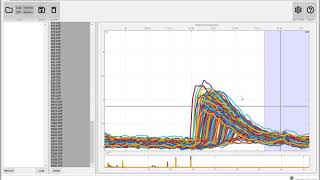
PARADISe 5.7 Beta for Untargeted GC-MS Analysis
Explore the revamped PARADISe 5.7 beta for enhanced untargeted GCMS data analysis, offering improved information extraction and advanced features for comprehensive analytical insights.
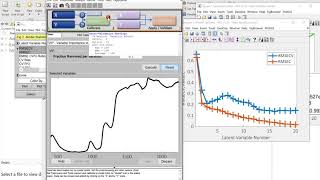
Variable Selection in PLS_Toolbox - Part 3
Explore advanced techniques for variable selection in PLS_Toolbox, enhancing your data analysis skills and improving model performance.
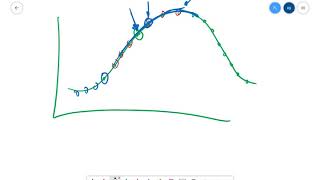
Preprocessing: Derivatives and Baseline Removal in Spectral Analysis
Learn techniques for removing baselines and artifacts from data, enhancing signal quality and improving analytical results in chemometrics and machine learning.
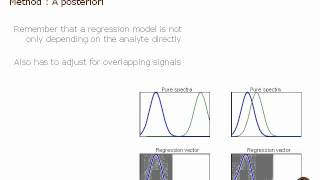
Variable Selection in Multivariate Data Analysis - Part 1
Explore key methods for variable selection in multivariate data analysis, including a-priori, a-posteriori, and model-based approaches. Learn their importance and applications.
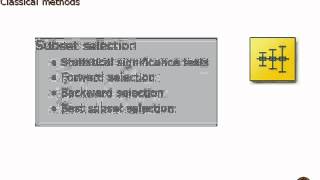
Variable Selection in Chemometrics: Advanced Methodologies - Part 2
Advanced methodologies for variable selection in chemometrics, including genetic algorithms, jack-knifing, and iPLS, building on fundamental concepts.
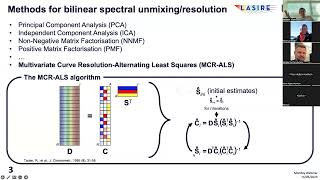
The Black Hole Effect in MCR with Raffaele Vitale
Exploring the black hole effect in Multivariate Curve Resolution, its impact on data analysis, and strategies to overcome this phenomenon in chemometrics and machine learning.
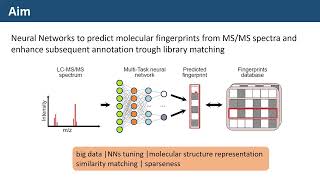
Chemometrics and Molecular Fingerprints to Enhance LC-MS/MS Spectral Match
Explore computational approaches to enhance LC-MS/MS spectral matching using chemometrics and deep learning for improved molecular structure prediction and compound identification.
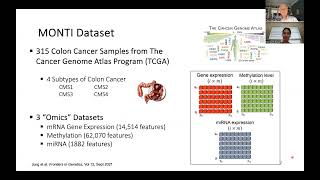
TUSCA: A Method for Tucker3 Modeling with ASCA+ - Webinar
Explore TUSCA, a novel method combining Tucker3 and ASCA+ for analyzing multi-way datasets from designed experiments, enhancing interpretation and visualization of complex data structures.
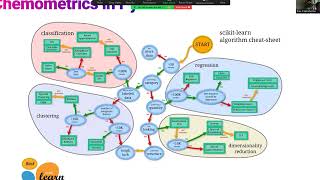
Chemotools - Integrating Chemometrics and Scikit-Learn for Spectral Data Analysis
Explore chemotools, a Python library unifying chemometrics and machine learning for spectral data analysis, streamlining model development and implementation in the scientific community.
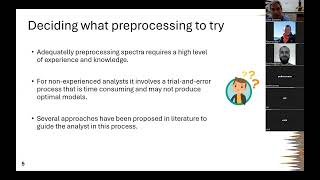
ExpertPLS - A MATLAB Toolbox for Spectral Preprocessing Selection
Automated MATLAB toolbox for spectral preprocessing selection, quantifying noise and scatter effects to optimize PLS models efficiently and objectively, surpassing trial-and-error methods.
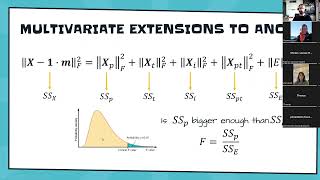
Statistical Inference of Omics Data with Variable-Selection
Learn statistical inference techniques for omics data analysis, focusing on variable selection methods to enhance spectral matching and predict molecular structures from LC-MS/MS spectra using chemometrics and deep learning approaches.