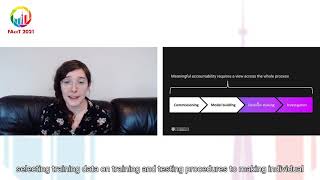
Reviewable Automated Decision-Making - A Framework for Accountable Algorithmic Systems
Explore a framework for accountable algorithmic systems, focusing on reviewable automated decision-making to enhance transparency and fairness in AI-driven processes.
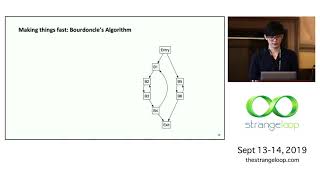
Easy Abstract Interpretation with SPARTA
Streamline static analyzer development with SPARTA, a C++ library providing efficient, scalable components. Learn algorithms, benefits, and implementation for language-independent program analysis.
Searching for the Emergence of Life-like Behaviors in Chemical Networks - Stephanie Colón-Santos - AAAS Annual Meeting
Exploring chemical networks for life-like behaviors using untargeted analysis and Chemical Ecosystem Selection experiments to identify complex patterns and unique products in prebiotic mixtures.

Develop for Quantum Impact - Krysta Svore - AAAS Annual Meeting
Explore quantum computing's potential with Dr. Krysta Svore as she discusses Microsoft's mission, quantum systems development, and the future of solving complex problems through innovative quantum technologies.
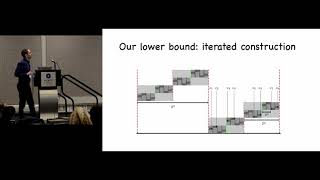
Finding Monotone Patterns in Sublinear Time
Explore efficient algorithms for detecting monotone patterns in large datasets, focusing on sublinear time complexity and adaptive techniques for various pattern types.
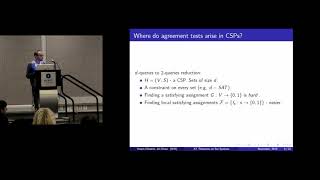
Agreement Testing Theorems on Layered Set Systems
Explore agreement testing theorems on layered set systems, their applications in CSPs, and recent advancements in this field of theoretical computer science.

Sublinear Algorithms for Gap Edit Distance
Explore sublinear algorithms for efficiently computing gap edit distance, including dynamic programming, approximation techniques, and key theoretical results.
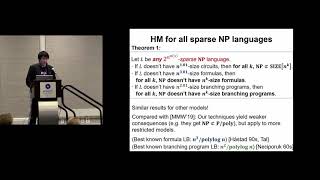
Hardness Magnification for All Sparse NP Languages
Explore hardness magnification in computational complexity, focusing on sparse NP languages and the Minimum Circuit Size Problem, with insights on algorithms and open challenges.
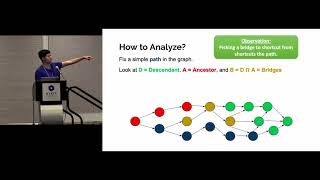
Parallel Reachability in Almost Linear Work and Square Root Depth
Explore efficient parallel algorithms for graph reachability, focusing on distributed computing and improved runtime complexity in large-scale networks.
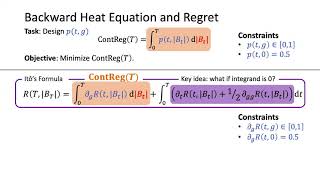
Optimal Anytime Regret with Two Experts
Explore optimal anytime regret in expert learning, focusing on two-expert scenarios. Discover techniques, proof overviews, and algorithmic designs for minimizing regret in prediction tasks.
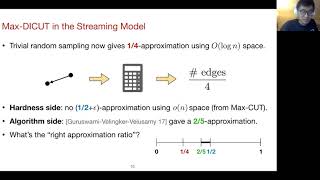
Optimal Streaming Approximations for All Boolean Max 2-CSPs and Max k-SAT
Explore streaming approximations for Boolean Max 2-CSPs and Max k-SAT, covering algorithms, lower bounds, and communication complexity in constraint satisfaction problems.
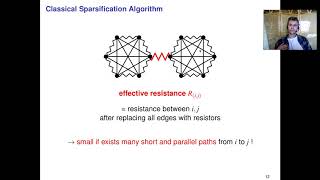
Quantum Speedup for Graph Sparsification, Cut Approximation and Laplacian Solving
Explore quantum algorithms for graph sparsification, cut approximation, and Laplacian solving, offering speedups over classical methods in these fundamental graph problems.
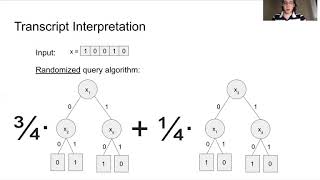
A New Minimax Theorem for Randomized Algorithms
Explore a novel minimax theorem for randomized algorithms, comparing it with Yao's minimax and discussing its implications for algorithm analysis and design.
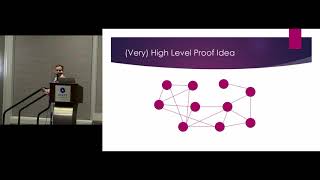
Random K-Out Subgraph Leaves Only O-N-K- Inter-Component Edges
Explore efficient graph partitioning techniques, focusing on random k-out subgraphs and their impact on inter-component edges. Learn about applications in connectivity and dense graph analysis.
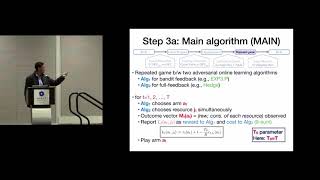
Adversarial Bandits with Knapsacks
Explore dynamic pricing and bandits with knapsacks in adversarial settings, covering algorithms, challenges, and future research directions in this field.
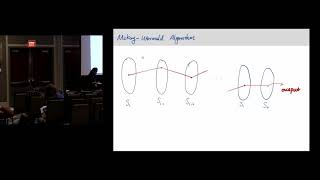
Fast Uniform Generation of Random Graphs with Given Degree Sequences
Explore efficient algorithms for generating random graphs with specified degree sequences, focusing on rejection and switching methods.
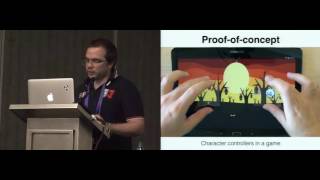
TouchTokens - Guiding Touch Patterns with Passive Tokens
Innovative approach to combine tangible and gestural input using passive tokens on multi-touch surfaces, enhancing interface design with high-accuracy touch pattern recognition.
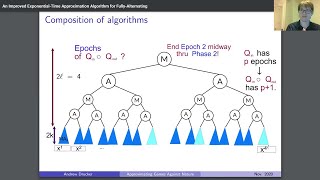
An Improved Exponential-Time Approximation Algorithm for Fully-Alternating Games Against Nature
Explore improved exponential-time approximation algorithms for fully-alternating games against nature, covering adversarial versions, MA formulas, and steepener algorithms.
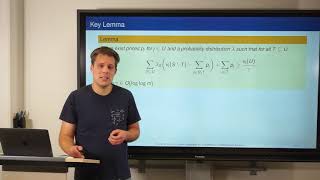
An O(log log m) Prophet Inequality for Subadditive Combinatorial Auctions
Explore advanced techniques in combinatorial auctions, focusing on subadditive prophet inequalities and their applications in algorithmic game theory and mechanism design.
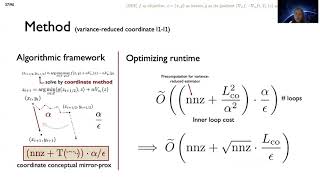
Coordinate Methods for Matrix Games
Explore efficient algorithms for solving matrix games, focusing on coordinate methods and their implementation challenges and benefits.
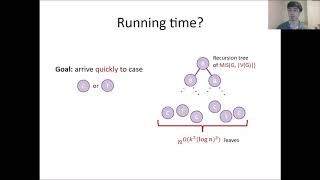
Independent Set on P_k-Free Graphs in Quasi-Polynomial Time
Explore efficient algorithms for solving the Independent Set problem on P_k-Free Graphs, including novel approaches and complexity analysis.