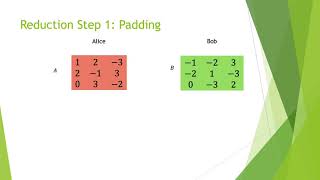
Smoothed Complexity of 2-player Nash Equilibria
Explore smoothed complexity in 2-player Nash equilibria, covering algorithmic hardness, approximation challenges, and novel approaches to finding equilibria in perturbed games.
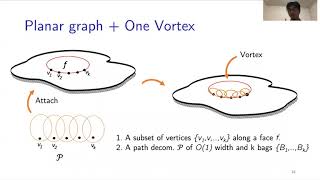
On Light Spanners, Low-Treewidth Embeddings and Efficient Traversing in Minor-Free Graphs
Explore efficient graph traversal techniques using light spanners and low-treewidth embeddings, with applications to minor-free graphs and approximation algorithms.
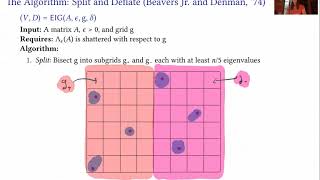
Pseudospectral Shattering the Sign Function and Diagonalization in Nearly Matrix Multiplication Time
Explore advanced matrix algorithms, including pseudospectral shattering and diagonalization techniques, for efficient computation in nearly matrix multiplication time.
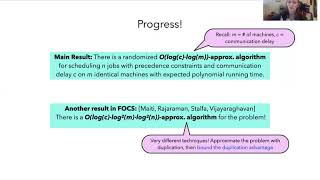
Scheduling with Communication Delays via LP Hierarchies and Clustering
Explore scheduling with communication delays using LP hierarchies and clustering, covering techniques like simplifying assumptions, LP scheduling, and clustering for efficient problem-solving.
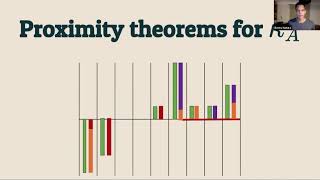
Revisiting Tardos’s Framework for Linear Programming - Faster Exact Solutions using Approximate Solvers
Explore advanced linear programming techniques, focusing on Tardos's framework and innovative approaches for faster exact solutions using approximate solvers.
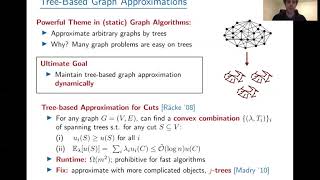
Fast Dynamic Cuts, Distances and Effective Resistance via Vertex Sparsifier
Explore dynamic graph algorithms and vertex sparsification techniques for efficient computation of cuts, distances, and resistance in evolving networks.
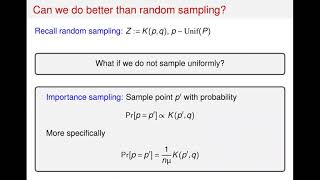
Kernel Density Estimation through Density Constrained Near Neighbor Search
Explore kernel density estimation through near neighbor search, focusing on importance sampling, locality sensitive hashing, and data-dependent techniques for improved efficiency and accuracy.
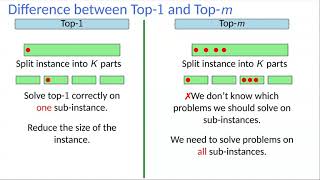
Collaborative Top Distribution Identifications with Limited Interaction
Explore collaborative learning strategies for efficient multi-armed bandit problem-solving, focusing on top-m identifications with limited interactions and error reduction techniques.
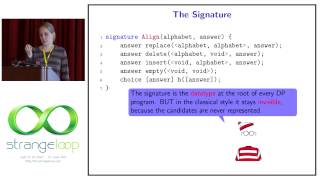
Dynamic Programming at Ease - With Grammars, Algebras, Products
Explore dynamic programming for combinatorial optimization problems using grammars, algebras, and products. Learn to efficiently solve complex problems by reusing intermediate results and reducing complexity.

Allegro Means Both Fast and Happy - Coincidence
Explore lesser-known, faster variants of classic sorting algorithms while uncovering surprises and learning to navigate modern complex architectures.
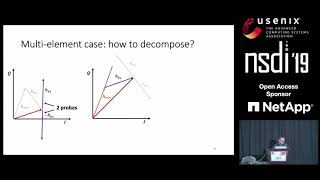
Towards Programming the Radio Environment with Large Arrays of Inexpensive Antennas
Explore reconfiguring wireless environments with large arrays of inexpensive antennas to improve communication. Innovative approach achieves significant throughput and capacity gains in real indoor settings.
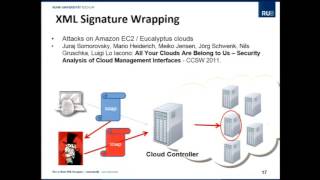
How to Break XML Encryption - Automatically
Explore automated attacks on XML Encryption, including vulnerability detection and exploitation techniques. Learn about recent developments, implementation challenges, and practical security implications.
Generic Programming in C++ - A Real-World Example
Explore the design and implementation of hex/unhex functions for Boost.Algorithm, examining key decisions and showcasing practical generic programming techniques in C++.
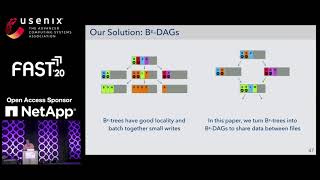
How to Copy Files
Explores efficient file cloning techniques in BetrFS, introducing "nimble clones" that optimize performance and space usage through copy-on-abundant-write policy and write-optimized key-value store.

Learning Differentially Private Mechanisms
Explore techniques for developing privacy-preserving algorithms and mechanisms, focusing on differential privacy principles and their practical applications.
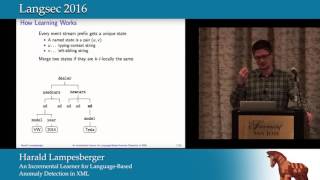
An Incremental Learner for Language-Based Anomaly Detection in XML
Incremental learning approach for XML anomaly detection, inferring types and datatypes to create extension point-free automaton for improved stream validation and attack prevention.
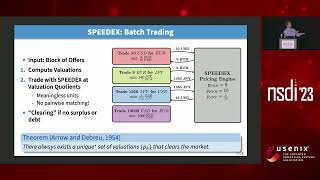
SPEEDEX - A Scalable, Parallelizable, and Economically Efficient Decentralized Exchange
Explore SPEEDEX, a high-throughput decentralized exchange offering secure asset trading, improved scalability, and prevention of internal arbitrage and front-running attacks within Layer-1 blockchains.
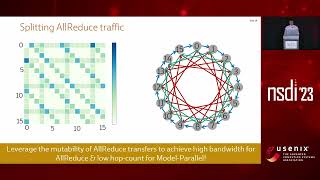
TopoOpt - Co-optimizing Network Topology and Parallelization Strategy for Distributed Training Jobs
Novel direct-connect fabric optimizing distributed DNN training across computation, communication, and network topology. Reduces training time by up to 3.4x compared to similar-cost Fat-Tree interconnects.

Revisiting Trade-Offs and Impossibility Theorems
Explore trade-offs and impossibility theorems in computing, examining fundamental limitations and potential solutions in algorithmic design and system architecture.

The Quantum Computers Are Coming
Explore the fascinating world of quantum computing, from its foundations to cutting-edge developments. Learn about QBITs, quantum algorithms, and their potential impact on technology and science.
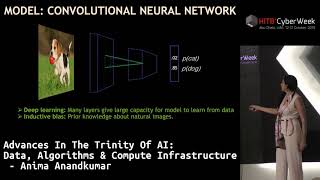
Advances in the Trinity of AI
Explore the synergy of data, algorithms, and computing infrastructure in AI's evolution, and discover future applications and algorithmic designs shaping next-generation AI technologies.