
Sum of Subset Problem Using Backtracking - Design and Analysis of Algorithms
Explore the Sum of Subset problem using backtracking, with practical examples. Learn efficient algorithm design and analysis techniques for solving complex computational challenges.
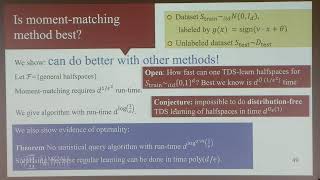
Testing Assumptions of Learning Algorithms
Explore how property testing can mitigate reliance on distributional assumptions and no distribution shift in supervised learning algorithms, ensuring more reliable theoretical guarantees.
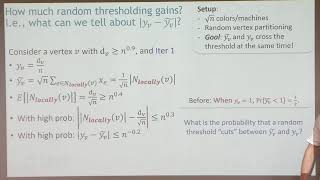
Graph Algorithms in the Massively Parallel Computation Model
Explore efficient graph algorithms in the Massively Parallel Computation model, focusing on techniques for near-linear memory regime and comparing MPC to other distributed/parallel models.
An Introduction to Distributed, Massively Parallel, and Local Computation Algorithms
Explore distributed, massively parallel, and local computation algorithms, focusing on their applications, challenges, and recent advancements in sublinear algorithmic techniques.
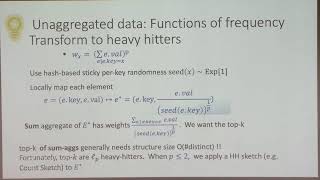
Sampling Big Ideas in Sublinear Algorithms
Explore random sampling techniques for enhancing data analysis scalability, focusing on weighted and coordinated sampling schemes for streamed or distributed data.

Beyond Moments - Robust Certificates for Affine Transformations
Explores algorithm for recovering affine transformations from corrupted samples, presenting robust certificates and highlighting limitations of moment-based methods in robust statistics.
List-Decoding Random Code Ensembles - Advances in Error-Correcting Codes
Explore advanced error-correcting code theory, focusing on list-decoding techniques for random code ensembles. Gain insights into cutting-edge research in coding theory.
Relaxed Local Correctability from Local Testing
Explore relaxed locally correctable codes with polylogarithmic query complexity, bridging the gap between lower and upper bounds using locally testable codes at multiple scales.
Accomplishments of the Exascale Computing Project
Explore the Exascale Computing Project's legacy, including key outcomes in algorithm design, performance portability, and multidisciplinary collaboration for advanced computational science.

0/1 Knapsack Problem Using FIFO Branch and Bound - Design and Analysis of Algorithms
Comprehensive tutorial on solving the 0/1 Knapsack problem using FIFO Branch and Bound method, with practical examples and step-by-step explanations for efficient algorithm implementation.
Towards Provably Performant Congestion Control
Explores framework for designing congestion control algorithms with provable performance across diverse network scenarios, synthesizing algorithms and uncovering fundamental impossibility results.

Building Efficient Learning Algorithms: A Computational Regularization Perspective - Lorenzo Rosasco
Explore efficient learning algorithms through a computational regularization lens. Unify algorithmic tricks in least squares learning for accuracy and resource efficiency.
Direct Access for Conjunctive Queries with Aggregation
Explore efficient algorithms for simulating sorted query answers with aggregation, examining tractability for various aggregate functions and lexicographic ordering scenarios.
Optimal Reads-From Consistency Checking for C11-Style Memory Models
Explore optimal consistency checking algorithms for C11-style memory models, improving efficiency in concurrency testing and model checking for various C/C++ variants.
Software and Hardware for Sparse Machine Learning
Explore cutting-edge software and hardware solutions for sparse machine learning, enhancing efficiency and performance in ML applications.

Merging Inductive Relations for Improved Program Specification
Explore an algorithm for merging inductive relations, improving automatic generation performance and simplifying mechanized proofs in proof engineering tools like QuickChick for Coq.

Greedy Method in Design and Analysis of Algorithms - Lecture 1
Master the Greedy Method in algorithm design through practical examples. Enhance problem-solving skills and optimize solutions for efficient computational processes.

EfficientML.ai Lecture - Introduction to Efficient Machine Learning
Explore cutting-edge techniques for optimizing machine learning models, focusing on efficiency and performance in real-world applications.
Extroverted Sublinear Algorithms
Explore extroverted sublinear algorithms with Google Brain researcher Ilya Mironov, delving into innovative computational techniques for efficient data processing and analysis.

Sublinear-Time Algorithms in Learning
Explore cutting-edge sublinear algorithms for efficient machine learning, focusing on extroverted approaches and their applications in large-scale data analysis.

Generative Design in Nike's Innovation Department
Explore generative design in Nike's Innovation Department, focusing on future products at the intersection of design, digital craft, and science. Learn about co-creation with computers and augmenting human creativity.