
BigO Notation and Time Complexity Tutorial - Code Efficiency and Algorithm Analysis
Learn to analyze algorithm efficiency using BigO notation and time complexity. Gain skills to write better code, choose optimal algorithms, and improve overall programming performance.
Regularizing the Irregular: Analyses and Transformations for Recursive, Irregular Applications
Explores techniques for optimizing irregular programs operating on trees, using vector-based abstractions to enhance locality and enable vectorization in compiler research.

Quick Sort Using Divide and Conquer - Algorithm, Example, and Time Complexity
Comprehensive exploration of Quick Sort algorithm, including divide-and-conquer approach, implementation examples, and time complexity analysis for efficient sorting techniques.

Binary Search Using Divide and Conquer - Time Complexity and Examples
Explore binary search algorithm using divide and conquer approach, including implementation examples and time complexity analysis for efficient problem-solving in computer science.
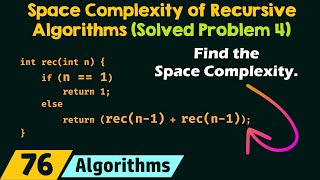
Space Complexity of Recursive Algorithms - Problem 4
Master the calculation of space complexity in recursive algorithms through a detailed solved example demonstrating key analytical techniques and practical applications.
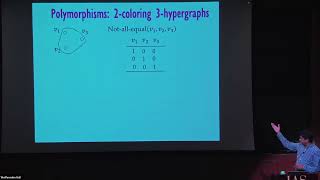
When and How are Promise Constraint Satisfaction Problems Efficiently Solvable
Delve into the mathematical foundations of Constraint Satisfaction Problems (CSP), exploring algorithmic efficiency, polymorphisms, and promise CSP applications in graph coloring and discrepancy minimization.

Differences Between Divide and Conquer and Dynamic Programming in Algorithm Design
Understand key distinctions between Divide & Conquer and Dynamic Programming approaches in algorithm design, exploring their unique problem-solving methodologies and implementation strategies.

Introduction to Hashing in Data Structures - Hash Functions, Hash Tables, Hash Keys, and Hash Values
Master the fundamentals of hashing in data structures, including hash functions, tables, keys, and values. Learn efficient data storage and retrieval techniques for optimized programming solutions.

Identity Check Problem for Shallow Quantum Circuits
Explore an efficient classical algorithm for checking quantum circuit identity, focusing on shallow geometrically local circuits and their distance approximation to identity channels.
Finite Time Analysis of Temporal Difference Learning with Linear Function Approximation: Tail Averaging and Regularization
Delve into advanced temporal difference learning analysis, exploring tail-averaging techniques and regularization methods for improved convergence rates in reinforcement learning applications.

Network Security and Cryptography - Lecture 2
Explore advanced network algorithms, protocols, and architectures in this comprehensive lecture on computer networking fundamentals and cutting-edge technologies.

How to Calculate Time Complexity with Examples - Part 1
Learn to calculate time complexity with practical examples, focusing on analyzing algorithms efficiently for better problem-solving and optimization in computer science.
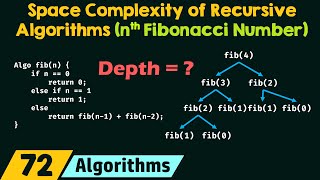
Space Complexity of Recursive Algorithms - nth Fibonacci Number
Analyze space complexity of recursive algorithms using the nth Fibonacci number as an example. Explore the Fibonacci sequence and its implementation.
Graph SAGE - Inductive Representation Learning on Large Graphs - GNN Paper Explained
Deep dive into Graph SAGE, exploring its innovative approach to large-scale graph learning. Covers key concepts, training methods, aggregator functions, and comparisons with other graph neural networks.
Improving Intrinsic Exploration with Language Abstractions - Machine Learning Paper Explained
Explores using natural language to improve reinforcement learning agents' exploration in sparse-reward environments, demonstrating significant performance gains across challenging tasks in MiniGrid and MiniHack.

Beyond Worst-Case Analysis - Panel Discussion
Experts discuss advanced algorithmic analysis, exploring beyond worst-case scenarios to improve efficiency and understanding in computer science and machine learning applications.
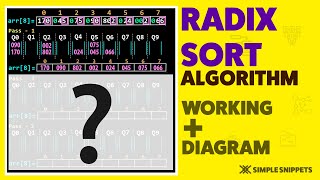
Radix Sort (Bucket Sort) Sorting Algorithm - Part 1
Comprehensive tutorial on Radix Sort algorithm, covering its working principles, implementation using queues, and step-by-step explanation with diagrams for efficient non-comparative sorting.
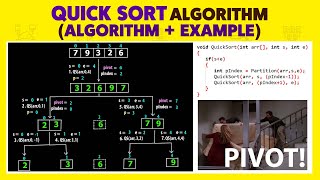
Quick Sort Algorithm - How It Works with Example Diagram - Part 1
Comprehensive visual explanation of Quick Sort algorithm, including its partitioning process, pivot selection methods, and step-by-step demonstration using diagrams and examples.
Space Complexity of Algorithms - Calculation and Analysis
Learn to calculate and understand space complexity in algorithms, including auxiliary space, big O notation, and practical examples for various algorithm types.

Big Oh vs Big Omega vs Big Theta Notations - Asymptotic Analysis of Algorithms with Example
Explore Big O, Omega, and Theta notations for algorithm analysis. Learn their mathematical definitions, practical applications, and differences in measuring best, worst, and average-case time complexities.

What Is Big O Notation and Time Complexity of Algorithms - Algorithm Analysis in Data Structures
Comprehensive tutorial on Big O notation, time complexity, and algorithm analysis in data structures. Covers key concepts, practical examples, and calculation methods.