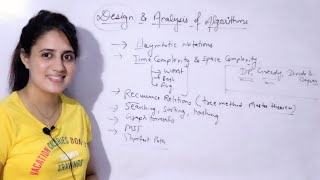
Design and Analysis of Algorithms
Explore algorithm fundamentals, analysis techniques, and key concepts for GATE/NET exams. Learn to write effective algorithms and understand their properties.
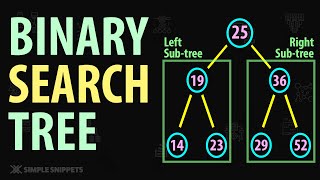
Binary Search Tree Data Structure - How BST Has O(log N) Time Complexity for Searching? - DSA
Comprehensive exploration of Binary Search Trees, covering structure, time complexity analysis, and comparisons with linear data types. Ideal for understanding BST efficiency.
An Introduction to Boolean Function Analysis - Dor Minzer
Explore Boolean function analysis, covering influences, PCP theory, and hypercontractive inequalities. Gain insights into fundamental concepts and advanced techniques in discrete mathematics and theoretical computer science.
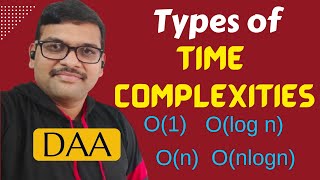
Types of Time Complexities in Data Structures and Algorithms
Explore various time complexity types in algorithm analysis, understanding their impact on performance and efficiency in solving computational problems.

How to Calculate Time Complexity of an Algorithm - Solved Questions
Comprehensive guide to calculating time complexity in Hindi, covering Big O notation and algorithm analysis with practical examples and solved questions for interview preparation.

Best Case, Worst Case and Average Case Analysis of Algorithms
Explore best, worst, and average case analysis for algorithms and data structures. Learn essential techniques to evaluate algorithm efficiency and performance in different scenarios.

Asymptotic Notations - Big O, Big Omega and Big Theta Explained
Comprehensive explanation of asymptotic notations used in algorithm analysis, covering Big O, Big Omega, and Big Theta with practical examples and downloadable notes.

Dijkstra's Algorithm - Finding Single Source Shortest Path
Explore Dijkstra's algorithm for finding the shortest path in graphs. Learn its implementation, applications, and role in greedy methods for efficient problem-solving.
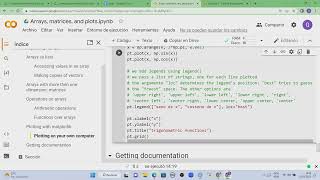
Computational Methods for Simulating and Analyzing Ecological Systems - Class 4
Explore computational methods for ecological simulations and analysis, focusing on plotting techniques, floating points, and algorithmic problem-solving in quantitative ecology.
Randomness and Complexity - Lecture 2
Explore connections between randomness and complexity in mathematics, focusing on advanced concepts and their applications in discrete mathematics and computer science.
Fast Fourier Transform - Lecture 7c of CS Theory Toolkit
Explore the Fast Fourier Transform algorithm and its application in efficient integer multiplication, with insights from a CMU graduate-level computer science theory course.

Aspects of Convex, Nonconvex, and Geometric Optimization
Explore advanced optimization techniques in convex, nonconvex, and geometric contexts with expert insights on signal processing applications and mathematical foundations.
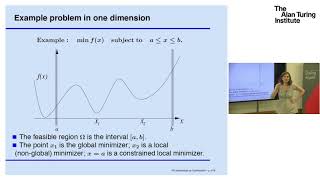
Optimisation - An Introduction: Professor Coralia Cartis, University of Oxford
Explore optimization techniques, from basic concepts to advanced methods, covering minimizers, derivatives, quadratic functions, and gradient methods for solving complex mathematical problems.
Expander Graph Application 2: Derandomization - Lecture 16c of CS Theory Toolkit
Explore derandomization techniques using expander graphs to reduce error in randomized algorithms without significantly increasing random bits used.
Finding Large Cliques in Random and Semi-Random Graphs
Explore algorithms for finding large cliques in graphs, including constructive arguments, polynomial-time proofs, and paradigms for tackling this NP-hard problem.

An Improved Cutting Plane Method for Convex Optimization, Convex-Concave Games
Explore advanced cutting plane methods for convex optimization and games, covering improved algorithms, runtime bottlenecks, data structures, and practical applications in computational mathematics.
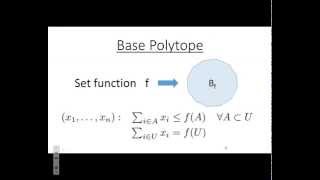
Provable Submodular Function Minimization via Fujishige Wolfe Algorithm
Explore submodular function minimization through the Fujishige-Wolfe algorithm, analyzing its convergence and implications for combinatorial optimization.
Functions of Matrices - Lecture 5
Explore matrix functions with Nick Higham, covering algorithms, analysis, nonnormality bounds, and practical coding experiments for advanced mathematical understanding.
The Sharp Threshold for Making Squares
Explores the threshold for finding perfect square products in random integer sequences, combining number theory and probabilistic combinatorics to prove a conjecture on this sharp threshold.
Cutoff for Biased Transpositions in Card Shuffling
Explore card shuffling algorithms and mixing times with biased transpositions, extending Diaconis and Shahshahani's work on random transpositions in deck shuffling.
Maximal Matching in Bounded-deletion Streams
Explore maximal matching in bounded-deletion graph streams, analyzing space complexity as a function of deletion parameter K. Gain insights into algorithmic techniques and lower bound results.