The Ham Sandwich Theorem and the Continuum - Algebraic Topology Lecture 14
Explore the Borsuk-Ulam theorem, Ham Sandwich theorem, and their applications in algebraic topology. Learn how these concepts relate to continuous maps and homeomorphisms in affine spaces.
Applications of Euler's Formula and Graphs in Algebraic Topology
Explore Euler's formula applications to Platonic solids, polyhedra, and higher dimensions. Learn about planar graphs and delve into advanced geometric concepts in algebraic topology.
Delta Complexes, Betti Numbers, and Torsion in Algebraic Topology
Explore homology groups of torus and projective plane using delta-complexes. Learn about Betti numbers and torsion in algebraic topology, with practical computations and insights into fundamental concepts.
More Homology Computations in Algebraic Topology - Lecture 2
Explore homology computations for the 2-sphere using tetrahedron and delta-complex models. Learn how linear algebra applies to topological problems and simplify calculations with semi-simplicial complexes.
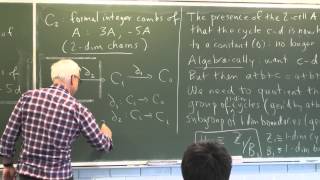
Introduction to Homology in Algebraic Topology - Part 2
Explores cycles, boundaries, and homology in algebraic topology, focusing on graph modifications and using commutative group theory to analyze formal combinations of geometric elements.
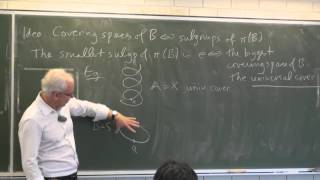
Universal Covering Spaces in Algebraic Topology
Explore fundamental groups, covering spaces, and universal covers. Learn about helical coverings, two-fold coverings, and connections between geometry and topology in this advanced algebraic topology lecture.
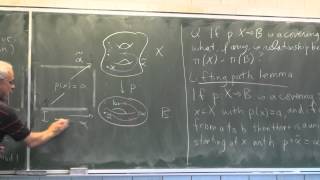
Covering Spaces and Fundamental Groups - Algebraic Topology Lecture 28
Exploring covering spaces and fundamental groups, focusing on torus examples and key lemmas to understand relationships between covering spaces and base spaces.
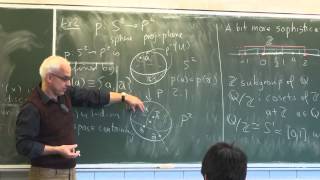
Covering Spaces in Algebraic Topology
Explore covering spaces in algebraic topology, including fundamental groups, line-circle coverings, sphere-projective plane relations, and torus knots. Visualize complex topological concepts through practical examples.
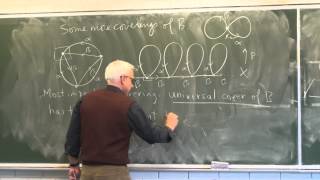
Covering Spaces and 2-Oriented Graphs - Algebraic Topology
Explore covering spaces through wedge of circles, examining graphs with labeled edges. Learn about universal covering spaces and their fundamental groups in algebraic topology.
Free Abelian Groups and Non-Commutative Groups - Algebraic Topology Review 4
Explore free abelian groups and their role in algebraic topology. Learn about the Fundamental Theorem of Finitely Generated Commutative Groups and non-commutative groups, including cosets and normal subgroups.
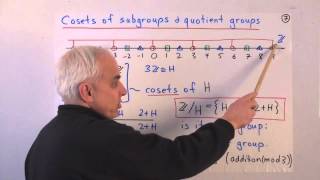
Commutative Groups: Isomorphisms, Homomorphisms, Cosets and Quotient Groups - Lecture 3
Explore commutative groups, isomorphisms, homomorphisms, cosets, and quotient groups. Learn the fundamental structure theorem and its applications in understanding group theory concepts.
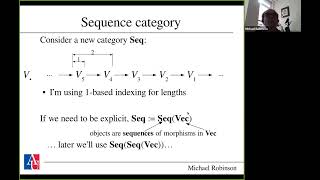
The Snake Lemma and Indecomposable Chain Maps
Explore the snake lemma's connecting homomorphism through vector space chain complexes, using Escolar and Hiraoka's representation to simplify proofs and reveal key indecomposable chain maps.
Hodge Structures in 8-Dimensional Homotopy Hopf Manifolds
Explore Hodge structures on 8-dimensional homotopy Hopf manifolds, examining connections between these structures and K3 surfaces, with implications for Homological Mirror Symmetry.
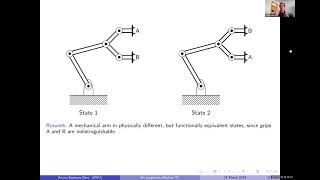
Effective Topological Complexity and Effective Lusternik-Schnirelmann Category
Exploring effective topological complexity and Lusternik-Schnirelmann category in motion planning, focusing on symmetries in configuration spaces and their impact on problem complexity.
Simplicial Complexes and Face Rings - January 29, 2024
Explore simplicial complexes and face rings, including stars and links, and their correspondence in Stanley-Reisner rings. Gain insights into fundamental concepts of algebraic topology.
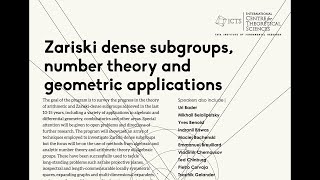
Lower Dimensional Betti Numbers of Homogeneous Spaces of Lie Groups
Exploration of lower dimensional Betti numbers in homogeneous spaces of Lie groups, discussing mathematical techniques and applications in algebraic topology and differential geometry.
Lefschetz Operators on Minkowski Valuations
Explore Lefschetz operators' action on continuous Minkowski valuations compatible with rigid motions, including difference body, projection body, and mean section body maps.
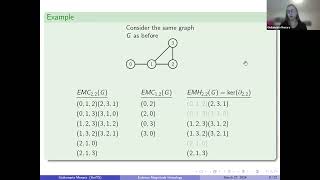
Eulerian Magnitude Homology - Subgraph Structure and Random Graphs
Explore connections between magnitude homology group ranks and graph substructures. Introduces eulerian and discriminant magnitude homology, relating them to subgraph counts and random graph models.
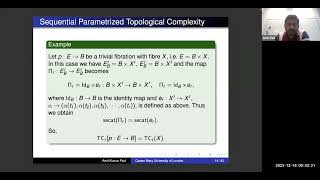
Sequential Parametrized Topological Complexity of Sphere Bundles
Introduction to sequential parametrized motion planning and its application to sphere bundles, exploring algorithms that navigate systems through prescribed states while adapting to variable external conditions.
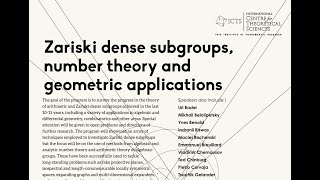
Central Extensions of Arithmetic Lattices by Matthew Stover
Explore central extensions of arithmetic lattices, focusing on techniques from algebraic and analytic number theory. Gain insights into applications in geometry, topology, and mathematical physics.
Uniform Stability of Higher-rank Lattices - Lecture 2
Explore uniform stability in higher-rank arithmetic groups, focusing on advanced mathematical concepts and their applications in group theory and geometry.