Random Monomial Ideals - Seminar on Applied Geometry and Algebra
Explore probabilistic models of random monomial ideals, their properties, and applications in algebraic geometry. Gain insights into average behavior of ideals and potential for generating algebraic objects.
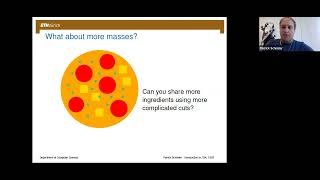
Topological Methods in Discrete Geometry
Explore topological applications in discrete geometry, focusing on mass partitions and Helly-type theorems. Learn about classical results and recent generalizations in these areas.
Graduate Course on the Tangent Groupoid in Noncommutative Geometry - Lecture 4
Explore advanced concepts in noncommutative geometry, focusing on the tangent groupoid and its applications in graduate-level mathematics.
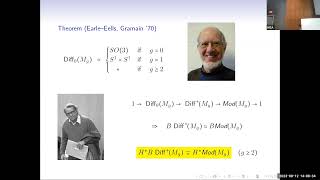
On Mapping Class Groups of Non-Orientable Surfaces
Exploración de la estructura y cohomología de grupos de clases de mapeo en superficies no orientables, incluyendo resultados recientes sobre el plano proyectivo y la botella de Klein.
A Local Torelli Theorem for Log Symplectic Manifolds
Explore log symplectic manifolds, their moduli space, and local Torelli theorem. Discover new components in Pn's moduli space of log symplectic structures.
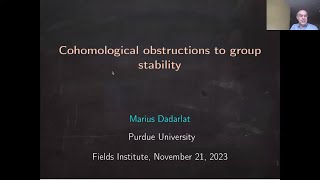
Cohomological Obstructions to Group Stability
Explore cohomological obstructions to group stability in this advanced mathematics seminar, delving into operator algebras and their applications in group theory.
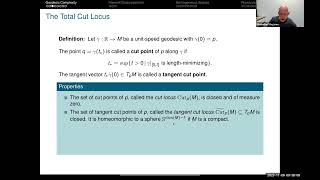
Geodesic Complexity and Fibered Decompositions of Cut Loci
Explore geodesic complexity in Riemannian manifolds, focusing on cut locus structure and fibered decompositions to establish bounds and applications in projective and lens spaces.
Homeomorphisms of Euclidean Space
Explore recent advances in understanding the topological group of homeomorphisms of Euclidean space, including methods and emerging conjectures in geometric topology.
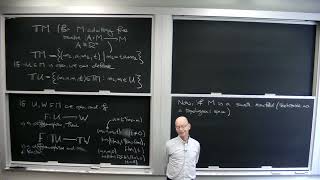
Tangent Groupoid in Noncommutative Geometry - Lecture 9
Explore advanced concepts in noncommutative geometry, focusing on the tangent groupoid and its applications in graduate-level mathematics.
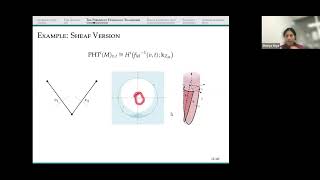
A Sheaf-Theoretic Construction of Shape Space
Sheaf-theoretic approach to construct shape space using Persistent Homology Transform. Explores homotopy sheaves, metrics, stability theorems, and approximation of manifolds.
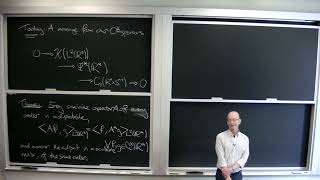
Tangent Groupoid in Noncommutative Geometry - Lecture 7
Explore advanced concepts in noncommutative geometry, focusing on the tangent groupoid and its applications in graduate-level mathematics.
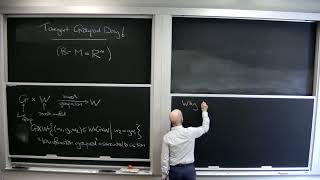
Tangent Groupoid in Noncommutative Geometry - Lecture 8
Explore advanced concepts in noncommutative geometry, focusing on the tangent groupoid and its applications in graduate-level mathematics.
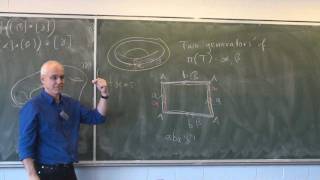
Fundamental Group of Surfaces - Multiplication and Properties
Explores fundamental group of surfaces, proving loop multiplication forms a group. Covers torus and projective plane, with examples and a problem on describing fundamental groups.
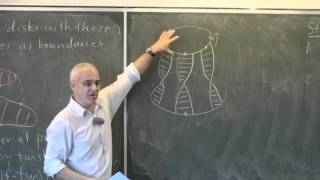
Knots and Surfaces - Seifert Surfaces in Algebraic Topology - Lecture 2
Explore Seifert surfaces, their construction for knots like the trefoil, and learn about Euler numbers for surfaces with boundaries in this advanced algebraic topology lecture.
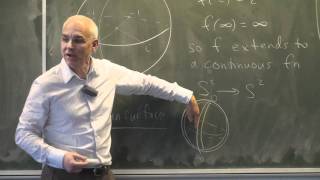
Sphere Geometry and Complex Analysis - Algebraic Topology Lecture 4
Explore advanced concepts in sphere geometry, including inversive geometry, Riemann sphere, complex analysis, and projective lines, enhancing understanding of algebraic topology.
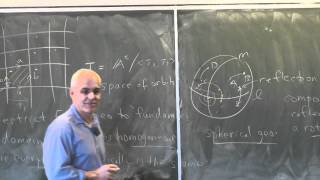
The Geometry of Surfaces - Algebraic Topology Lecture 20
Explore the connection between 2D surfaces and classical geometries, focusing on isometries and introducing hyperbolic geometry through circle inversions in the Beltrami Poincare disk model.
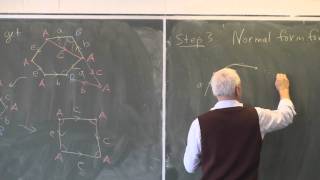
Classification of Combinatorial Surfaces - Lecture 2
Explores the classification of two-dimensional surfaces using polygon reduction techniques. Covers cutting, pasting, and creating crosscaps and handles to achieve standard forms in algebraic topology.
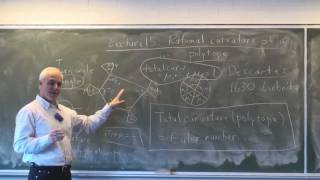
Rational Curvature of a Polytope - Algebraic Topology Lecture 15
Introduces a new rational definition of polytope curvature, using turn-angle to connect curvature with Euler number. Explores opposite cones and applies Harriot's theorem on spherical triangles.
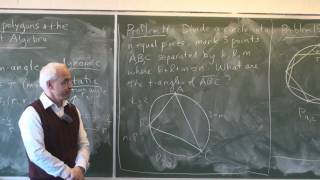
Duality for Polygons and the Fundamental Theorem of Algebra - Algebraic Topology Lecture 12
Explore duality in polygons and a rational proof of the Fundamental Theorem of Algebra using winding numbers. Gain insights into algebraic topology concepts and their applications.
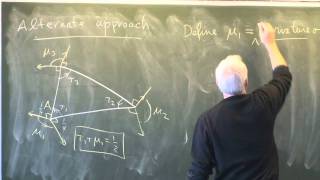
Rational Curvature, Winding, and Turning in Algebraic Topology - Lecture 11
Explores rational curvature, turn angles, and winding numbers in algebraic topology. Introduces new geometric concepts for describing polygons and planar curves, emphasizing practical applications in mathematics.
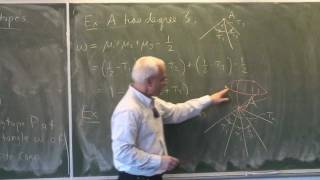
Rational Curvature of Polytopes and the Euler Number - Algebraic Topology Lecture 16
Explore the relationship between polyhedron curvature and Euler number using rational formulation. Learn about Harriot's theorem and analyze various polyhedra, including tetrahedron, cube, and dodecahedron.