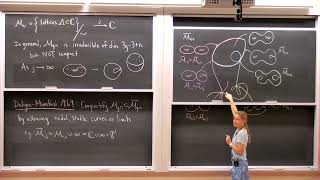
Cohomology of Moduli Spaces of Curves
Explore the intricate cohomology of curve moduli spaces with Hannah Larson, delving into advanced algebraic geometry concepts and their applications.
Quantum Complexity of Clique Homology
Explore the quantum mechanical structure in topology, connecting complexity theory to QMA hardness and examining implications for quantum algorithms and PCPs.
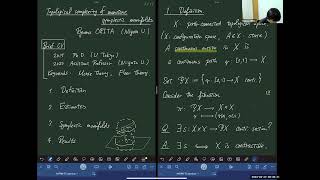
Topological Complexity of Monotone Symplectic Manifolds
Explore topological complexity in 4D spherically monotone manifolds, focusing on Kodaira dimension estimation and its implications for symplectic geometry.
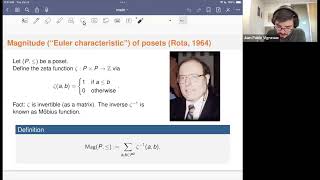
Combinatorial Approach to Categorical Möbius Inversion and Magnitude
Explore categorical Möbius inversion and magnitude through a combinatorial lens, uncovering new interpretations of Möbius coefficients and their implications for magnitude homology.
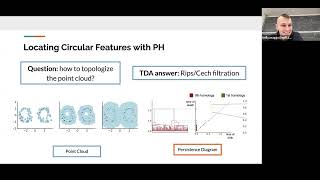
Cohomology Classes in the RNA Transcriptome
Explore how cohomology classes in single-cell sequencing data can model transient biological processes, using persistent cohomology and differential forms to infer gene expression dynamics.
Homological Percolation in a Torus
Explore homological percolation on tori, examining phase transitions in higher dimensions using algebraic topology. Discover new perspectives on percolation beyond traditional giant components.
Universally Counting Curves in Calabi-Yau Threefolds
Explore enumerative geometry through a new perspective on curve counting in complex threefolds, focusing on the Grothendieck group of 1-cycles and its implications for the MNOP conjecture.
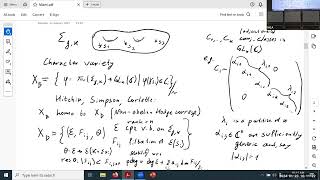
Cohomology Rings of Character Varieties
Explore cohomology rings of character varieties, including P=W conjecture proof and zero-dimensional COHA computation. Discover connections to Hilbert scheme of C^2 for punctured sphere case.
Chinese Remainder Theorem and Carlson's Theorem for Monoidal Triangulated Categories
Explore Carlson's connectedness theorem generalization for monoidal triangulated categories, including a Chinese remainder theorem version and Balmer support properties.

Stable Module Category for Finite Group Schemes over Commutative Noetherian Rings
Explore finite group schemes, tensor triangular analysis, and Balmer spectrum calculations in stable module categories, based on recent advancements in cohomology and representation theory.
Polynomial Superfunctors - Applications to Finite Supergroup Schemes
Explore polynomial superfunctors and their applications in finite supergroup schemes. Gain insights into cohomology calculations and recent developments in representation theory.
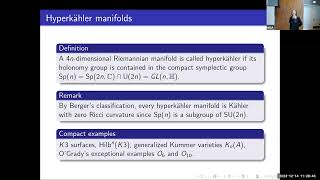
Twistor Spaces and Compact Manifolds Admitting Kähler and Non-Kähler Structures
Explore twistor spaces and compact manifolds with dual Kähler and non-Kähler structures. Discover historical examples and new findings in higher dimensions using quaternion twistor spaces of hyperkähler manifolds.
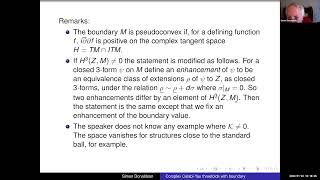
Complex Calabi-Yau Threefolds with Boundary
Explore complex Calabi-Yau threefolds with boundary, extending Hitchin's local Torelli Theorem. Discover connections to G2 structures and affine differential geometry in this advanced mathematical lecture.
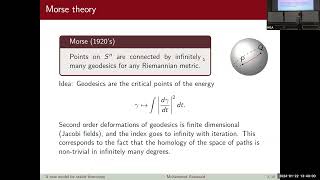
A New Model for Stable Homotopy - Extending Pontryagin-Thom Construction
Explore a new model for stable homotopy, extending the Pontryagin-Thom construction to the entire stable homotopy category through the lens of bordism theory.
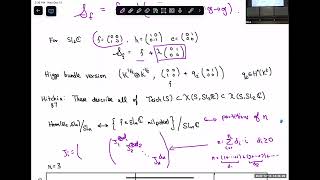
Higgs Bundles, Convex Cocompact Subgroups of SU(1,n), and Slodowy Slices
Explore Higgs bundles, SU(1,n) subgroups, and Slodowy slices. Discover connections between stable Higgs bundles and holonomy groups, focusing on SU(1,n) representations and complex hyperbolic manifolds.
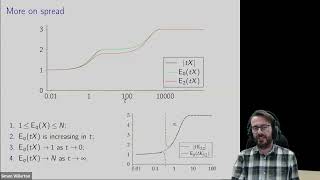
Instantaneous Dimension of Metric Spaces via Spread and Magnitude
Explore how spaces exhibit different dimensions at various scales using spread and magnitude concepts. Learn to quantify this phenomenon and its connections to diverse mathematical areas.
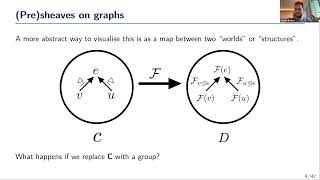
A Sheaf-based Approach to Graph Neural Networks
Explore sheaf theory's application to Graph Neural Networks, offering a novel perspective on Geometric Deep Learning beyond traditional geometric structures.
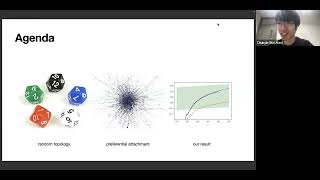
The Asymptotics of Betti Numbers in Preferential Attachment Clique Complexes
Explore the higher-order connectivity of preferential attachment networks through Betti numbers, examining growth rates and asymptotic behavior in this advanced mathematical analysis.

A^1-Brouwer Degrees in Macaulay2
Explore A^1-Brouwer degrees using Macaulay2 software in this Fields Institute talk by Thomas Brazelton from Harvard University, focusing on applications in enumerative geometry.
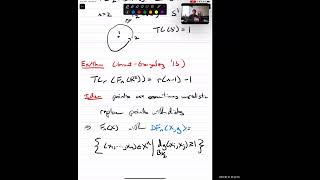
Disk Configuration Spaces and Topological Complexity
Exploring disk configuration spaces, their topology, and topological complexity, focusing on ordered configurations of unit-diameter disks in infinite strips and their geometric implications.
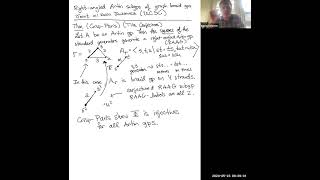
Right-Angled Artin Subgroups of Graph Braid Groups
Explore right-angled Artin subgroups in graph braid groups, examining recent conjectures and their applications to topological complexity in algebraic topology.