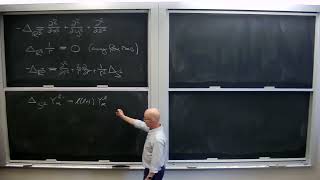
Graduate Course on the Tangent Groupoid in Noncommutative Geometry - Lecture 1
Explore advanced concepts in noncommutative geometry, focusing on the tangent groupoid and its applications in graduate-level mathematics.
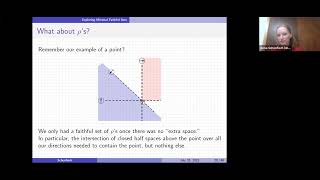
Ordering Descriptor Types by Their Ability to Faithfully Represent Shapes
Explore topological descriptors in shape comparison, focusing on augmented vs non-augmented types and their ability to faithfully represent simplicial complexes. Accessible discussion with interesting open questions and visuals.
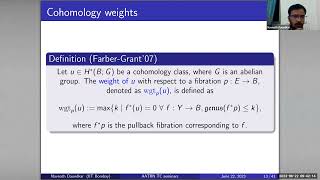
An Upper Bound on the Sequential Topological Complexity
Exploring upper bounds on sequential topological complexity in robot motion planning, with applications to lens spaces and improved dimensional upper bounds under group actions.
Alexander Petrov: On de Rham Cohomology in Positive Characteristic
Explores de Rham cohomology in positive characteristic, discussing Hodge decomposition analogs, isomorphism failures, and structures on de Rham complexes over F_p, including Sen operators and Frobenius pullback decompositions.
Comparing the Baum-Connes Conjecture and the Farrell-Jones Conjecture
Vergleich der Baum-Connes-Vermutung und der Farrell-Jones-Vermutung in der algebraischen und geometrischen Topologie, mit Fokus auf Gemeinsamkeiten und Unterschiede.
Localisation in Homotopy Theory by Abhinandan Das
Explore localization techniques in homotopy theory, focusing on applications and implications for understanding topological spaces and their properties.
Duality and Stratification in Commutative Algebra by Srikanth B. Iyengar
Explore duality and stratification in commutative algebra, focusing on derived categories, triangulated structures, and connections to algebraic topology and representation theory.
Ambidexterity in Topology and Algebra - Lecture 4
Explore ambidexterity in topology and algebra, focusing on duality phenomena and classification problems in tensor-triangulated categories. Gain insights into advanced mathematical concepts.
Duality and Stratification in Commutative Algebra - Lecture 4
Explore duality and stratification in commutative algebra, focusing on derived categories, Grothendieck duality, and connections to algebraic topology and representation theory.
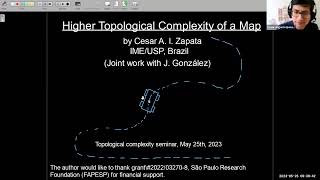
Higher Topological Complexity of a Map
Explore higher topological complexity of maps, extending Farber's concept. Learn about unified TC_{r,s}(f) and its relevance in r-multitasking motion planning for robot devices with s prescribed stages.
Stratification and Duality for Representations of Finite Groups - Lecture 4
Explore finite group representations through stratification and duality concepts. Delve into advanced algebraic techniques and their applications in modular representation theory.
Duality and Stratification in Commutative Algebra - Lecture 3
Explore duality and stratification in commutative algebra, focusing on derived categories, Grothendieck duality, and connections to algebraic topology and representation theory.
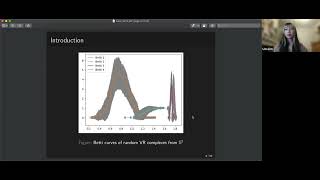
Strange Random Topology of the Circle
Explore the intriguing behavior of "topological noise" in random Cech complexes constructed from the circle, revealing unexpected homotopy equivalences and higher Betti numbers in specific filtration radii intervals.
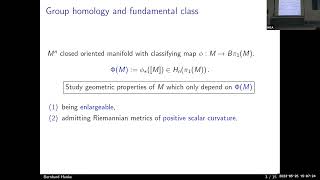
Bernhard Hanke, Augsburg University - Large and Small Group Homology
Explore group homology's surprising role in encoding metric properties of smooth manifolds, including enlargeability and positive scalar curvature, with applications and key concepts explained.
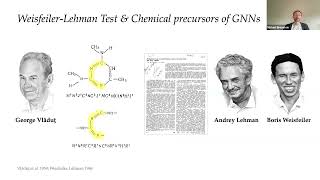
Michael Bronstein: Physics-Inspired Graph Neural Networks
Explore physics-inspired continuous learning models for graph neural networks, leveraging tools from differential geometry and algebraic topology to enhance expressive power beyond traditional message-passing paradigms.
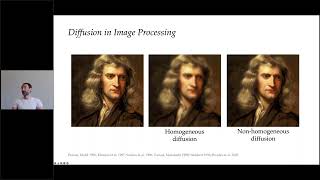
Physics-Inspired Learning on Graph - Michael Bronstein, PhD
Explore physics-inspired continuous learning models for graphs, challenging traditional message-passing paradigms. Discover new approaches using differential geometry, algebraic topology, and differential equations to revolutionize graph machine learning.
Residues and Trace Maps in Grothendieck Duality - Lecture 4
Explore residues and trace maps in Grothendieck Duality, advancing understanding of algebraic geometry and commutative algebra concepts within the broader context of dualities in topology and algebra.
Ambidexterity III by Neil Strickland
Explore advanced concepts in algebraic topology, focusing on ambidexterity and its applications in duality phenomena within tensor-triangulated categories.
Quillen Stratification Theorems - Lecture 4
Explore Quillen Stratification Theorems in algebraic topology, examining their applications and implications for understanding cohomological support varieties and triangulated categories.
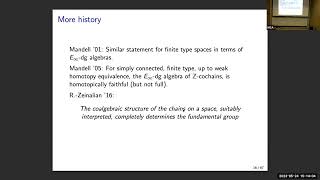
Homotopy Theories of Coalgebras
Explore homotopy theories of simplicial coalgebras, extending algebraic models for p-adic homotopy theory to include fundamental groups. Discover key ideas and potential G-equivariant analogs.
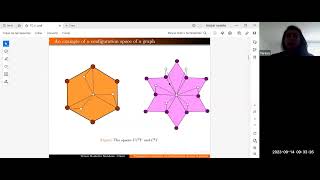
Bounds for the Higher Topological Complexity of Configuration Spaces
Explore bounds for higher topological complexities in unordered configuration spaces of trees and anchored configuration spaces of circles with two anchor points.