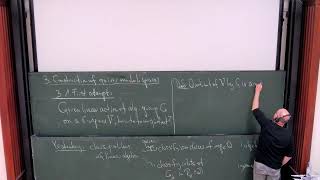
Felix Klein Lectures 2020 - Quiver Moduli and Applications
Explore quiver moduli spaces' construction, topology, and geometry, with focus on cohomology and applications to Gromov-Witten and Donaldson-Thomas theories via wall-crossing.
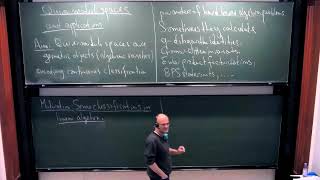
Felix Klein Lectures 2020- Quiver Moduli and Applications
Explore quiver moduli spaces: their construction, topology, and applications in representation theory, Gromov-Witten theory, and Donaldson-Thomas theory. Gain insights into these algebraic varieties and their geometric properties.
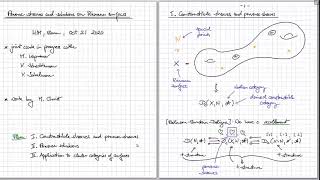
Perverse Sheaves and Schobers on Riemann Surfaces - Tobias Dyckerhoff
Explore derived constructible categories on stratified Riemann surfaces, t-structures, Verdier duality, and categorified perverse sheaves with applications in algebraic geometry and topology.
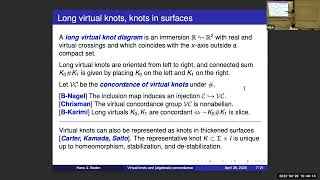
Hans Boden, McMaster University - Virtual Knots and Algebraic Concordance
Explore virtual knots, concordance groups, and new invariants using mock Seifert matrices. Discover algebraic structures and open problems in knot theory.
Generic Character Sheaves for Parahoric Subgroups
Exploration of Lusztig's character sheaves theory, extending to positive-depth cases and addressing Lusztig's conjecture. Focuses on perverse sheaves and parahoric Deligne-Lusztig induction in representation theory.
Residues and Trace Maps in Grothendieck Duality - Lecture 3
Explores residues and trace maps in Grothendieck duality theory, advancing understanding of algebraic geometry and commutative algebra concepts for researchers and advanced students.
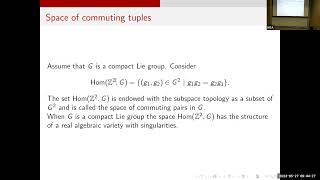
On the Second Homotopy Group of Spaces of Commuting Elements in Lie Groups
Explore the computation of the second homotopy group of Hom(Z^n, G) spaces, focusing on compact Lie groups. Learn about geometric generators and specific results for simply connected, simple groups.
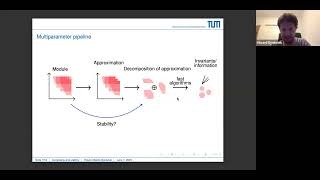
Stabilizing Decomposition of Multiparameter Modules
Explores stability theories for multiparameter module decomposition, addressing challenges and presenting recent findings. Discusses potential strengthening of stability results for staircase decomposable modules.
Gorenstein Duality in Topology - Lecture 3
Explore Gorenstein duality in topology, examining its connections to algebraic geometry and representation theory. Gain insights into advanced mathematical concepts and their applications.
Stratification and Duality for Representations of Finite Groups - Lecture 2
Explore advanced concepts in finite group representation theory, focusing on stratification and duality principles. Gain insights into algebraic structures and their applications in mathematics.
Introduction to Chromatic Homotopy Theory - Lecture 2
Explore chromatic homotopy theory's foundations, techniques, and applications in algebraic topology. Delve into advanced concepts and their significance in modern mathematical research.
Gorenstein Duality in Topology - Lecture 2
Explore Gorenstein duality in topology, connecting algebraic concepts to topological structures and generalizing Poincaré duality for manifolds in this advanced mathematical lecture.
Introduction to Chromatic Homotopy Theory - Lecture 4
Explore chromatic homotopy theory's advanced concepts and applications in algebraic topology, building on previous lectures to deepen understanding of this complex mathematical field.
Quillen's Stratification Theorems - Lecture 3
Explore Quillen's Stratification Theorem(s) in algebraic topology, focusing on key concepts, applications, and implications for understanding cohomological support varieties and triangulated categories.
Ambidexterity in Topology and Algebra - Lecture 2
Explore ambidexterity in topology and algebra, focusing on duality phenomena and classification problems in tensor-triangulated categories. Gain insights into advanced mathematical concepts and their applications.
Morava E-Theory - Prep 6
Explore Morava E-Theory in algebraic topology, connecting concepts from commutative algebra and modular representation theory. Gain insights into duality phenomena and classification problems in tensor-triangulated categories.
Quillen's Stratification Theorems - Lecture 2
Explore Quillen's Stratification Theorem(s) in algebraic topology, focusing on key concepts, applications, and implications for understanding cohomological support varieties and triangulated categories.
Stratification and Duality for Representations of Finite Groups - Lecture 3
Explore advanced concepts in finite group representation theory, focusing on stratification and duality principles. Gain insights into algebraic structures and their applications in mathematics.
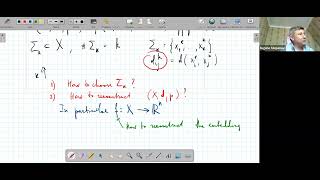
Reconstructing Hidden Geometric Structures in Data From Distance Matrices
Explore techniques for reconstructing metric spaces and embeddings from distance matrices, covering theoretical foundations, practical applications, and open problems in geometric data analysis.
Differential Topology for Diamonds
Explores Banach-Colmez tangent spaces for diamonds in smooth rigid analytic varieties, proposing conjectures on preperfectoid loci and cohomological smoothness, with examples and computations.
Bi-Lipschitz Embeddings of the Space of Persistence Barcodes
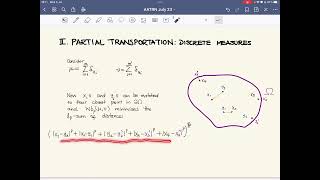
Explore bi-Lipschitz embeddings of persistence barcodes into Hilbert space, focusing on Figalli and Gigli's metric for optimal partial transport and its applications to unordered m-tuples.