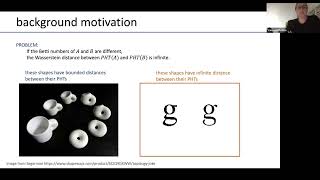
Vanessa Robins - The Extended Persistent Homology Transform for Manifolds with Boundary
Explore extended persistent homology transform for shape analysis, offering finite distances between shapes with different Betti numbers and applications in shape clustering.
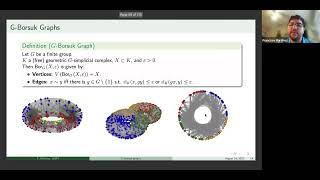
Chromatic Number of G-Borsuk Graphs
Explore G-Borsuk graphs, their chromatic numbers, and topological connections. Delve into G-actions, Hom-complexes, and random graph thresholds for a deeper understanding of this algebraic topology concept.

New Results in Computing Zigzag and Multiparameter Persistence
Explore new advancements in computing zigzag and multiparameter persistence, including efficient conversion methods and improved algorithms for 2-parameter persistence modules.
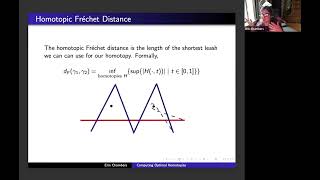
Computing Optimal Homotopies
Explore optimal curve similarity measures using homotopy-based approaches, examining structural properties, algorithms, and open questions in topology and computational geometry.
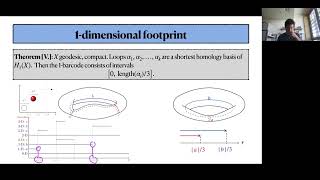
Žiga Virk - Information Encoded in Persistence Diagrams
Explore topological data analysis through persistence diagrams, uncovering spatial properties like homology, geodesics, and proximity in various mathematical contexts.
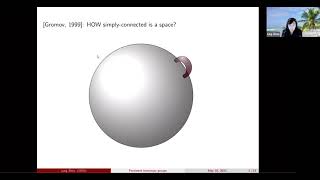
Persistent Homotopy Groups of Metric Spaces
Explore persistent homotopy groups of metric spaces, their stability, and advantages over persistent homology. Learn about tree-like structures and ultrametrics in fundamental groups.
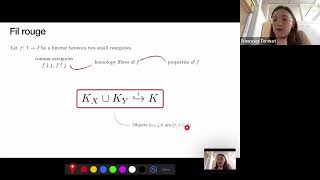
What's Behind the Homotopical Decomposition of a Simplicial Complex
Explore homotopical decomposition of simplicial complexes, focusing on conditions for homotopy type preservation and the mathematics behind decomposability results.

Chirality and Quantifying Embeddability
Explore chirality, embeddings, and non-embeddability in topology, with applications to chemical structures and generalizations of classical results.
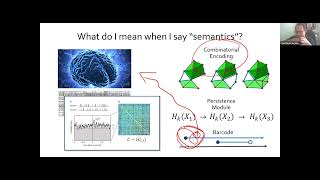
An Approach to Assigning Semantics to Persistent Homology Classes
Explore a novel approach to interpreting persistent homology classes in applied settings, overcoming traditional limitations by leveraging comparative measurements against known models.

Fedor Manin - Linear Nullhomotopies of Maps to Spheres
Explore controlled Lipschitz constant nullhomotopies of maps to spheres, focusing on mathematical techniques and recent research developments in algebraic topology.
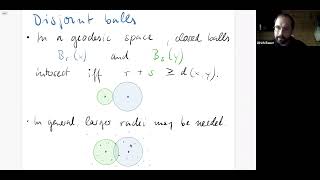
Ulrich Bauer - Gromov Hyperbolicity, Geodesic Defect, and Apparent Pairs in Rips Filtrations
Explore Gromov hyperbolicity, geodesic defect, and apparent pairs in Rips filtrations, extending Rips' results on contractibility and examining computational implications for persistent homology.
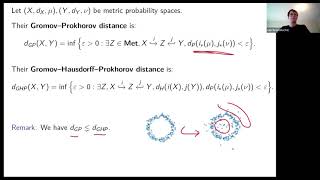
Luis Scoccola - Density-Sensitive and Robust Vietoris-Rips Filtrations
Explore density-sensitive and robust Vietoris-Rips filtrations in algebraic topology, including function-Rips, degree-Rips, and subdivision-Rips, with applications and open questions.
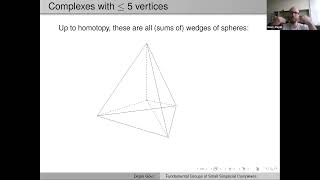
Dejan Govc - Fundamental Groups of Small Simplicial Complexes
Explore minimal triangulations of manifolds and fundamental groups of small simplicial complexes, with insights on estimating vertex counts in minimal triangulations.

Herbert Edelsbrunner Interviewed by Dmitriy Morozov - September 30, 2020
Insightful interview with Herbert Edelsbrunner, exploring his contributions to computational geometry and topology, career journey, and perspectives on the field's evolution and future directions.
Algebraic Tools for Multiparameter Persistent Homology
Explore advanced algebraic techniques for analyzing multiparameter persistent homology, including primary decomposition and multigraded algebra, with examples and applications in topology.
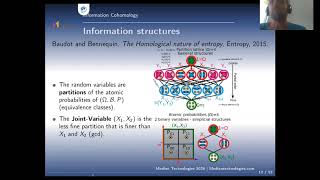
Cohomological Characterization of Information Structures
Exploring cohomological methods to quantify statistical interactions in datasets, linking information theory, statistical physics, and machine learning for improved data analysis and interpretation.
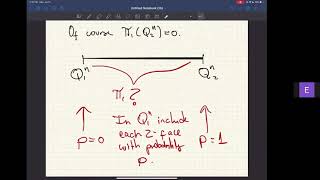
The Fundamental Group of 2-Dimensional Random Cubical Complexes
Explores fundamental groups in random 2D cubical complexes, analyzing their behavior and structure at different probability thresholds. Insights into topology and percolation theory.
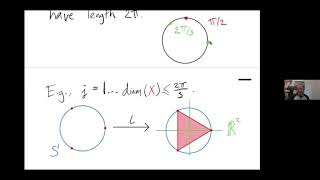
Borsuk–Ulam Theorems for Maps into Higher-Dimensional Codomains
Explore Borsuk-Ulam theorems for sphere maps to higher-dimensional spaces, examining topological properties and optimal diameter bounds for odd maps from S^n to R^k where k > n.
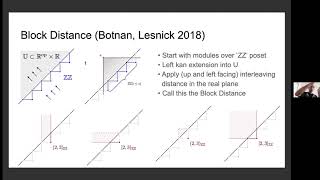
Comparative Stability of Two Zigzag Bottleneck Distances
Explores zigzag persistence in algebraic topology, comparing bottleneck distances for zigzag modules. Analyzes similarities and differences between approaches, focusing on Auslander-Reiten quiver perspective.
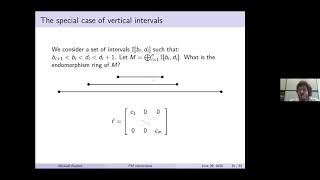
Every nD Persistence Module Is the Restriction of an (n+1)D Indecomposable Module
Explore a constructive process for building (n+1)D indecomposable modules from nD persistence modules, with insights on its implications and consequences.
Efficient Approximation of the Matching Distance for 2-Parameter Persistence
Explore efficient algorithms for approximating matching distance in 2-parameter persistence modules, focusing on quad-tree refinement and local adaptive bounds for improved computational performance.