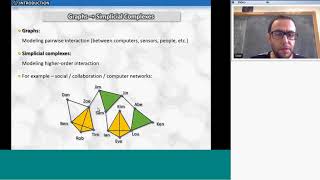
Omer Bobrowski - Maximally Persistent Cycles in Random Geometric Complexes
Explore persistent cycles in random geometric complexes, examining key tools, processes, and results. Gain insights into random graph theory and future research directions.
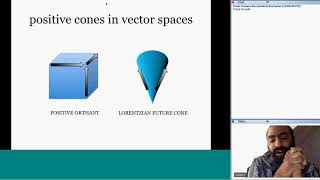
Sanjeevi Krishnan - Homological Programming
Explore algebraic topology applications in programming, covering pursuit-evasion problems, positive cones, Alexander duality, and directed topology, with insights into decomposability and computational aspects.
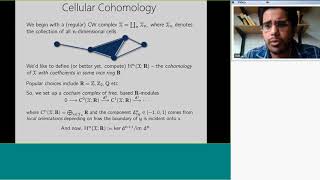
Vidit Nanda - Morse Theory for Local Coefficients
Explore Morse theory with local coefficients, covering cohomogeneous complexes, wave graphs, and isomorphisms. Delve into advanced topics and theorems in algebraic topology.
Applied Algebraic Topology Network - Student Seminar Introduction to JavaPlex
Learn to use JavaPlex for topological data analysis, covering key concepts like witness complexes, data representation, and visualization tools. Ideal for students exploring computational topology.
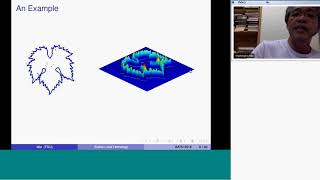
Washington Mio - Stable Homology of Metric Measure Spaces
Explore stable homology in metric measure spaces, covering Wasserstein distance, local homology stability, and applications in data analysis and taxonomic classification.
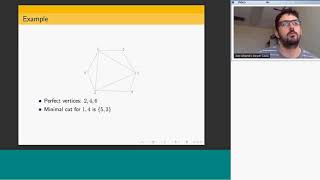
José Samper Seminar - Higher Chordality
Explore higher chordality in algebraic topology, covering community algebra, linear resolution, graphs, polytopes, and complex links. Gain insights into advanced mathematical concepts.
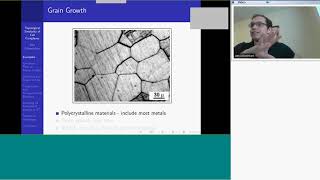
Benjamin Schweinhart - Statistical Topology of Random Cell Complexes, and Applications
Explore statistical topology of random cell complexes, covering curvature flow, grain growth, graph limits, and computational evidence for steady state hypothesis.
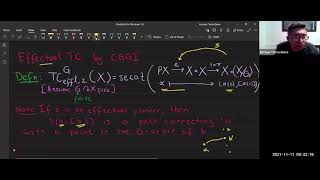
Enrique Torres-Giese - Sequential Motion Planning Assisted by Group Actions
Sequential motion planning with group actions: exploring effectual and effective TC, orbital topological complexity, and their relationships. Calculations for actions on orientable surfaces and spheres included.
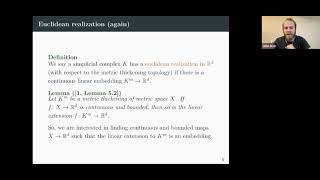
Johnathan Bush - Maps of Čech and Vietoris–Rips Complexes into Euclidean Spaces
Explore simplex-preserving maps in Čech and Vietoris–Rips complexes, their applications, and the challenge of finding such maps from various domains to Euclidean spaces.
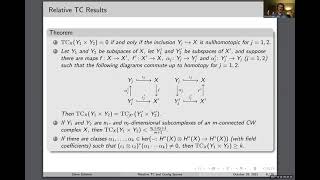
Steve Scheirer - Relative Topological Complexity and Configuration Spaces
Explore relative topological complexity and configuration spaces in this advanced algebraic topology talk, covering definitions, results, and applications.
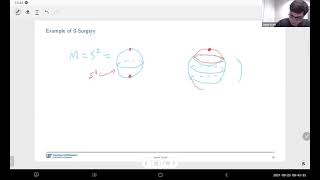
Jamie Scott - Applications of Surgery to a Generalized Rudyak Conjecture
Exploring applications of surgery theory to Rudyak's conjecture, discussing generalizations to topological complexity, and examining cases for simply connected codomains.
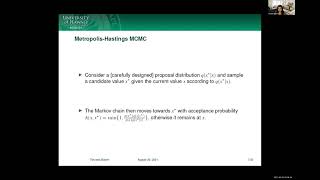
Farzana Nasrin - Random Persistence Diagram Generator
Explore a method for generating random persistence diagrams using parametric models and Markov chain Monte Carlo algorithms, with applications in material science and topology.
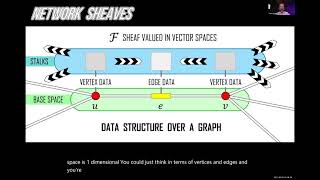
Robert Ghrist - Laplacians and Network Sheaves
Explore cellular sheaves, Laplacians, and network dynamics in algebraic topology. Learn about sheaf cohomology computation and applications in decentralized methods.
Emergent Network Geometry
Explore emergent network geometry, from complex networks to quantum spacetime, revealing hidden structures and applications in diverse fields like neuroscience and collaboration networks.
High Dimensional Expanders
Explore high-dimensional expanders, their mathematical properties, and applications in theoretical computer science. Learn about coboundary and spectral expansion, and their implications for complex structures.
The Slices of Hermitian K-Theory
Explore Hermitian K-theory's slices, their construction, and applications in algebraic geometry. Gain insights into Milnor's conjecture on quadratic forms through this advanced mathematical lecture.
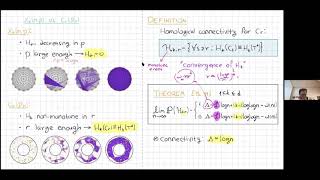
Omer Bobrowski - Random Simplicial Complexes
Explore higher-dimensional generalizations of random graphs, focusing on random d-complexes and Cech complexes. Learn about connectivity, cycle formation, and giant components in these structures.

Omer Bobrowski - Random Simplicial Complexes, Lecture I
Explore random simplicial complexes, their applications in data analysis, and key phenomena like connectivity and cycle formation. Includes introduction to algebraic topology and homology theory.
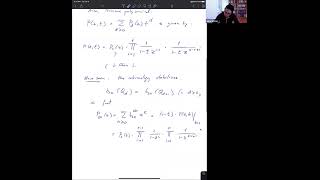
On the Cohomology of Quot Schemes Parametrizing Torsion Quotients on a Smooth Curve
Explore cohomology of Quot schemes on smooth curves, focusing on torsion quotients. Delve into additive basis, natural maps, and geometric interpretations with expert insights.
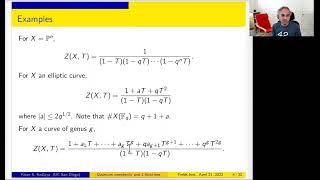
Quantum Complexity and L-functions
Explore quantum algorithms for L-functions and zeta functions, examining complexity results, cohomology's role, and applications to modular forms and Mordell-Weil theorem.
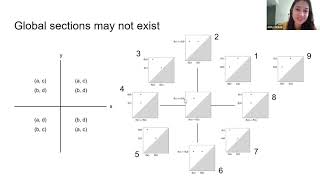
Persistence Diagram Bundles- A Multidimensional Generalization of Vineyards
Explore persistence diagram bundles, a multidimensional generalization of vineyards for analyzing topological changes in data sets with multiple parameters, including computation methods and potential applications.