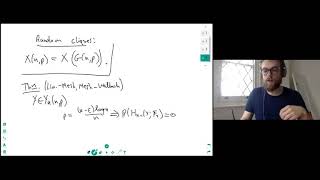
From Large to Infinite Random Simplicial Complexes
Explore two models of random simplicial complexes extending the Erdos-Renyi model, examining their Alexander duality relation and the unique infinite Rado simplicial complex.
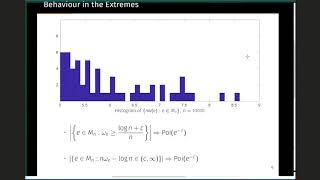
The Bulk and the Extremes of Online Minimal Spanning Acycles
Explores distributional properties of weights in random minimum spanning acycles, focusing on online settings. Examines bulk convergence to giant shadow measure and extremal convergence to inhomogeneous Poisson point process.
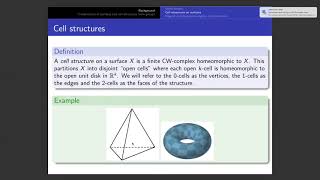
On a Canonical Construction of Tessellated Surfaces From Finite Groups
Explores a construction linking finite group multiplication tables to tessellated surfaces, discussing properties, group actions, and connections to classical mathematical constructions.
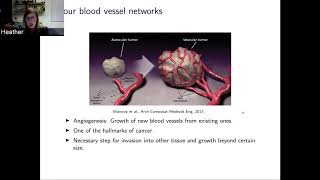
Heather Harrington - Multi-Parameter Persistent Homology and Applications
Explore multi-parameter persistent homology and its applications in topological data analysis, uncovering complex patterns and structures in high-dimensional datasets.
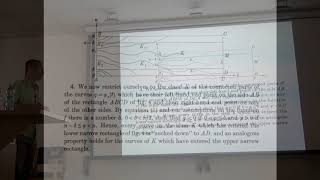
Bedlewo- On a Problem of Whitney and the Retract Theorem of Ważewski
Explores Whitney's inverted pendulum problem, its controversial solution, and the application of Ważewski's retract theorem to provide a rigorous mathematical argument for the original idea.
Topological Methods in Discrete Geometry - New Developments
Explores recent advancements in topological methods for discrete geometry, focusing on configuration spaces in cooperative game theory and their connections to embedding problems in Euclidean spaces.
Topological Complexity of Fibrations and Covering Maps
Explore topological complexity of fibrations and covering maps, examining their homotopy invariance and applications in robotics and mechanical device manipulation.
Solving Equations and Optimization Problems with Uncertainty
Explore algorithms for detecting zeros of imprecise continuous functions and approximating worst-case optima in optimization problems with uncertain feasible domains.
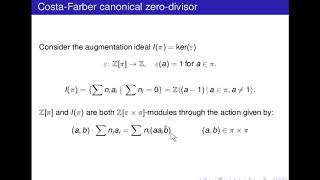
Bedlewo - Topological Complexity of the Klein Bottle
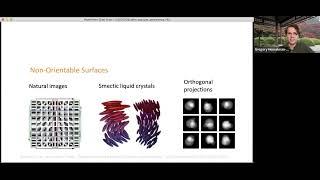
Explore the topological complexity of non-orientable surfaces, focusing on the Klein bottle and extending findings to surfaces of genus ≥2. Collaborative research insights shared.
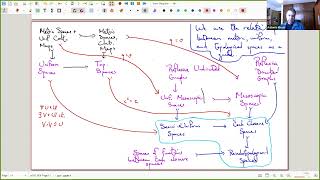
Antonio Rieser - Algebraic Topology for Graphs and Mesoscopic Spaces
Explore algebraic topology for graphs and mesoscopic spaces, covering homotopy, homology, and metric cohomology. Learn about pseudotopological spaces and their applications in various mathematical categories.
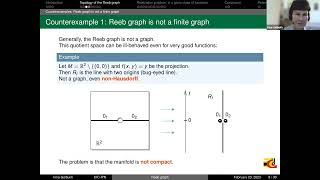
The Reeb Graph of a Smooth Function Encodes the Function Class and Manifold Type
Explore how Reeb graphs of smooth functions encode function class and manifold type, examining structures for Morse and Morse-Bott functions and their relationship to manifold properties.
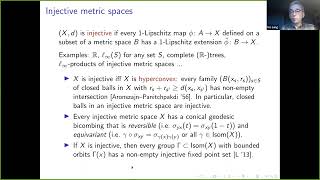
Urs Lang - Combinatorial Dimension and Higher-Rank Hyperbolicity
Exploration of (n,δ)-hyperbolicity in metric spaces, its relation to Gromov's δ-hyperbolicity, and applications in geometric group theory and hierarchically hyperbolic groups.
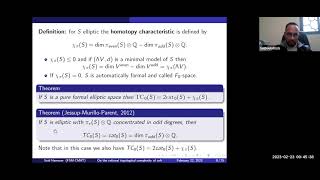
On the Rational Topological Complexity of Coformal Elliptic Spaces
Explore rational topological complexity bounds for elliptic spaces, focusing on coformal cases where it aligns with rational homotopy dimension.
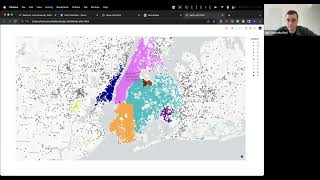
Recent Advances in Theory and Implementation of Multi-Parameter Persistence
Explores recent developments in multi-parameter persistence, covering stable filtrations and discrete descriptors. Includes interactive clustering software demo and discusses extensions of one-parameter persistence concepts.
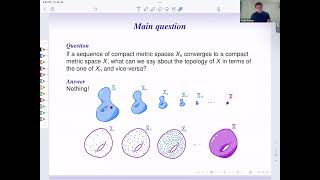
The Lower Semi-Continuity of Pi_1 and Nilpotent Structures in Persistence
Explore lower semi-continuity of π₁ in non-compact spaces, examining symmetries and nilpotent structures in persistence theory for compact geodesic space sequences.
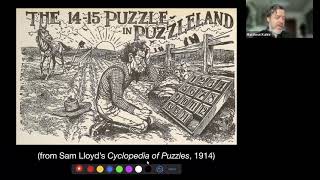
Configuration Spaces of Hard Squares
Exploring topology of configuration spaces with hard squares, focusing on Betti numbers' growth rate in confined regions. New insights into complex geometric arrangements.
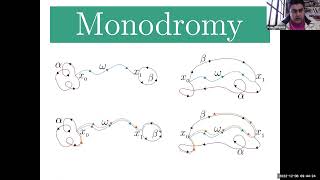
Symmetric and Symmetrized Topological Complexity of the Torus
Explore symmetric and symmetrized topological complexity of the torus, completing the description for closed surfaces using obstruction theory and explicit resolution of integers over full braid group.
Torsion Homology Growth and Related Topics
Explore torsion homology growth in compact CW complexes, examining Betti number growth in finite covers and connections to amenable category and minimal volume entropy.
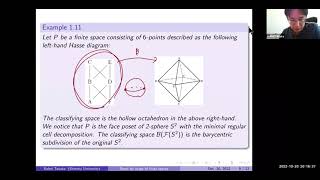
Kohei Tanaka - Sectional Category for Maps of Finite Spaces
Explore combinatorial approaches to sectional category in finite T_0 spaces, examining McCord maps, weak homotopy equivalences, and Fadell-Neuwirth fibrations through computational examples.
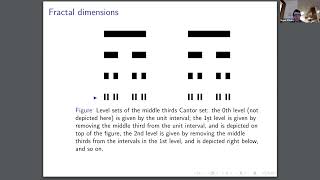
Alpha Magnitude
Explores alpha magnitude, a new metric space invariant, its properties, and potential for estimating fractal dimensions in real-world datasets, offering computational advantages over existing methods.
Saecular Persistence
Explore saecular persistence, a method to decompose persistence modules with non-field coefficients. Learn about applications in topology, generalized persistence diagrams, and scientific data analysis.