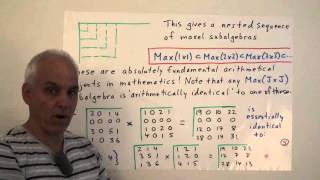
Maxel Algebra II - Data Structures in Mathematics
Exploring maxel algebra as an extension of matrix algebra, focusing on diagonal maxels and their role in projecting and restricting maxels, revealing nested matrix algebra structures.
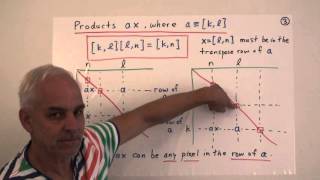
Maxel Theory - New Thinking About Matrices - Data Structures Math Foundations 168
Exploring maxel theory and its impact on linear algebra, focusing on pixel geometry and matrix multiplication for new insights into matrix algebra.
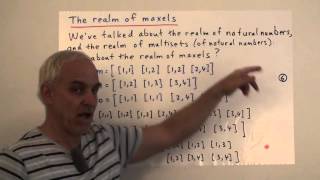
Maxel Theory: New Thinking About Matrices - Math Foundations 166
Explore Maxel theory, a novel approach to matrix theory using pixels. Learn about maxel algebra, multiplicative structure, and applications in linear algebra.
Teaching Connections Between Algebra and Geometry - Part 2
Exploring connections between algebra and geometry, including Cartesian geometry, conics, projective geometry, triangle geometry, and rational trigonometry for a fresh approach to math education.
Matrices, Determinants, and the Birth of Linear Algebra - A Historical Perspective
Explore the historical development of matrices and determinants, from ancient Chinese mathematics to modern linear algebra, featuring key contributors and their groundbreaking concepts.
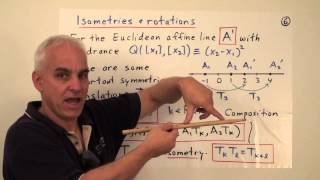
Algebraic Structure on the Euclidean Projective Line - Rational Geometry Math Foundations 137
Explores algebraic structure on the Euclidean projective line, covering projective formulas, isometries, rotations, and their compositions. Connects to chaos theory and complex number multiplication.
The Chromatic Algebra of 2x2 Matrices - Part 2
Explores chromatic algebra of 2x2 matrices, focusing on subalgebras, complexions, dot products, and the four-dimensional Dihedrons algebra. Compares to quaternions and highlights unique properties.
The Chromatic Algebra of 2x2 Matrices - Wild Linear Algebra B41
Explore chromatic algebra in 2x2 matrices, covering subalgebras, complexions, trace, determinant, and characteristic polynomials. Introduces unique dot products on 2x2 matrices.
Relativistic Dot Products and Complex Numbers in Linear Algebra - Part 2
Exploring triality of dot products and associated complex numbers in chromogeometry, organized within 2x2 matrices. Delves into interactions between three geometries.

Galois Theory I - Introduction to Polynomial Equations and Symmetries
Explore Galois theory's insights into solving polynomial equations, from quadratic to quartic, and the historical development of algebraic problem-solving techniques.
Historical Development of Group Theory - From Number Theory to Geometry
Explore the historical development of group theory, from its roots in number theory and algebra to its impact on geometry, covering key concepts and influential mathematicians.
Circles and Spheres via Dot Products - Part 1
Explore circles using dot products in linear algebra. Learn two approaches: quadratic and bilinear equations. Discover applications to tangents, pole/polar duality, and classical theorems in projective geometry.
Applications of the Dot Product to Planar Geometry - Part 2
Explore advanced applications of dot product in planar geometry, including linear functionals, point-normal form of lines, vector projections, isometries, and rotations.
Applications of the Dot Product to Planar Geometry - Part 1
Explore how the dot product shapes planar Euclidean geometry, introducing linear functionals, normal vectors for lines, and geometric projections in linear algebra.
The Rational Number Line and Irrationalities - Famous Math Problems 19b
Geometric approach to modeling the continuum using the rational number line. Explores properties, projective view, and introduces irrationalities through Euclidean geometry and polynomial equations.
Quadratic Curvature for Algebraic Curves - Differential Geometry Lecture 14
Explores quadratic curvature for algebraic curves, extending from parabolas to general conics. Discusses connections between curvature and foci, emphasizing the power of formulas in differential geometry.
Curvature for the General Parabola - Differential Geometry Lecture 13
Explores curvature of general parabolas using projective geometry, focus-directrix definition, and local behavior. Introduces formulas for parabola curvature as a foundation for understanding curvature of general curves.
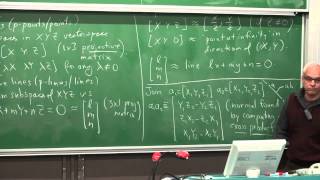
Duality, Polarity and Projective Linear Algebra in Differential Geometry - Lecture 10
Explore projective geometry's impact on differential geometry, focusing on conics, projective linear algebra, and duality between points and lines in the projective plane.
Duality, Polarity and Projective Linear Algebra - Differential Geometry Lecture 11
Explores projective geometry, quadratic forms, and pole-polar duality in relation to the unit circle. Connects these concepts to Lorentz/Einstein/Minkowski geometry and Apollonius' work.
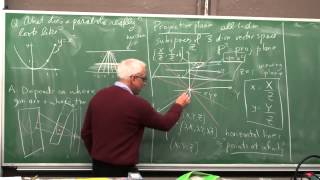
Projective View of Conics and Quadrics - Differential Geometry Lecture 9
Explore projective geometry's application to conics and quadrics, using homogeneous coordinates to unify the study of algebraic curves and surfaces in plane and space.
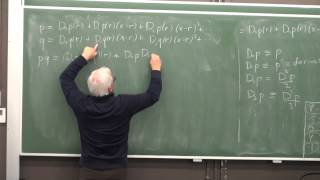
The Differential Calculus for Curves - Lagrange's Algebraic Approach - Lecture 4
Explore Lagrange's algebraic approach to differential calculus, focusing on polynomial functions and Taylor approximations. Learn about tangent lines, conics, and sub-derivatives without limits or real numbers.