Sketching and Projecting
Explore sketching and projecting methods for linear systems and linear discriminant analysis, focusing on stochastic gradient approaches to achieve efficient solutions with reduced computational burden.
From Geometry to Algebra and Back Again: 4000 Years of Papers
Explore 4000 years of vector algebra history, its applications in art, science, and programming, and discover the potential of Geometric Algebra as a superior alternative.
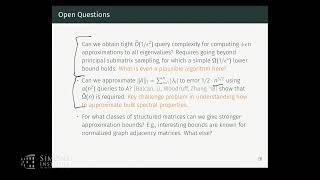
Sublinear Time Eigenvalue Approximation via Random Sampling
Explore efficient algorithms for approximating eigenvalues of large matrices using random sampling techniques, with applications in data analysis and machine learning.
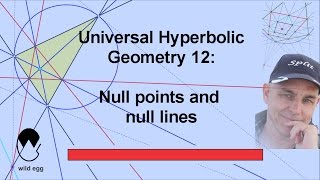
Null Points and Null Lines in Universal Hyperbolic Geometry - Lecture 12
Explore null points and null lines in universal hyperbolic geometry, including rational and projective parametrization, joins and meets theorems, and a triply nil triangle.
The Circle and Projective Homogeneous Coordinates - Universal Hyperbolic Geometry Lecture 7a
Introduction to projective geometry and its relation to universal hyperbolic geometry, exploring concepts like affine spaces, perspective, and one-dimensional projective geometry.
The Circle and Projective Homogeneous Coordinates in Universal Hyperbolic Geometry - Lecture 7b
Explores projective geometry as the foundation of universal hyperbolic geometry, focusing on the circle in projective homogeneous coordinates and its significance in mathematics and physics.
The Circle and Cartesian Coordinates in Universal Hyperbolic Geometry - Lecture 5
Explore Cartesian coordinates and the unit circle, covering key theorems on lines, points, and circles. Learn about determinants, parametrization, and the intersection of lines and circles in geometry.
Stirling Numbers and Pascal Triangles - Foundations of Linear Algebra
Explore Stirling numbers and Pascal triangles in linear algebra. Learn about falling and rising powers, change of basis, and applications to polynomial sequences. Gain insights into combinatorial and number theoretic interpretations.
More Bases of Polynomial Spaces - Lecture 21
Explore advanced polynomial bases: Lagrange, Chebyshev, Bernstein, and Spread. Learn their properties, applications in approximation, and relationships, enhancing understanding of polynomial spaces in linear algebra.
Applications of 2x2 Matrices - Wild Linear Algebra A6
Explores 2x2 matrices, focusing on coordinate changes, linear equations, vector operations, and determinants. Covers fundamental concepts and applications in linear algebra.
Arithmetic with Negative Multisets and Integral Polynumbers - Math Foundations 232
Explores advanced arithmetic using negative msets and anti-objects, introducing integral polynumbers and Laurent polynomials in a pure algebraic context, revolutionizing traditional algebra understanding.
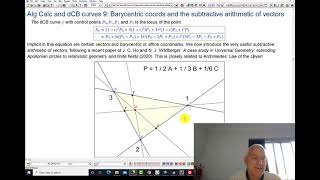
Barycentric Coordinates and Subtractive Arithmetic of Vectors - Algebraic Calculus and dCB Curves 9
Explore barycentric coordinates and vector arithmetic in affine geometry, enhancing understanding of de Casteljau Bezier polygons and curves. Gain insights into advanced mathematical concepts and their applications.
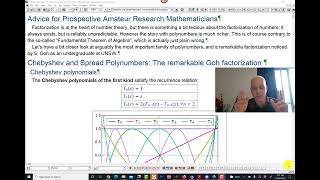
Chebyshev and Spread Polynumbers - Exploring the Goh Factorization
Explore polynomials in number theory, focusing on Chebyshev and spread polynomials. Learn about the Goh factorization and its implications for modern mathematics and computation.
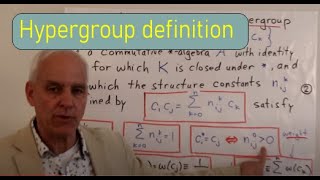
Hypergroup Definition and Five Key Examples - Diffusion Symmetry 4
Explore finite commutative hypergroups through five key examples, including class and character hypergroups, distance-transitive graphs, double cosets, and automorphism orbits. Gain insights for applications in physics and chemistry.
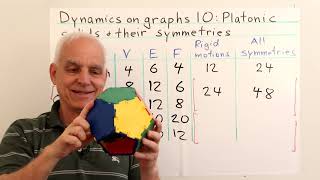
Platonic Solids and Their Symmetries - Dynamics on Graphs 10
Explore Platonic solids' symmetries, focusing on rotations and reflections. Discover connections to exceptional structures in mathematics and physics, laying groundwork for understanding 4D regular solids.
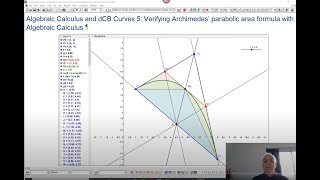
Verifying Archimedes' Parabolic Area Formula with Algebraic Calculus - AC and DCB Curves 5
Explore a novel algebraic approach to calculus, focusing on curves and geometry. Learn how to verify Archimedes' parabolic area formula using quadratic de Casteljau Bezier curves and the Fundamental theorem of Algebraic Calculus.
Tips and Tricks for Computing Cyclotomic Polynomials - Famous Math Problems 20d
Explore techniques for computing cyclotomic polynomials, including the Euler totient function and prime power decomposition. Learn to tackle complex calculations like Phi_1001.
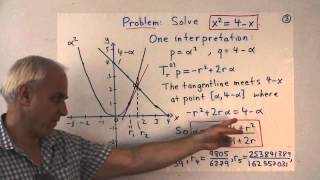
Solving Quadratics and Cubics Approximately - Real Numbers and Limits - Math Foundations 85
Explore approximate solutions for quadratic and cubic equations using standard formulas and Newton's method. Learn historical context and connect algebraic techniques with numerical methods.
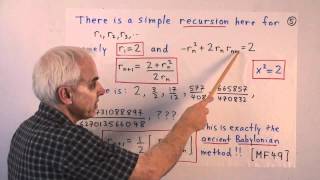
Newton's Method for Finding Zeros - Real Numbers and Limits
Explore Newton's method for finding zeros, focusing on quadratic functions and approximating square roots. Learn about tangent lines, recursion, and practical applications in mathematics.
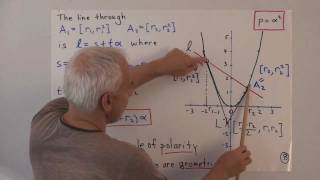
Lines and Parabolas - Quadratic Polynomials and Geometric Relations
Explore advanced parabola concepts: algebraic calculus, subderivatives, tangent lines, Taylor expansions, and geometric relations. Learn to analyze and graph parabolas using completing the square method.
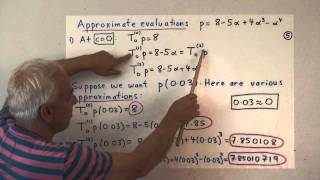
Tangent Lines and Conics of Polynomials - Math Foundations 71
Explore tangent lines and conics of polynomials using polynumbers. Learn to define tangents, compute approximations, and understand Taylor expansions in this advanced mathematical exploration.