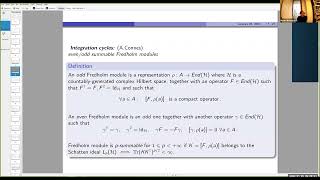
Homological Mirror Symmetry - Maxim Kontsevich Pt. III
Explore advanced algebraic concepts with Maxim Kontsevich, focusing on Getzler-Gauss-Manin connections for non-commutative algebras and their applications in quantum mathematics.
Braids and Configuration Spaces
Explore topology, homotopy, and braid groups in this talk on configuration spaces. Discover connections between fundamental groups, loop spaces, and unordered configurations in mathematics.
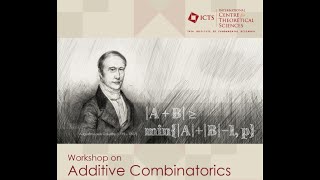
Basic Lower Bounds and Kneser's Theorem by David Grynkiewicz
Explore set addition, basic lower bounds, and Kneser's Theorem in additive combinatorics. Learn key proofs, including Cauchy-Davenport theorem, and applications to field extensions.
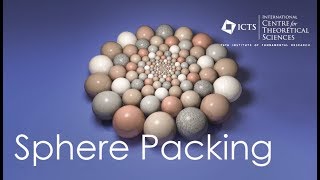
Quadratic Forms and Hermite Constant, Reduction Theory by Radhika Ganapathy
Explores techniques for computing densest lattice packings, including quadratic forms, Hermite constants, and reduction theory. Covers perfect forms, eutactic lattices, and Voronoi's algorithm for listing perfect forms.
Structure of Group Rings and the Group of Units of Integral Group Rings - Lecture 1
Explores group rings, their structure, and units of integral group rings. Covers idempotents, invertible elements, augmentation mapping, and constructions of units including Bass and cyclotomic units.

Proof - Invertibility Implies a Unique Solution to F(x)=Y - Linear Algebra - Khan Academy
Explore the proof of how invertibility guarantees a unique solution to f(x)=y for all y in the co-domain of f, enhancing your understanding of linear algebra concepts.

Visualizing a Column Space as a Plane in R3 - Vectors and Spaces - Linear Algebra
Explore how to visualize column space as a plane in R3, determining planar equations and understanding multi-dimensional concepts in linear algebra.
Null Space and Column Space Basis - Vectors and Spaces - Linear Algebra - Khan Academy
Learn to determine null space and column space basis for matrices, essential concepts in linear algebra for understanding vector spaces and transformations.

Defining the Angle Between Vectors - Vectors and Spaces - Linear Algebra - Khan Academy
Learn to define and understand the concept of angles between vectors in linear algebra, enhancing your grasp of vector geometry and spatial relationships.

Linear Subspaces - Vectors and Spaces - Linear Algebra
Explore linear subspaces in Rn, a fundamental concept in linear algebra. Learn to visualize and understand multi-dimensional mathematical reasoning through vectors, matrices, and transformations.

Parametric Representations of Lines - Vectors and Spaces - Linear Algebra - Khan Academy
Explore parametric representations of lines in R2 and R3, a fundamental concept in linear algebra. Learn to visualize and understand multi-dimensional mathematical reasoning.

Vector Examples - Vectors and Spaces - Linear Algebra - Khan Academy
Explore visual understanding of basic vector operations in linear algebra. Learn to visualize and manipulate vectors in multiple dimensions, enhancing your grasp of mathematical concepts.
Introduction to Dynamical Systems - Lecture 1
Explore dynamical systems, from linear ODEs to nonlinear chaos. Learn about equilibrium points, eigenvalues, attractors, and bifurcations. Gain insights into Lorenz systems, Poincaré maps, and iterative methods.
Computer-Assisted Proofs in the Arithmetic of Quadratic Forms - IPAM at UCLA
Explore computer-assisted proofs in quadratic forms arithmetic, covering equivalence, representation, local-global principles, and modular forms. Gain insights into complex computations across mathematics.
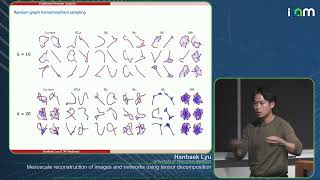
Mesoscale Reconstruction of Images and Networks Using Tensor Decomposition
Explore mesoscale reconstruction of images and networks using tensor decomposition, focusing on a unified framework, error bounds, and online CP-dictionary learning for multi-modal datasets.
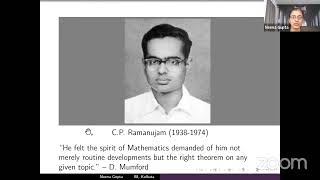
Neena Gupta- The Zariski Cancellation Problem and Related Problems in Affine Algebraic Geometry
Explore Zariski Cancellation Problem and related topics in affine algebraic geometry, including Asanuma rings, affine fibration, epimorphism theorems, and notable examples from leading mathematicians.
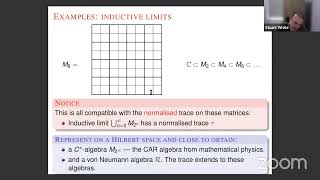
Stuart White- Classification of Simple Amenable C-Algebras
Explore the classification of simple amenable C*-algebras with Stuart White, covering operator algebras, group actions, inductive limits, and the Elliott programme in this mathematical lecture.
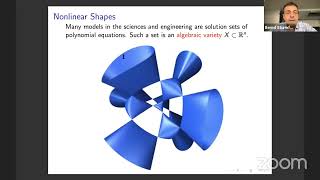
Beyond Linear Algebra
Explore advanced mathematical concepts beyond linear algebra, including critical point equations, nonlinear algebra in PDE, and geometric interpretations in optimization and statistics.
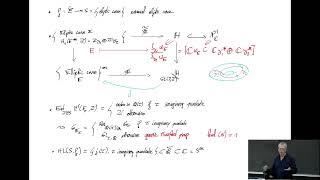
Hodge Theory, Between Algebraicity and Transcendence
Explore recent advances in Hodge theory, comparing algebraic structures and bounding transcendence using o-minimal geometry. Gain insights into complex algebraic varieties and their applications.
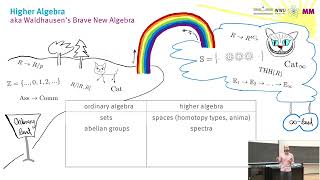
Thomas Nikolaus: Frobenius Homomorphisms in Higher Algebra
Explore algebraic K theory, higher algebra, and Frobenius homomorphisms in topology and K theory with insights from Thomas Nikolaus.
Jennifer Hom: Homology Cobordism and Heegaard Floer Homology
Explore homology cobordism and Heegaard Floer homology, delving into manifolds, theorems, and chain complexes in this advanced mathematical lecture.