Math4ML Exercises - Getting Started & Linear Algebra
Introduction to Math4ML exercises, focusing on linear algebra fundamentals. Includes autograder demonstrations and hands-on problems to reinforce key concepts like array shapes, dimensions, and matrix operations.
Probability - Math for Machine Learning
Explore core probability concepts for machine learning, including surprises, loss functions, and Gaussians. Gain insights into the mathematical foundations of ML algorithms.
Linear Algebra - Math for Machine Learning
Explore core linear algebra concepts essential for machine learning, including arrays, linear functions, and SVD, with practical applications and programming analogies.
Residual Intersections in Geometry and Algebra by David Eisenbud
Explore geometric questions from the 19th century, including tangent conics and space curves, leading to the theory of residual intersections in geometry and algebra. Open problems discussed.
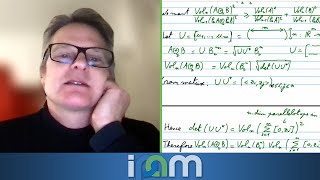
Volume of P-Zonoids and Inequalities for Determinants
Explore new inequalities for 2-zonoid volumes, potential extensions to p-zonoids, and related determinant inequalities. Delve into Minkowski sums, projections, and support functions in this advanced mathematics lecture.
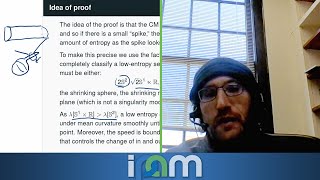
Entropy and C^0 Stability of Hypersurfaces - IPAM at UCLA
Explore entropy's role in hypersurface complexity, focusing on sphere rigidity, stability properties, and generalizations in higher dimensions. Gain insights into cutting-edge research in geometric analysis.
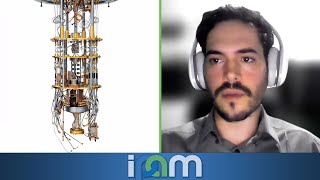
Variational Quantum Architectures for Linear Algebra Applications
Explore variational quantum algorithms for linear algebra applications, including singular value decomposition, linear system solving, and generative models, with focus on NISQ-era implementations and real-world examples.
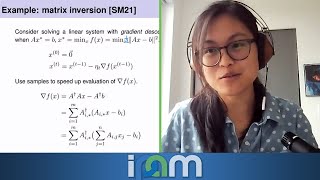
On Quantum Linear Algebra for Machine Learning - IPAM at UCLA
Explore quantum singular value transformation for machine learning, its applications, limitations, and connections to classical algorithms in this technical talk on quantum linear algebra.
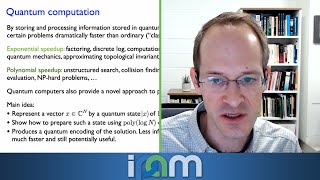
Efficient Quantum Algorithm for Dissipative Nonlinear Differential Equations
Explore efficient quantum algorithms for nonlinear differential equations, overcoming limitations through Carleman linearization. Discover potential applications in biology, fluid dynamics, and plasma physics.
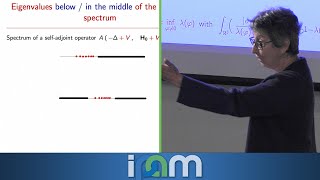
Maria Esteban - Spectral Results and Open Problems for Dirac-Coulomb Operators With Charge Distributions
Explore spectral results and open problems for Dirac-Coulomb operators with general charge distributions, focusing on self-adjoint extensions, eigenvalue characterizations, and electron stability conditions.
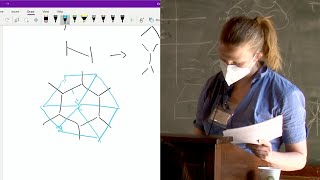
Lattice Topological Phases - IPAM at UCLA
Explore lattice topological phases with Fiona Burnell, covering lattice Hamiltonians, vector spaces, local rules, and gauge choices in this comprehensive lecture on advanced quantum physics concepts.
Alexander Volberg: The Probability of Buffon Needle to Land Near Cantor Set
Explore the probability of Buffon's needle landing near Cantor sets, delving into unexpected connections with various mathematical fields and theories.
Landscape Function and Its Relations With Eigenvectors of a Schrödinger Operator
Explore landscape functions and their connections to Schrodinger operator eigenvectors, covering effective potentials, energy computations, and exponential decay in various contexts.
Sums in Progressions to Squarefree Moduli Among Polynomials Over a Finite Field
Explore polynomial sums in progressions to squarefree moduli over finite fields, covering Fourier analysis, polynomial anatomy, and arithmetic functions.
Restricted Geometric Langlands as a Common Denominator
Explore the unifying framework of restricted geometric Langlands correspondence, connecting various contexts and its relation to classical Langlands conjecture via categorical trace.
Geometric Langlands in Its Various Contexts
Explore geometric Langlands correspondence, its contexts, and related conjectures. Unify different perspectives through restricted Langlands correspondence and its relation to classical theory.
A Non-Archimedean Definable Chow Theorem
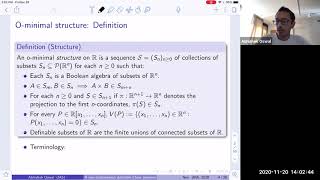
Explore non-archimedean algebraization theorems and their applications in Diophantine geometry, focusing on a p-adic analogue of the definable Chow theorem.
Wall Finiteness Obstruction for DG Categories I
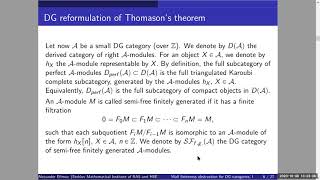
Explore Wall finiteness obstruction theorem for DG categories, its applications to phantom DG categories, and implications for algebraic geometry, including results on Barlow surface and stratified varieties.
Wall Finiteness Obstruction for DG Categories II
Exploration of Wall finiteness obstruction theorem for DG categories, including applications to phantom DG categories and derived categories of algebraic varieties. Discusses extensions to algebras over DG operads.
A Homological Interpretation of Higher Du Bois and Higher Rational Singularities
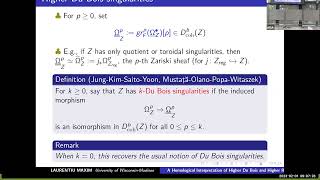
Explore homological interpretations of higher Du Bois and rational singularities, focusing on hypersurfaces and characteristic classes. Gain insights into advanced algebraic geometry concepts.
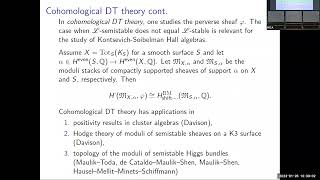
Homological Mirror Symmetry - Categorical Donaldson-Thomas Theory of C^3 and Beyond
Explore advanced concepts in Donaldson-Thomas theory, including categorifications, refinements, and applications to C^3 and beyond, with a focus on categorical invariants and correspondences.