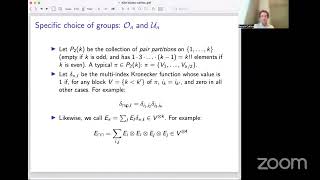
Weingarten Calculus and Its Applications
Explore Weingarten calculus and its applications in compact groups, quantum probability, and random matrix theory, with insights on theoretical properties and recent developments.
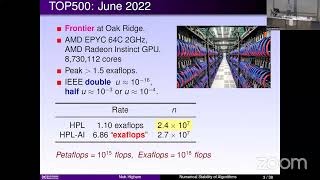
Numerical Stability of Algorithms at Extreme Scale and Low Precisions
Explore numerical stability in extreme-scale computing and low-precision arithmetic, focusing on error bounds, blocked algorithms, and probabilistic analysis for matrix computations.
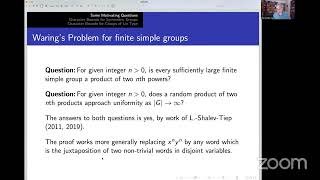
Character Estimates for Finite Simple Groups and Applications
Explore character estimates for finite simple groups and their applications in various mathematical problems, including mixing times, Waring's Problem, and conjectures by Ore and Thompson.
Variety of Fractional Laplacians
Explore various types of fractional Laplacians, their properties, and applications in mathematical analysis through proofs, comparisons, and counterexamples.
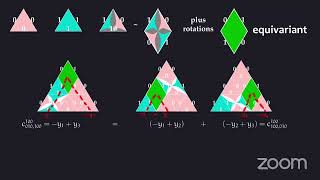
Allen Knutson- Schubert Calculus and Quiver Varieties
Explore Schubert calculus, quiver varieties, and their connections through puzzle rules, Yang-Baxter equations, and representation theory in this advanced mathematics lecture.
The Box Problem: Optimizing Volume in Rectangular Cardboard Boxes - Grades 8-9
Explore volume optimization through 'The Box Problem'. Investigate using models, tables, and graphs. Learn to define variables, write functions, and use graphing calculators for advanced analysis.

Convex Sunflower Theorems and Neural Codes
Explore convex sunflower theorems and neural codes, connecting neuroscience with discrete geometry to understand place cell encoding and cognitive mapping in rat hippocampus.
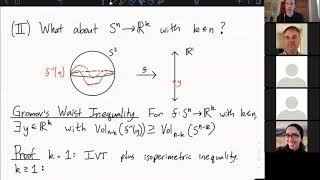
Borsuk-Ulam Theorems into Higher-Dimensional Codomains
Exploration of Borsuk-Ulam theorems in higher dimensions, generalizing results and discussing open questions related to optimal diameters and Schur polynomials.
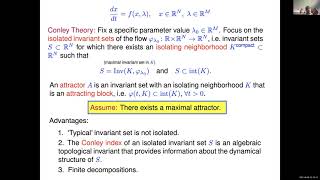
Solving Systems of ODEs via Combinatorial Homological Algebra
Exploring efficient computation of homological representations in dynamical systems, with applications to differential equations and parameter space analysis.
Using Algebraic Geometry to Detect Robustness in Reaction Networks
Explore algebraic geometry techniques to detect robustness in reaction networks, focusing on absolute concentration robustness and its implications for biological systems.
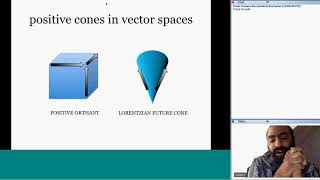
Sanjeevi Krishnan - Homological Programming
Explore algebraic topology applications in programming, covering pursuit-evasion problems, positive cones, Alexander duality, and directed topology, with insights into decomposability and computational aspects.
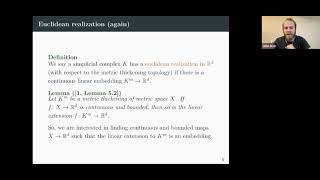
Johnathan Bush - Maps of Čech and Vietoris–Rips Complexes into Euclidean Spaces
Explore simplex-preserving maps in Čech and Vietoris–Rips complexes, their applications, and the challenge of finding such maps from various domains to Euclidean spaces.
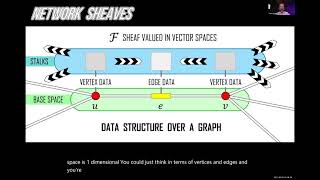
Robert Ghrist - Laplacians and Network Sheaves
Explore cellular sheaves, Laplacians, and network dynamics in algebraic topology. Learn about sheaf cohomology computation and applications in decentralized methods.
Basic Homotopy Theory by Samik Basu
Explore fundamental concepts in homotopy theory, including maps, CW complexes, equivalences, and fibrations. Gain insights into key computations and sequences in this foundational area of topology.
Additive Number Theory - Extremal Problems and the Combinatorics of Sumsets by M. Nathanson
Explore extremal problems and combinatorics of sumsets in additive number theory, covering density, lower bounds, Cauchy-Davenport theorem, and Erdos-Turan conjecture.
The Selberg Sieve and Large Sieve - Lecture 1
Explore the Selberg Sieve and Large Sieve in number theory, covering linear algebra, duality principles, and applications like the Bombieri-Vinogradov theorem in this advanced mathematics lecture.
Cyclotomic KLR Algebras - Part 1 of 4
Exploring cyclotomic KLR algebras, their connection to quantum groups, and their role in categorifying highest weight representations, with a focus on type A and the Ariki–Brundan–Kleshchev theorem.
Axel Målqvist - Localization of Multiscale Problems
Explore multiscale problem-solving techniques, focusing on Local Orthogonal Decomposition for PDEs. Learn about convergence, high-contrast data, and applications to time-dependent problems.
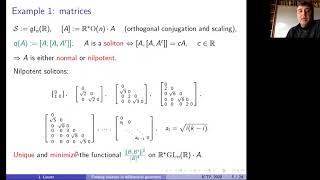
Finding Solitons in Differential Geometry
Explore solitons in differential geometry, their role in discovering distinguished geometric structures, and applications in various mathematical contexts including Lie groups and algebras.
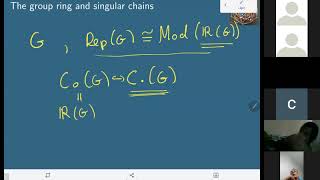
Singular Chains on Lie Groups and the Cartan Relations
Explore the connection between Lie group representations and infinitesimal descriptions using Cartan relations, with applications to Chern-Weil theory and higher local systems on classifying spaces.
Lorentzian Geometry - T. Drumm
Explore Lorentzian geometry, covering basic definitions, hyperbolic spaces, isometries, and advanced concepts like Margulis space-times and crooked planes.