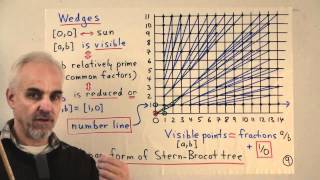
The Stern-Brocot Tree, Matrices and Wedges - Real Numbers and Limits Math Foundations
Explore the Stern-Brocot tree's matrix and geometric representations, including wedges, for a deeper understanding of fractions and their relationships in mathematics.
Complex Numbers and Algebra - Math History - NJ Wildberger
Explore complex numbers' history, applications in cubic equations, and geometric representations. Delve into the Fundamental Theorem of Algebra and its proofs by d'Alembert and Gauss.
Rational Trigonometry in Three Dimensions - Universal Hyperbolic Geometry
Extending rational trigonometry to 3D using vectors and dot products. Explores quadrance, spread, and key trigonometric laws. Introduces solid spread and determinants for three vectors.
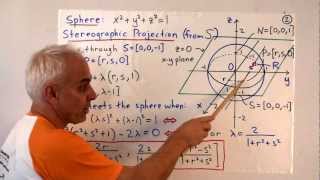
Parametrizing and Projecting a Sphere - Universal Hyperbolic Geometry
Explore stereographic and gnomonic projections of a sphere, including rational parametrization, coordinate systems, and their applications in elliptic geometry.
The J Function, SL(2) and the Jacobi Identity - Universal Hyperbolic Geometry
Explores connections between hyperbolic geometry, matrix algebra, and Lie theory, demonstrating how the Jacobi identity proves the concurrence of triangle altitudes in projective geometry.
Reflections and Projective Linear Algebra - Universal Hyperbolic Geometry
Explore reflections in hyperbolic geometry through projective linear algebra. Learn about null points, reflection matrices, and the sl(2) Lie algebra. Gain insights into fundamental symmetries and their mathematical representations.
Non-Euclidean Geometry - Math History - NJ Wildberger
Explore the complex history and modern interpretations of non-Euclidean geometry, challenging traditional narratives and proposing new perspectives on this fundamental mathematical concept.
Duality and Perpendicularity - Universal Hyperbolic Geometry
Explore perpendicularity in universal hyperbolic geometry, including duality, altitudes, and key theorems. Learn about unique aspects like perpendicular points and their applications in geometric analysis.
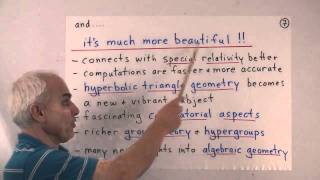
Universal Hyperbolic Geometry - NJ Wildberger
Discover a revolutionary approach to hyperbolic geometry, simplifying complex concepts using high school algebra and projective geometry, with connections to Einstein's special relativity theory.
Polynomial Equations - Math History - NJ Wildberger
Explore the Golden Age of European mathematics, focusing on polynomial equations, algebraic advancements, and key figures like Tartaglia and Cardano. Learn about historical developments in solving complex equations.
Number Theory and Algebra in Asia - Math History - NJ Wildberger
Explores number theory, algebra, and astronomy in ancient Chinese, Indian, and Arab mathematics, highlighting key figures and their contributions to mathematical development.
Polynomials and Sequence Spaces - Wild Linear Algebra - NJ Wildberger
Explore polynomials as sequences, introducing factorial powers and difference operators. Learn about forward/backward differences, Newton's theorem, and formulas for summing series, with practical examples and exercises.
Greek Number Theory - Math History - NJ Wildberger
Explore ancient Greek number theory, including primes, perfect numbers, and the Fundamental Theorem of Arithmetic. Learn about Euclidean algorithms, continued fractions, and Pell's equation.
Bases of Polynomial Spaces - Wild Linear Algebra - NJ Wildberger
Explore polynomial spaces through linear algebra, focusing on bases, translations, and derivatives. Gain insights into calculus concepts from an algebraic perspective, emphasizing practical applications and theoretical foundations.
More Row Reduction With Parameters - Wild Linear Algebra A
Explores advanced row reduction techniques with parameters, focusing on solving linear equations, vector representations, and applications in 2D and 3D spaces. Includes practical examples and exercises.
Applications of Row Reduction II - Wild Linear Algebra A
Explore row reduction applications in linear transformations, spanning sets, and linear independence. Gain insights into vector spaces and matrix operations through practical examples and in-depth analysis.
Randomness in Number Theory
Explore randomness in number theory, covering topics like finite fields, graphs, quantum gates, and the Riemann Hypothesis with Princeton's Peter Sarnak.
Benign Overfitting in Linear Prediction
Explore the phenomenon of benign overfitting in linear prediction, its implications for deep learning, and its impact on adversarial examples in machine learning.
Quantum-Inspired Classical Linear Algebra
Explore quantum-inspired classical algorithms for linear algebra, including sketching, sampling, and low-rank approximation techniques in this advanced computational talk.
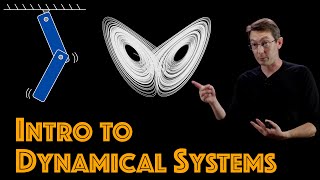
Topics in Dynamical Systems - Fixed Points, Linearization, Invariant Manifolds, Bifurcations & Chaos
Explore dynamical systems: fixed points, linearization, manifolds, bifurcations, and chaos. Gain insights into nonlinear dynamics and their applications in describing our changing world.

Solving Systems of Differential Equations with Eigenvalues and Eigenvectors
Learn to solve systems of linear ODEs using eigenvalues and eigenvectors. Covers problem setup, solution methods, and intuitive interpretation, with code examples in Python and MATLAB.