Linear Algebra With Polynomials - Wild Linear Algebra A
Explore polynomials in linear algebra, covering interpolation, regression, and isomorphism. Learn to apply geometric approaches to transformations and connect polynomial spaces with vector spaces.
The Geometry of a System of Linear Equations - Wild Linear Algebra A
Explore the geometry of linear equations through a novel approach using properties instead of infinite sets. Gain insights into subspaces, kernel, and linear transformations with practical examples.
Rank and Nullity of a Linear Transformation - Wild Linear Algebra A - NJ Wildberger
Explore linear transformations in higher dimensions, focusing on kernel, image, nullity, and rank. Learn to visualize 4D space and apply row reduction techniques to solve problems.
An Informal Introduction to Abstract Algebra
Informal introduction to abstract algebra, covering fields, rings, and vector spaces. Explores key concepts and examples, from basic number systems to advanced constructions, providing essential background for algebraic topology.
Applications of Row Reduction II - Wild Linear Algebra A
Explore row reduction applications in linear transformations, spanning sets, and linear independence. Gain insights into vector spaces and matrix operations through practical examples and in-depth analysis.
Gram-Schmidt Process in Linear Algebra - Lecture 27
Learn the Gram-Schmidt Process to transform linearly independent vectors into an orthonormal basis, a crucial technique in linear algebra with applications in various fields of science and engineering.

What Is the Free Vector Space?
Explore the concept of free vector space through clear definitions, illustrative examples, and practical applications in this concise mathematical tutorial.
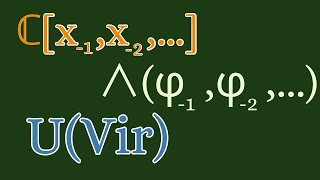
The Vector Spaces for Vertex Algebras
Explore key vector spaces for vertex algebras: polynomial rings, exterior algebras with infinite variables, and universal enveloping algebra of the Virasoro Lie algebra. Gain essential understanding for advanced algebraic studies.
Lattice Topological Phases - IPAM at UCLA
Explore lattice topological phases with Fiona Burnell, covering lattice Hamiltonians, vector spaces, local rules, and gauge choices in this comprehensive lecture on advanced quantum physics concepts.
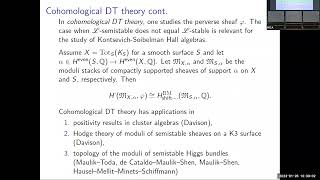
Homological Mirror Symmetry - Categorical Donaldson-Thomas Theory of C^3 and Beyond
Explore advanced concepts in Donaldson-Thomas theory, including categorifications, refinements, and applications to C^3 and beyond, with a focus on categorical invariants and correspondences.

Visualizing a Column Space as a Plane in R3 - Vectors and Spaces - Linear Algebra
Explore how to visualize column space as a plane in R3, determining planar equations and understanding multi-dimensional concepts in linear algebra.
Null Space and Column Space Basis - Vectors and Spaces - Linear Algebra - Khan Academy
Learn to determine null space and column space basis for matrices, essential concepts in linear algebra for understanding vector spaces and transformations.

Defining the Angle Between Vectors - Vectors and Spaces - Linear Algebra - Khan Academy
Learn to define and understand the concept of angles between vectors in linear algebra, enhancing your grasp of vector geometry and spatial relationships.

Linear Subspaces - Vectors and Spaces - Linear Algebra
Explore linear subspaces in Rn, a fundamental concept in linear algebra. Learn to visualize and understand multi-dimensional mathematical reasoning through vectors, matrices, and transformations.

Parametric Representations of Lines - Vectors and Spaces - Linear Algebra - Khan Academy
Explore parametric representations of lines in R2 and R3, a fundamental concept in linear algebra. Learn to visualize and understand multi-dimensional mathematical reasoning.

Vector Examples - Vectors and Spaces - Linear Algebra - Khan Academy
Explore visual understanding of basic vector operations in linear algebra. Learn to visualize and manipulate vectors in multiple dimensions, enhancing your grasp of mathematical concepts.
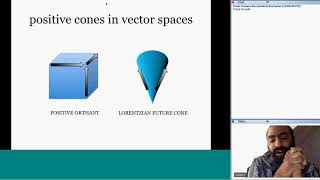
Sanjeevi Krishnan - Homological Programming
Explore algebraic topology applications in programming, covering pursuit-evasion problems, positive cones, Alexander duality, and directed topology, with insights into decomposability and computational aspects.

Another Example of a Projection Matrix - Linear Algebra - Khan Academy
Learn to calculate projection matrices by first determining the orthogonal complement's matrix. This advanced linear algebra lesson explores subspace projections and their applications in multidimensional reasoning.

Rowspace and Left Nullspace - Matrix Transformations - Linear Algebra - Khan Academy
Explore rowspace and left nullspace concepts in matrix transformations, enhancing your understanding of multi-dimensional mathematical reasoning in linear algebra.

Determinant and Area of a Parallelogram - Matrix Transformations - Linear Algebra - Khan Academy
Explore the relationship between 2x2 matrix determinants and parallelogram areas in linear algebra, enhancing understanding of matrix transformations and geometric interpretations.

Showing That Inverses Are Linear - Matrix Transformations - Linear Algebra
Explore the linearity of inverse transformations in matrix algebra, enhancing your understanding of linear algebra concepts and their applications in multidimensional reasoning.